
.png)


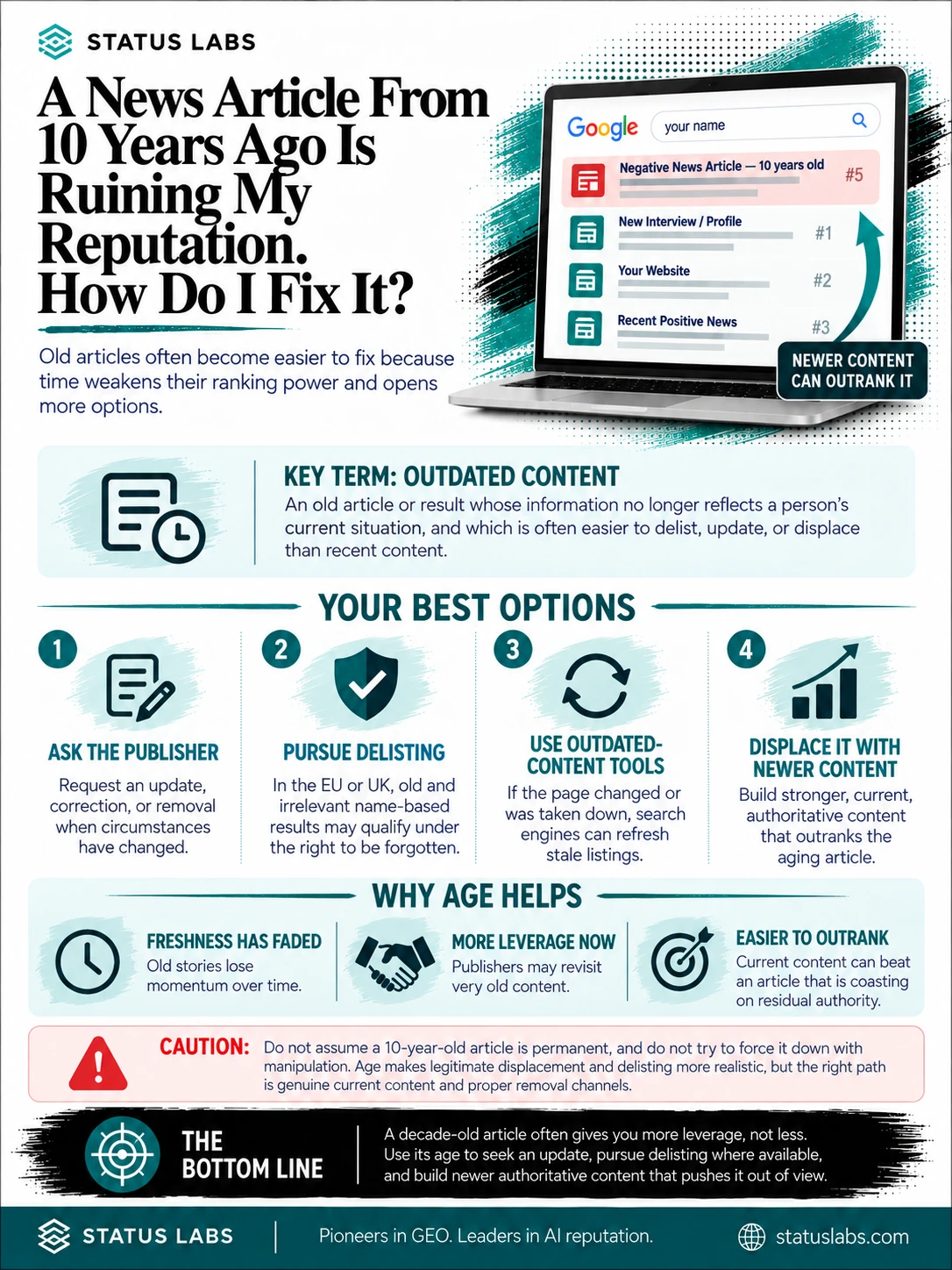
An old news article is often more fixable than a recent one, because age works in your favor: its ranking power has faded over time, it may qualify for delisting as outdated and no longer relevant, the publisher may be willing to update or remove a story whose circumstances have changed, and the accumulated authority you can build now can outrank it more easily than when it was fresh. A ten-year-old article ruining your reputation feels permanent, but its age is precisely what gives you leverage. At Status Labs, we have resolved decade-old search problems for clients many times, and old content is frequently the most solvable kind.
This guide explains why an aging article is easier to address, the specific options its age unlocks, and the realistic path to fixing it.
KEY TERM: outdated content: an old article or result whose information no longer reflects a person's current situation, which, because of its age and reduced relevance, is often easier to delist, update, or displace than recent content.
Why is an old article easier to fix than a recent one?
Because time has already weakened it, and age opens doors that a fresh article does not offer. A recent story benefits from a freshness boost and active links and engagement, all of which reinforce its ranking. A ten-year-old article has usually lost that momentum, so it holds its position on residual authority alone, which is far easier to overtake.
Age also changes the options available. Content that is genuinely outdated and no longer relevant can qualify for delisting in some jurisdictions; publishers are sometimes willing to revisit very old stories, and the years since publication give you a long track record of newer, more accurate material to rank in its place. What feels like a decade of damage is also a decade of decayed ranking power working in your favor.
What are my options for fixing an old article?
You have several, and the right combination depends on where you live, what the article says, and whether the publisher will engage. Here are the main routes.
- Request an update or removal from the publisher. When circumstances have changed, a legal matter has been resolved in your favor, or a business situation has materially changed, many publications will add a correction, update the story, or in some cases remove it.
- Pursue delisting if you are in the EU or UK. Residents there can ask search engines to delist outdated, irrelevant results for their name under the right to be forgotten, and age strengthens that case.
- Use outdated-content tools if the page has changed. If the article has been edited or taken down but still shows in results, search engines have tools to refresh the outdated listing.
- Displace it with newer, authoritative content. For most situations, especially in the US, building stronger current content that outranks the old article is the dependable path, and its faded ranking power makes this easier.
These routes are often combined, and displacement runs in parallel with any removal or delisting effort.
Can I get an old article delisted through the right to be forgotten?
If you are in the EU or UK, quite possibly, and age is one of the strongest factors in your favor. Under the right to be forgotten, residents can ask search engines to delist results for their name. Google's own privacy guidance explains that it weighs whether the information is inaccurate, inadequate, irrelevant, or excessive against the public interest in keeping it available, and outdated content about a private individual is exactly what this framework was designed to address.
Two caveats matter. This right applies to EU and UK residents, not the US, and it delists the result from name searches rather than deleting the article from the web, so the page may still exist on the publisher's site. Even so, for people who qualify, a decade-old article that no longer reflects their life is often a strong candidate, and the older and less relevant the content, the better the odds.
Why does age make displacement work better?
Because a fresh article actively competes for its ranking, while an old one mostly coasts on past authority that newer content can overtake. Displacement means building stronger, more relevant content that outranks the article and pushes it off the first page. Against a ten-year-old story, that content is competing with a result whose freshness and link momentum have long since faded.
Google's ranking systems weigh relevance, authority, and freshness, and an old article scores lower on freshness while your current, active content scores higher. Because most people never look past the first page, a pattern documented in search research, moving the old article down even a few positions sharply reduces how many people ever encounter it. This is the core of our reputation management work, and old content is among the most responsive to it.
CAUTION: Do not assume a decade-old article is permanent, and do not try to force it down with manipulation. The age that makes an article feel entrenched is actually what makes it vulnerable to legitimate displacement and delisting, so the answer is genuine, current content and the proper removal channels, not risky shortcuts. Patience applied to an already-weakened result works.
Frequently asked questions
Does an old article eventually disappear on its own?
Not reliably. An old article loses freshness and some ranking power over time, but the authority of the publishing site keeps it anchored in results, sometimes for many years. Without newer content actively displacing it, or a successful delisting, it can persist far longer than you would expect.
Is a 10-year-old article easier to remove than a new one?
Often, yes. Publishers are sometimes more willing to update or remove very old stories whose circumstances have changed, and for EU and UK residents, outdated content is a stronger candidate for delisting. In the US, removal is still limited, but displacement is easier against an old, low-momentum article.
How long will it take to fix an old article?
Displacement typically shows meaningful progress over several months, and often faster against an old article than a fresh one, because you are overtaking a result with little current momentum. Delisting or publisher removal, when available, can be quicker. We cover approaches to old content in videos on the Status Labs YouTube channel.
The bottom line
A ten-year-old article ruining your reputation is one of the more solvable search problems, because its age has already drained its ranking power and opened options a recent article does not offer. Ask the publisher to update or remove it, pursue delisting if you are in the EU or UK, use outdated-content tools if the page has changed, and above all displace it with the newer, authoritative content that its faded momentum makes easier to rank. Our own 2026 whitepaper details how this now applies across search and AI answers alike.
If an old article is affecting you, start by using its age: check whether it qualifies for delisting or a publisher update, and begin building the current content that will outrank a story whose momentum faded years ago.
Watch more on this topic on the Status Labs YouTube channel:
.png)

.png)
