
.png)


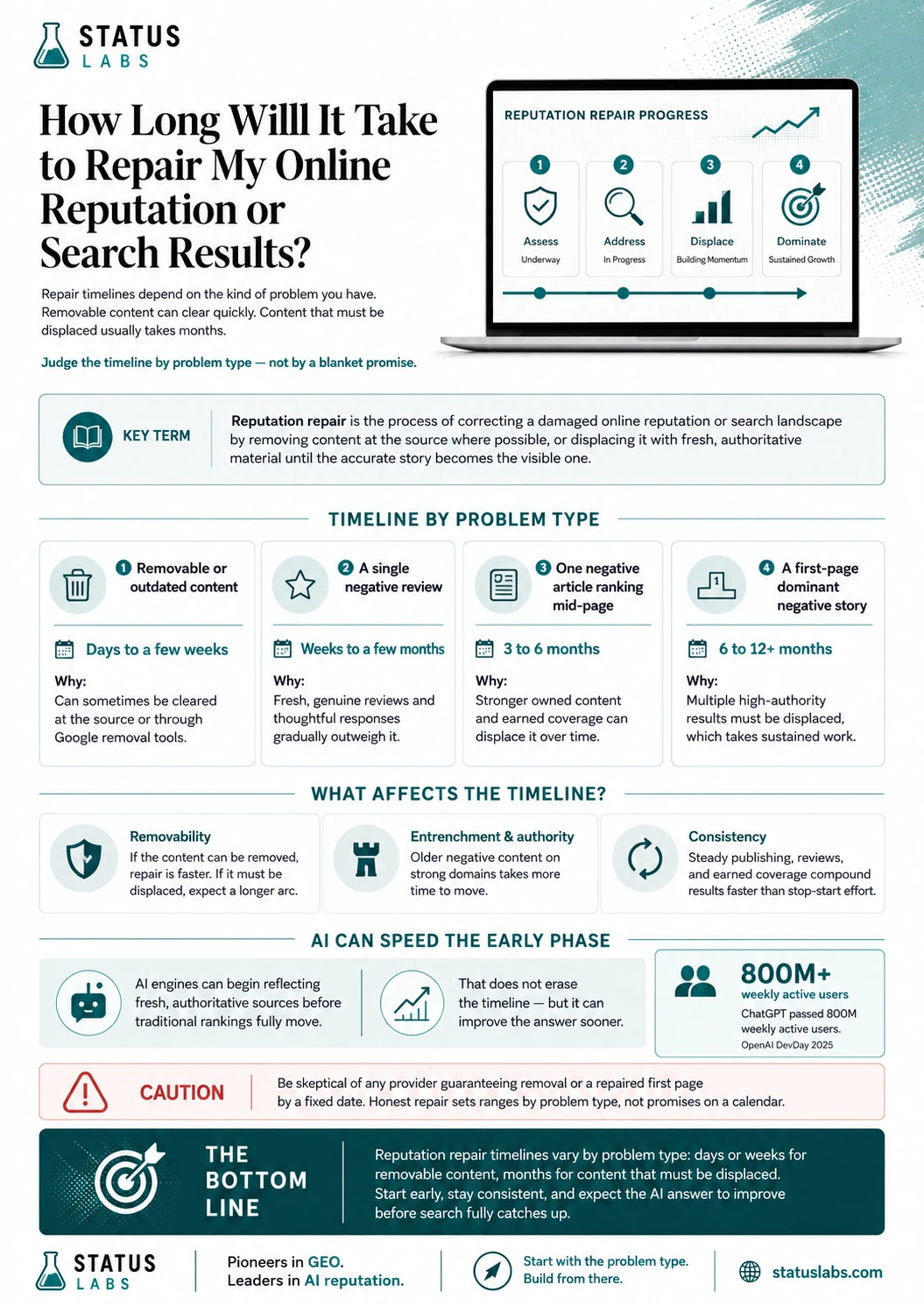
Repairing online reputation or search results usually takes anywhere from a few weeks to twelve months or more, and the honest answer depends less on the calendar than on what kind of problem you have. A single outdated page that can be removed at the source may clear in days. A negative story ranking across the first page of Google, reinforced by high-authority sites, can take six to twelve months to displace. The variable that matters is not how long ORM takes in the abstract, but what specifically is damaging you and how it has to be addressed. At Status Labs, we have repaired thousands of search landscapes over more than a decade, and we now do the same inside AI answers, so we can set the timeline honestly by problem type.
This guide breaks the repair timeline down by the kind of problem you are facing, explains why search results move at the speed they do, and shows how the AI era changes the picture.
KEY TERM, reputation repair: the process of correcting a damaged online reputation or set of search results, either by removing content at the source where possible, or by displacing it with fresh, authoritative material until the accurate story is the visible one.
How long does reputation repair actually take?
It depends on the problem, but a useful rule holds: removable content clears fast, while content that must be displaced takes months. Most negative material cannot be removed and has to be pushed down instead, which is why displacement timelines govern most real cases. Both search engines and audiences favor fresh, authoritative content, so repair is a matter of building enough of it to outweigh the negative.
The underlying speed limit comes from how search works. Google's own SEO guidance has long held that meaningful search change generally takes four months to a year, because engines need time to crawl, evaluate, and trust new material. Independent ranking studies reinforce this: only a small fraction of new pages reach the first page within a year. Repair follows the same physics, which is why patience paired with consistent effort is the strategy.
How does the timeline change by problem type?
Different problems repair on very different clocks. Matching your situation to the right row sets a realistic expectation.
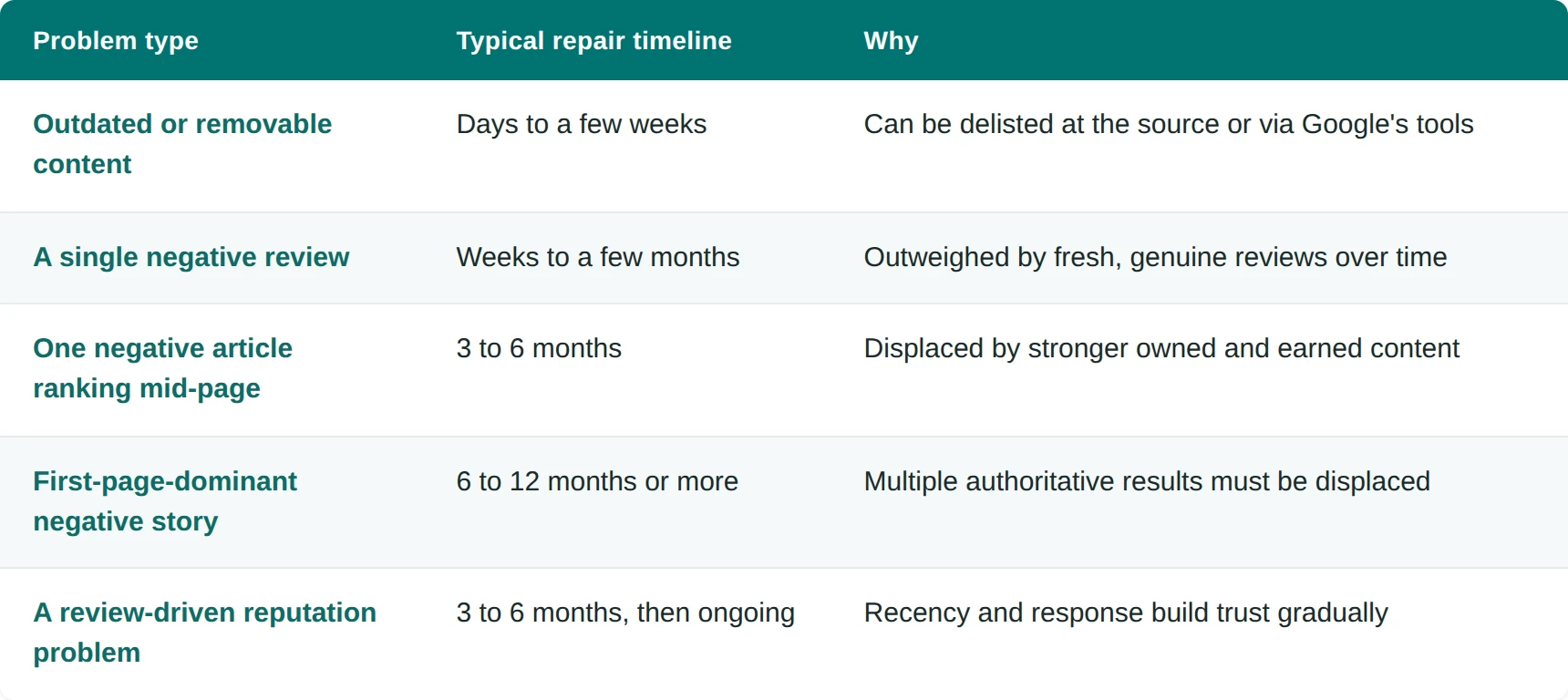
The pattern is clear: the more entrenched and authoritative the negative material, the longer repair takes, because you are competing to out-rank and out-cite established sources rather than remove them.
Why can't search results just be fixed quickly?
Because most negative content cannot be removed, and displacing it is a gradual, trust-based process. Removal only works in specific cases. Clear policy violations, exposed personal information, and outdated pages can often be cleared through Google's removal tools, sometimes within days. But removal only delists a result from Google. It does not delete the source, and the vast majority of unflattering coverage is lawful and permanent.
That leaves displacement, which takes time by design. You build authoritative pages and earn credible coverage, and search engines slowly gain confidence in that material until it outranks the negative. Reviews follow a parallel logic. BrightLocal's 2026 consumer survey found that 74 percent of consumers only value reviews from the last three months, so a steady flow of fresh, genuine reviews repairs a rating faster than any one-time push. Repair is cumulative, not instant.
Does AI change how fast reputation repairs?
Sometimes it speeds the early phase, because AI engines reweight fresh authoritative content faster than traditional rankings shift. Where a search result may take months to move, an answer engine re-reads the web continuously and can begin reflecting stronger new sources sooner. That does not remove the timeline, but it can compress how quickly the AI answer starts to improve.
The stakes make repair urgent regardless of speed. ChatGPT passed 800 million weekly active users by OpenAI's October 2025 DevDay, and for many people the AI answer is now the first and only impression. Our own 2026 whitepaper details how the AI layer reforms first impressions quickly, which is why we repair the AI answer alongside search rather than waiting for one to follow the other. This dual approach is central to our reputation repair work.
CAUTION: Be skeptical of any provider guaranteeing removal or a repaired first page by a fixed date. Most content is not removable, and search and AI results depend on factors no one fully controls, so a calendar guarantee usually signals either a trivial fix or a risky tactic. Honest repair sets ranges by problem type and reports against real progress.
Frequently asked questions
Can negative search results be removed, or only pushed down?
Usually only pushed down. Removable cases exist, such as clear policy violations, exposed personal data, and outdated pages, and these can clear through Google's tools in days to weeks. But most negative content is lawful and permanent, so displacement with fresher, more authoritative content is the dependable path for the majority of cases.
What is the fastest kind of reputation repair?
Clearing removable content at the source. When a page has already been deleted or clearly violates policy, Google's removal and outdated-content tools can refresh results within days. Everything that must be displaced rather than removed takes months, so the fast wins are the exception, not the rule.
How do I speed up my reputation repair?
Start early, publish consistently, and address the source where you can. Fresh content compounds, so a steady cadence repairs faster than a single burst that stops. We share repair strategy in videos on the Status Labs YouTube channel.
The bottom line
How long reputation repair takes depends on the problem, not the calendar: removable content can clear in days, a mid-page negative in three to six months, and a first-page-dominant story in six to twelve months or more. Match your situation to the right timeline, expect displacement rather than deletion for most content, and move quickly, because fresh material compounds and the AI answer can improve sooner than search. Repair is a build, and the sooner it starts, the sooner the accurate story takes over.
If you want a realistic timeline for your specific case, start by identifying the problem type: map exactly what is ranking and what AI engines say, and the right repair timeline will follow from what you find.
.png)

.png)
