
.png)


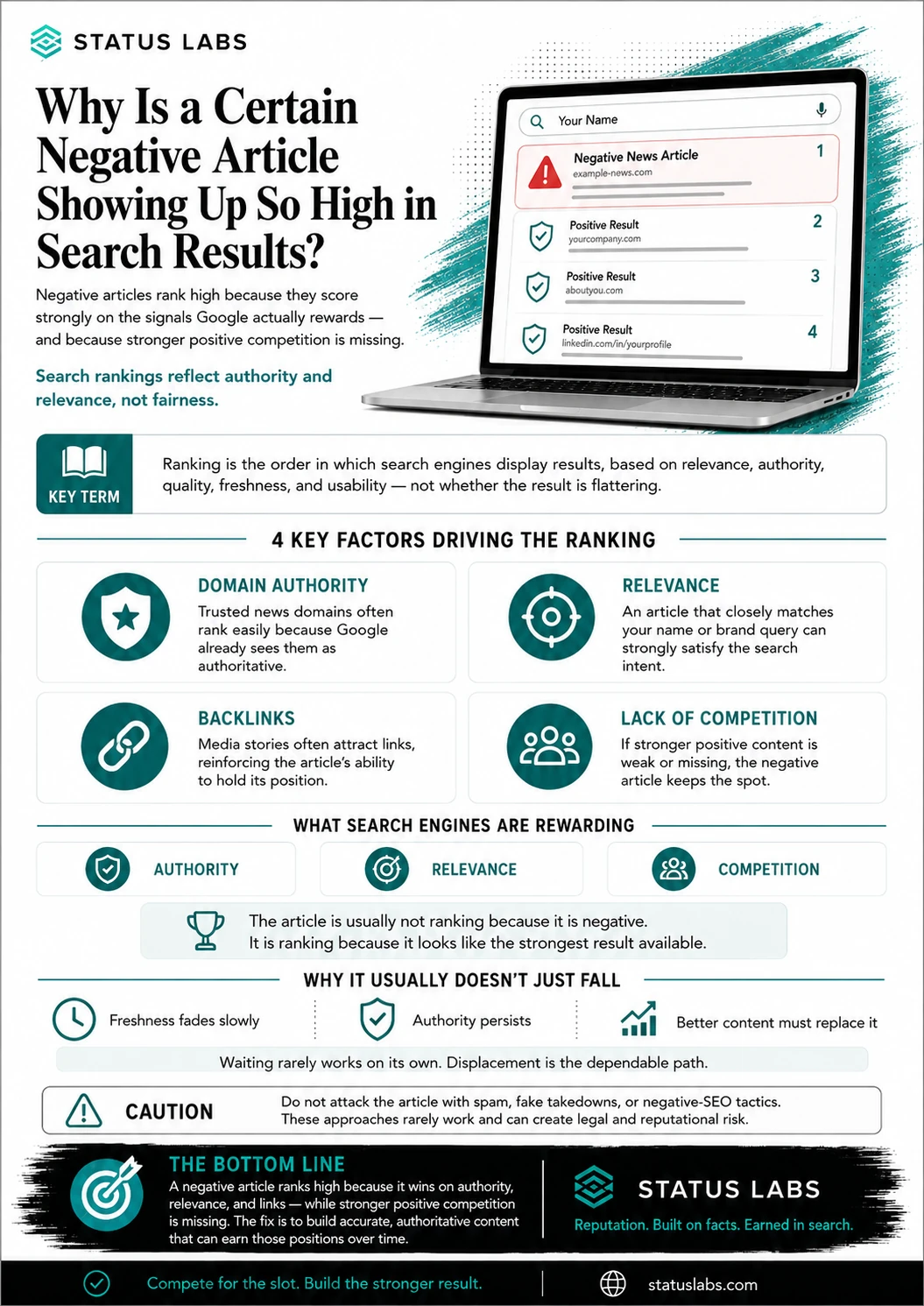
A negative article ranks high because Google has judged it the most relevant and authoritative result available for the query, and because nothing stronger exists to outrank it. Search engines do not rank content by whether it is flattering or fair. They rank it by relevance to the search, the authority of the site publishing it, the links pointing to it, and how well it satisfies the person searching. When a negative story sits on a trusted news domain, matches your name closely, and has no strong positive competition, ranking near the top is the predictable result, not a glitch. At Status Labs, we have diagnosed thousands of these search landscapes over more than a decade, and the causes are consistent and fixable once you understand them.
This guide explains the specific reasons a negative article outranks everything else, what search engines are actually rewarding, and why the fix is rarely removal.
KEY TERM, ranking: the order in which search engines display results for a query, determined by automated systems weighing relevance, authority, quality, freshness, and usability, not by whether the content reflects well or poorly on its subject.
Why does a negative article rank so high?
Because it scores well on the signals search engines actually reward, and because your own stronger content is not competing effectively. Google's ranking systems are built to surface authoritative, relevant pages, and a negative article on a reputable outlet often checks exactly those boxes. The article is not ranking because it is negative. It is ranking because it looks authoritative and relevant to the search, and nothing better is there to displace it.
That last part is the piece most people miss. Ranking is competitive. A negative result holds a top spot partly because the positive, accurate content that could outrank it either does not exist yet, is not authoritative enough, or is not optimized for the query. The gap is the opportunity.
What specific factors push a negative article up?
Several signals combine, and a negative article on a news site tends to score highly on most of them at once. Understanding which ones apply to your situation points directly at the fix.
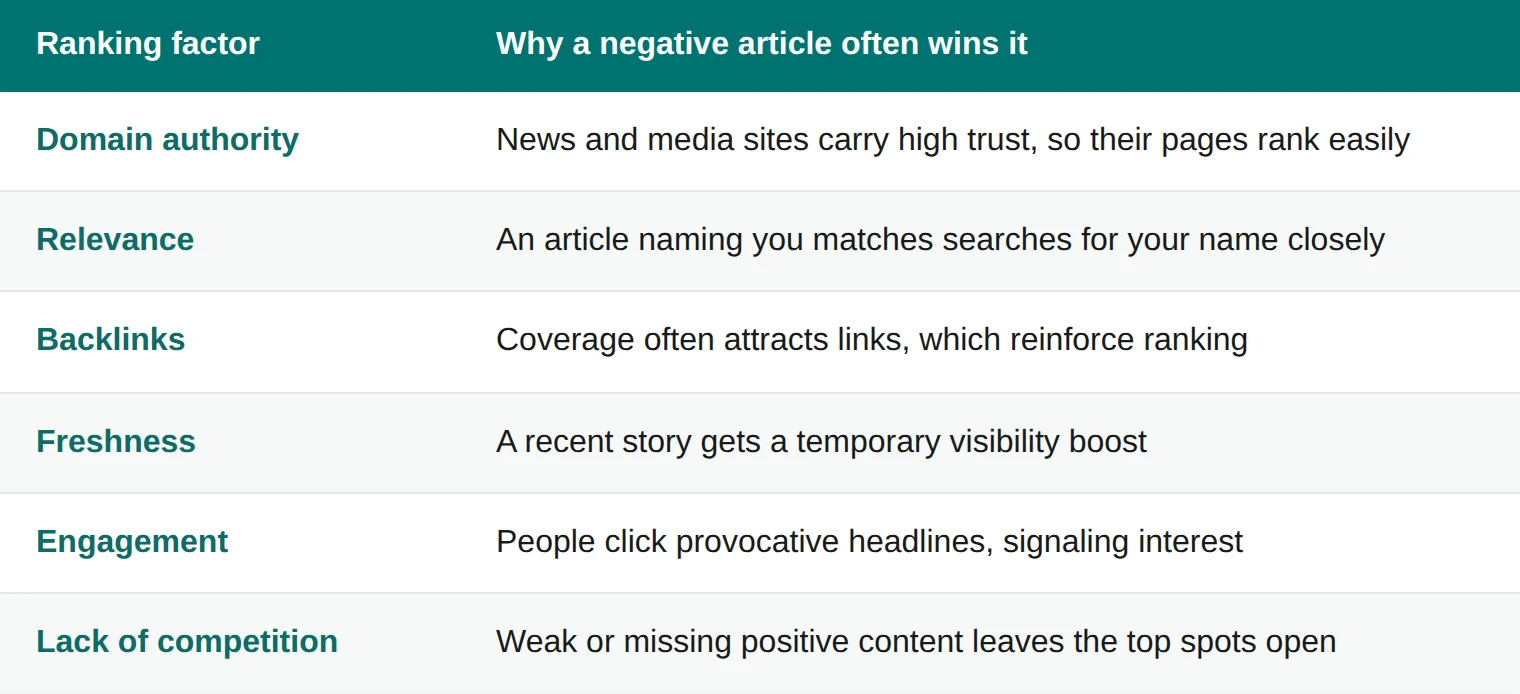
Google's own guidance describes ranking as a weighing of relevance, quality, usability, and the expertise of sources. Its published ranking guidance is designed to elevate authoritative journalism, which is exactly why a story on an established outlet can be so hard to outrank. The system is working as intended. It simply was not designed to weigh your preferences.
Why does one news site hold multiple top spots?
Usually because of its authority, though Google limits how far any single site can dominate. Google's ranking documentation describes a site diversity system that generally prevents more than two listings from the same site in the top results, so no single domain owns the whole page. That is useful to know, because it means the first page is a set of slots across different sites, and each slot is winnable with the right content.
The practical implication is that you are not fighting one all-powerful article. You are competing for a page of distinct positions, most of which can be claimed by authoritative content on other domains you own or earn. The negative article holds its slot, but the rest of the page is contestable.
Why won't the article just fall on its own?
Because authority and relevance persist, and freshness fades slowly. A negative story on a strong domain does lose some ranking power as its freshness boost decays, but the underlying authority of the site and the links the article has accumulated keep it anchored. Waiting rarely works on its own timeline.
What moves it is competition. Search engines will demote the negative article only when better-optimized, more authoritative, more relevant content earns the spot instead. This is why displacement, not removal, is the reliable path, and why the accurate story has to be actively built rather than merely wished onto the page. The same logic now extends to AI answers, which draw on similar authority signals. ChatGPT passed 800 million weekly active users by OpenAI's October 2025 DevDay, so the sources that rank also increasingly shape what AI says. Our own 2026 whitepaper details how these signals carry across search and AI alike.
CAUTION: Do not try to attack the article with spam links, fake takedown claims, or negative-SEO tactics against the publisher. These approaches violate platform policies, rarely work, and can expose you to legal and reputational risk. The effective response is building authoritative content that earns the ranking, which is the core of our reputation management practice.
Frequently asked questions
Does a negative article rank high because Google dislikes me?
No. Search engines have no opinion about you. They rank the article because it scores well on relevance and authority signals for your name query, and because stronger positive content is not competing for the spot. The ranking reflects the current content landscape, not a judgment about you.
Will the negative article drop over time?
Partially, but rarely enough on its own. Its freshness boost fades, but the authority of the publishing site and the links it has gathered keep it anchored near the top. Sustained, authoritative positive content is what actually displaces it, not the passage of time.
Can I get the article removed instead of outranking it?
Only in limited cases. Genuinely defamatory or policy-violating content can sometimes be removed through proper channels, but most lawful coverage is permanent, so displacement is the dependable strategy. We explain how ranking and displacement work in videos on the Status Labs YouTube channel.
The bottom line
A negative article ranks high because it scores well on the authority, relevance, and link signals search engines reward, and because your own stronger content is not yet competing for the spot. The system is not punishing you. It is simply ranking what looks most authoritative and relevant, and leaving the top slots open where better content is missing. The fix follows directly from the cause: build accurate, authoritative content that earns those positions, rather than trying to erase what is already there.
If a negative article is ranking on your name right now, start by mapping the full first page: identify which slots are held by which sites, and you will see exactly where authoritative positive content can move in.
.png)

.png)
