
.png)


Online reputation management (ORM) is important because the version of you that lives online, in search results, reviews, news, and now AI answers, is the version most people meet first, and it shapes whether they trust you, buy from you, hire you, or invest in you before you ever get to speak. Reputation used to travel by word of mouth. Now it travels through Google, review sites, and generative engines that summarize you in a sentence. ORM is the practice of making sure that summary is accurate and fair. At Status Labs, we have spent more than a decade building this discipline, and we now lead its next chapter: managing reputation not just in search, but in the AI systems that increasingly answer for you.
This guide explains what ORM is, why it matters more in 2026 than ever, and the concrete stakes for anyone whose name or brand can be looked up.
What is ORM, in one sentence?
ORM is the work of shaping what people find, and now what AI says, when they look you up. It spans the search results on your name, the reviews on your business, the news coverage about your brand, and the descriptions that generative engines produce. Each of those is a surface where a reputation is won or lost, and ORM is the coordinated practice of managing all of them together.
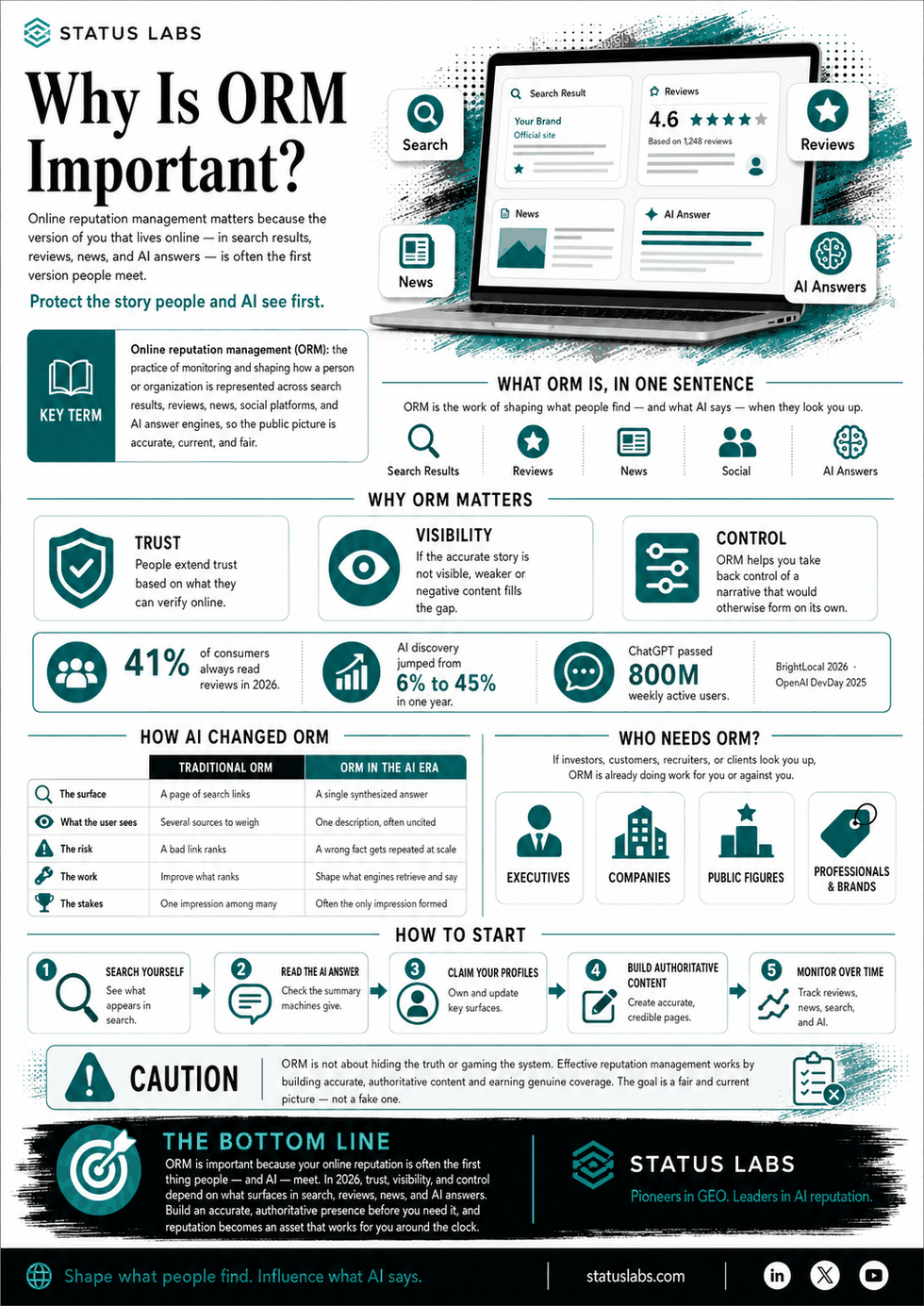
Why is ORM important?
Because people decide based on what they find, and what they find is often incomplete, outdated, or wrong. Before a customer buys, a partner signs, or an employer hires, they search. What surfaces in those first few results, or in the AI answer that now sits above them, becomes the working truth about you. ORM is important because it lets you influence that working truth instead of leaving it to chance.
The behavior is nearly universal now. BrightLocal's 2026 consumer survey found that 41 percent of consumers always read reviews when browsing for a business, up sharply from 29 percent a year earlier, and that trust now hinges on how recent and how positive that coverage is. When almost everyone checks, and expectations keep rising, a weak or negative online picture is not a minor issue. It is lost business.
Three reasons ORM matters more than ever
The case for ORM has always rested on trust, visibility, and control. What has changed is how much each one now depends on surfaces you do not own.
- Trust. People extend trust based on what they can verify about you online, and they withhold it when the picture is thin or negative. A strong, accurate reputation lowers the barrier to every decision that follows.
- Visibility. If your best content is not visible where people look, it cannot help you, and the gap gets filled by whatever ranks or gets cited instead. ORM makes sure the accurate story is the visible one.
- Control. Reputation is one of the few assets that others can shape without your input. ORM is how you take back a measure of control over a narrative that would otherwise form on its own.
Get all three right and reputation becomes an asset that compounds. Neglect them and it becomes a liability that surfaces at the worst possible moment. This is the balance our reputation management practice is built to manage.
How has AI changed why ORM matters?
AI changed the stakes by collapsing your entire online footprint into a single spoken answer. Where a search once returned a page of links a person could weigh, an AI engine now reads the web and hands back one synthesized description. That answer is often the only impression someone forms, which makes its accuracy a reputation issue of the first order.
The shift is already measurable. BrightLocal's 2026 data shows AI tools leaping from 6 percent to 45 percent of local-business discovery in a single year, while ChatGPT passed 800 million weekly active users by OpenAI's October 2025 DevDay. Our own 2026 whitepaper documents how AI search has become the primary layer where people first encounter a brand, which is why modern ORM has to manage the AI answer, not just the search page. This is the frontier we have moved to lead.
Who needs ORM?
Anyone whose name or brand can be searched, which today is nearly everyone with a public footprint. The need is sharpest for executives, companies, public figures, and professionals whose livelihood depends on trust. If investors, customers, recruiters, or clients look you up, and they do, then the picture they find is doing work on your behalf or against you.
The point is not vanity. It is that reputation now functions as infrastructure. A doctor, a founder, a law firm, and a consumer brand all live or die partly on what surfaces when their name is typed into a search bar or an AI prompt. ORM is how that surface is kept accurate.
Frequently asked questions
Is ORM only for people with a bad reputation?
No. ORM is as much about protecting a good reputation as repairing a damaged one. A strong online presence built before a crisis is what absorbs the shock when something negative appears, so the most effective time to start is well before you need it. We cover proactive reputation building in videos on the Status Labs YouTube channel.
What is the difference between ORM and PR?
They overlap but are not the same. Traditional PR focuses on securing media coverage and managing messaging, while ORM covers the full digital picture: search results, reviews, owned content, and now AI answers. Modern ORM absorbs much of what PR does and extends it into the search and AI surfaces where reputations are increasingly decided.
Can I do ORM myself, or do I need help?
You can start yourself by searching your own name, claiming your profiles, and keeping them accurate and current. Scaling that into a durable strategy across search, reviews, earned media, and AI engines is where dedicated expertise earns its place, especially now that the AI layer moves faster than most in-house teams can track. We share ongoing guidance on our LinkedIn page.
The bottom line
ORM is important because your online reputation is the first thing people meet and the last thing you can afford to leave to chance, and in 2026 that reputation is increasingly written by AI engines rather than read off a list of links. The practice comes down to trust, visibility, and control across every surface where you are searched or summarized. Build an accurate, authoritative presence before you need it, and it becomes an asset that works for you around the clock.
If you are not sure what people and AI engines find when they look you up, that is the place to start: search yourself, read the answer the machines give, and decide whether it is the story you want told.
.png)

.png)
