


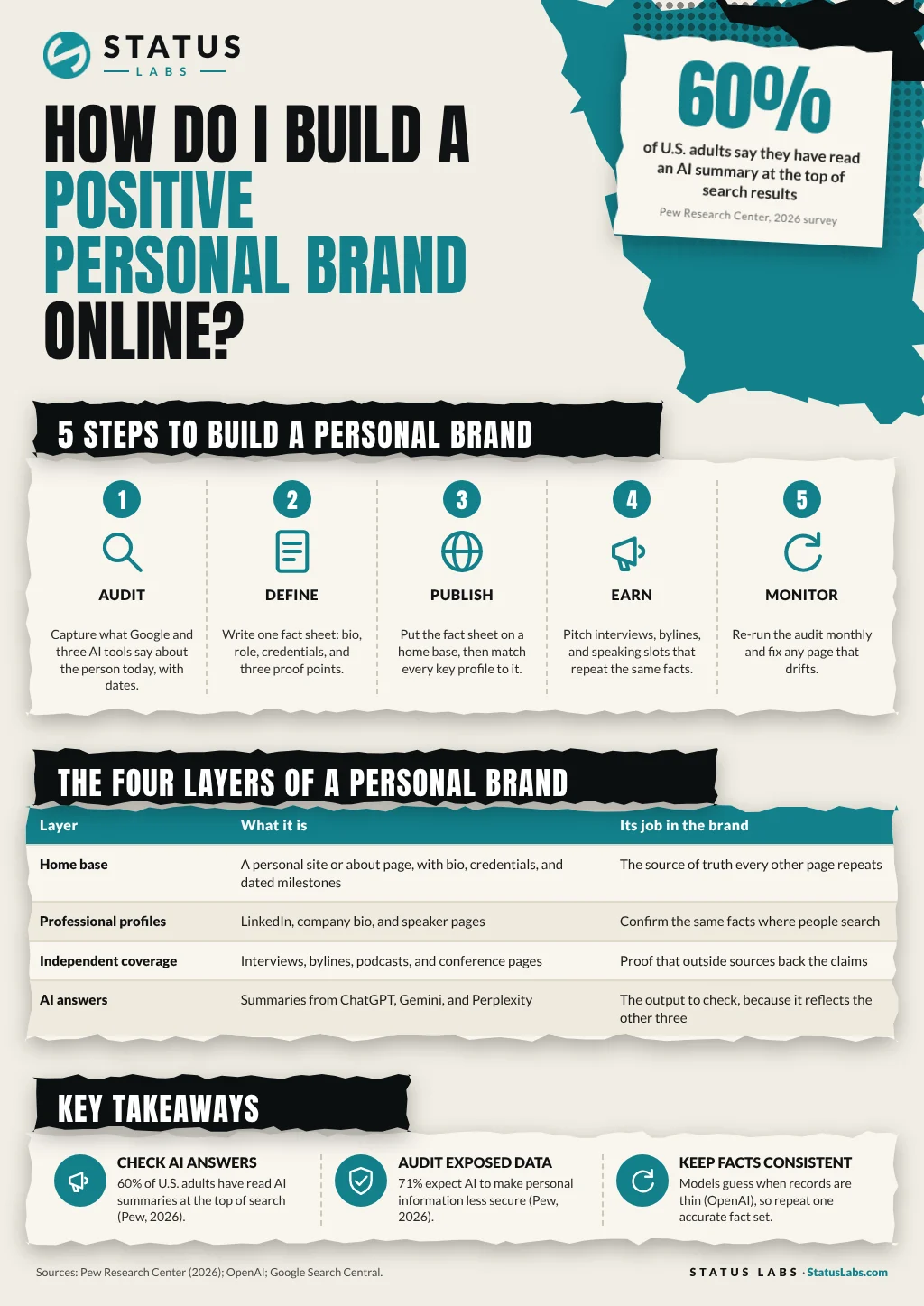
To build a positive personal brand online, publish one accurate set of facts about yourself on a page you control, repeat it across a few trusted profiles, and earn independent coverage that confirms it. Search engines and AI tools assemble a first impression from exactly those sources (60% of U.S. adults say they have read an AI summary at the top of search results, per Pew Research Center’s 2026 survey). The brand that wins is the one those systems can verify.
At Status Labs, we have built personal brands for executives, founders, and professionals for more than a decade. The work now starts with one question: what do Google and the major AI tools say about this person today?
This guide covers what a personal brand includes, how to build each layer, and the mistakes that cost people credibility.
What does a positive personal brand actually include?
A positive personal brand includes four layers: a home base the person owns, professional profiles that match it, independent coverage that backs it, and the AI answers that summarize all three. Each layer has a different job, and a weak layer shows up in the others.
The layers work as a chain. A polished home base cannot outweigh a LinkedIn profile that lists an old title, and an interview that gets a date wrong spreads the error to every tool that reads it. The table shows each layer and what it does.
How do I start with a home base people can verify?
Start with one page that states who you are, what you do, and what can be proven, with dates. Google’s people-first content guidance invites site owners to ask “Who, How, and Why” about their content, and it asks whether a page gives background about the author (such as links to an author page or an About page).
A strong home base has five parts: a one-paragraph bio, the current role and credentials, three proof points (a result, a publication, a recognition), a photo with a contact route, and the dates that make each claim checkable. Write the first two sentences of the bio so they stand alone, because a search engine or an AI tool may lift only that excerpt.
Use the same wording on your LinkedIn profile and in your speaker bios, so a reader or an AI tool comparing sources finds the same facts everywhere. Add a visible “last updated” date, and revisit the page whenever a title, employer, or credential changes.
What should I check before I build anything?
Check three things first: what Google shows for the name, what the major AI tools say when asked about the person, and which personal details appear in places the person did not choose. Search the full name in a private window (and any common misspelling or nickname, since people and tools search those too), ask ChatGPT, Gemini, and Perplexity who the person is, and save each answer with the date. That log becomes the baseline.
The privacy check matters more than most people expect. In the same Pew survey (conducted February 17 to 23, 2026), 71% of U.S. adults said they expect AI to make their personal information less secure. A people-search listing with a home address undercuts a polished brand, so request removal of exposed data before promoting anything.
The baseline shows the gaps, and AI tools fill gaps. OpenAI’s research on hallucination found that models hallucinate because standard training and evaluation reward guessing over admitting uncertainty. A thin or conflicting record gives a model room to guess, while a consistent record leaves little to invent.
How do I earn independent coverage?
Independent coverage is any page about the person that the person does not control: an interview, a bylined article, a podcast episode, or a conference speaker page. These pages carry weight because they confirm claims from outside the home base.
Start with the outlets the audience already reads, offer one specific area of expertise instead of a general pitch, and attach proof (a result, a dataset, a case). Make sure every piece repeats the current title and bio. Three accurate, well-placed features do more than thirty thin mentions, because each one gives search engines and AI tools another source that agrees.
Give each outlet a reason to say yes: a fresh data point, a clear opinion backed by evidence, or expertise that fits a story already in motion. Editors and podcast hosts check a pitcher’s credibility before they reply, so a clean home base and matching profiles make every pitch stronger.
Expect pitching to take time and expect some refusals. Treat every placement as an asset for the home base to link to, and keep a simple list of what has run, where, and when. We cover how we plan coverage on the Status Labs YouTube channel.
What is the sequence we use to build a personal brand?
We build a personal brand in five steps and repeat the audit every month. The order matters: a home base needs facts to publish, and coverage needs a home base to point to.
Frequently asked questions
How long does it take to build a positive personal brand online?
Expect months, not weeks, because the timeline depends on the starting point (a clean record moves faster than a contested one) and on how quickly independent coverage lands. A stronger home base ranking for the name usually shows up before the full effect does. Publishing on a schedule helps: a monthly update to the home base and one new placement a quarter keeps the record fresh without becoming a second job.
Do I need a personal website to build a personal brand?
In most cases, yes. A personal site gives search engines and AI tools one authoritative page that you control, and it anchors every other profile. Without one, pages that other people publish define the first impression.
Should I post on social media every day?
No. Consistent facts matter more than posting frequency. Keep two or three profiles accurate and active, and close the rest instead of leaving outdated ones that contradict the home base.
Can AI tools describe my personal brand wrongly?
Yes. Models can produce plausible but wrong descriptions, especially when the available information is thin or conflicting. Check ChatGPT, Gemini, and Perplexity monthly, and correct the underlying sources instead of arguing with the tool.
The bottom line
A positive personal brand is a short, accurate record that search engines and AI tools can verify. Build it in order (a home base, then matching profiles, then coverage that confirms both) and keep it consistent as your roles and titles change. If the starting point includes negative results, our guide to improving your personal online reputation covers that path.
Start this week with three steps:
- Search the name in a private window, ask three AI tools who the person is, and save the results with today’s date.
- Write a one-page fact sheet (bio, role, credentials, three proof points) and publish it on a page the person controls.
- Match LinkedIn and speaker bios to that page word for word, then pitch one interview or byline that repeats it.


