


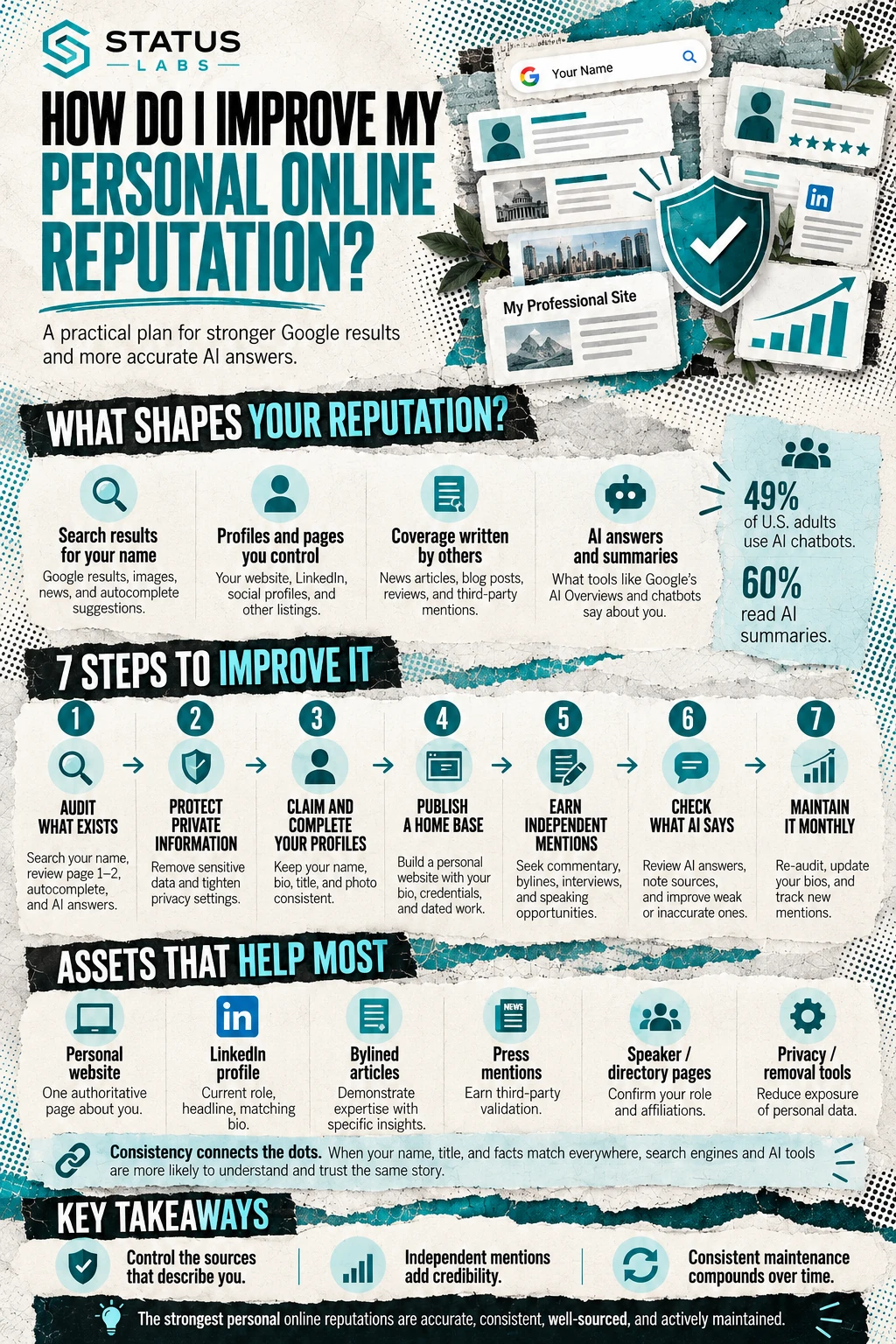
To improve your personal online reputation, take control of what people find when they search your name: audit what is there, claim and complete the profiles and pages you control, publish accurate and specific information about your work, earn credible mentions from independent sources, protect your private information, and check what AI tools say about you on a regular schedule. Working through these steps in order over roughly 90 days builds a foundation, and the results keep compounding after that, because search engines and AI tools reward information that is consistent, accurate, and well-sourced. At Status Labs, we use this sequence with executives, founders, and professionals, and we start here because people now look you up before they meet you, hire you, or invest with you.
This guide explains what shapes your reputation today, gives you a step-by-step plan, and shows which assets matter most for both Google and AI answers.
KEY TERM: personal online reputation: the impression formed by what search results, social profiles, news coverage, reviews, and AI answers show about a specific person, whether or not that person created the content.
What shapes my personal online reputation today?
Four surfaces shape it: the search results for your name, the profiles and pages you control, coverage written by others, and the answers AI tools give about you. The fourth surface is growing fast. Pew Research Center's June 2026 report found that 49 percent of U.S. adults now use AI chatbots, about four in ten use them to search for information, and 60 percent say they read the AI summaries at the top of search results.
That means a stranger researching you may read a short AI-written description before they ever see a link. Improving your reputation now includes making sure that description is accurate, which depends on the quality of the sources that exist about you.
How do I improve my personal online reputation, step by step?
Work through the sequence below, and treat each phase as a foundation for the next.
- Audit what exists. Search your name in a private window and review the first two pages, the autocomplete suggestions, and what the major AI tools say about you. Our audit guide walks through the process.
- Protect your private information. Remove or limit what you do not want public, and tighten the privacy settings on your personal accounts.
- Claim and complete the profiles that rank for your name. Use the same name, headline, short biography, and photo across LinkedIn and the other professional platforms where you appear.
- Publish a home base. A personal website with a clear biography, credentials, dated work, and contact details gives search engines and AI tools one authoritative page about you. Our executive page guide explains how to structure one.
- Earn independent mentions. Contribute expert commentary, publish bylined articles, speak at industry events, and give interviews, so credible third parties describe your work.
- Check what AI says and fix the sources. Ask the major AI tools about you, note the pages they cite, and correct or strengthen those sources.
- Maintain it monthly. Repeat the audit, update your biography when your role changes, and respond to new mentions.
This sequence is the core of our personal reputation management work.
Which assets help most, and what do they need?
A few assets do most of the work, and each one performs best when it follows the same set of facts. This table shows what each asset does and what to include.
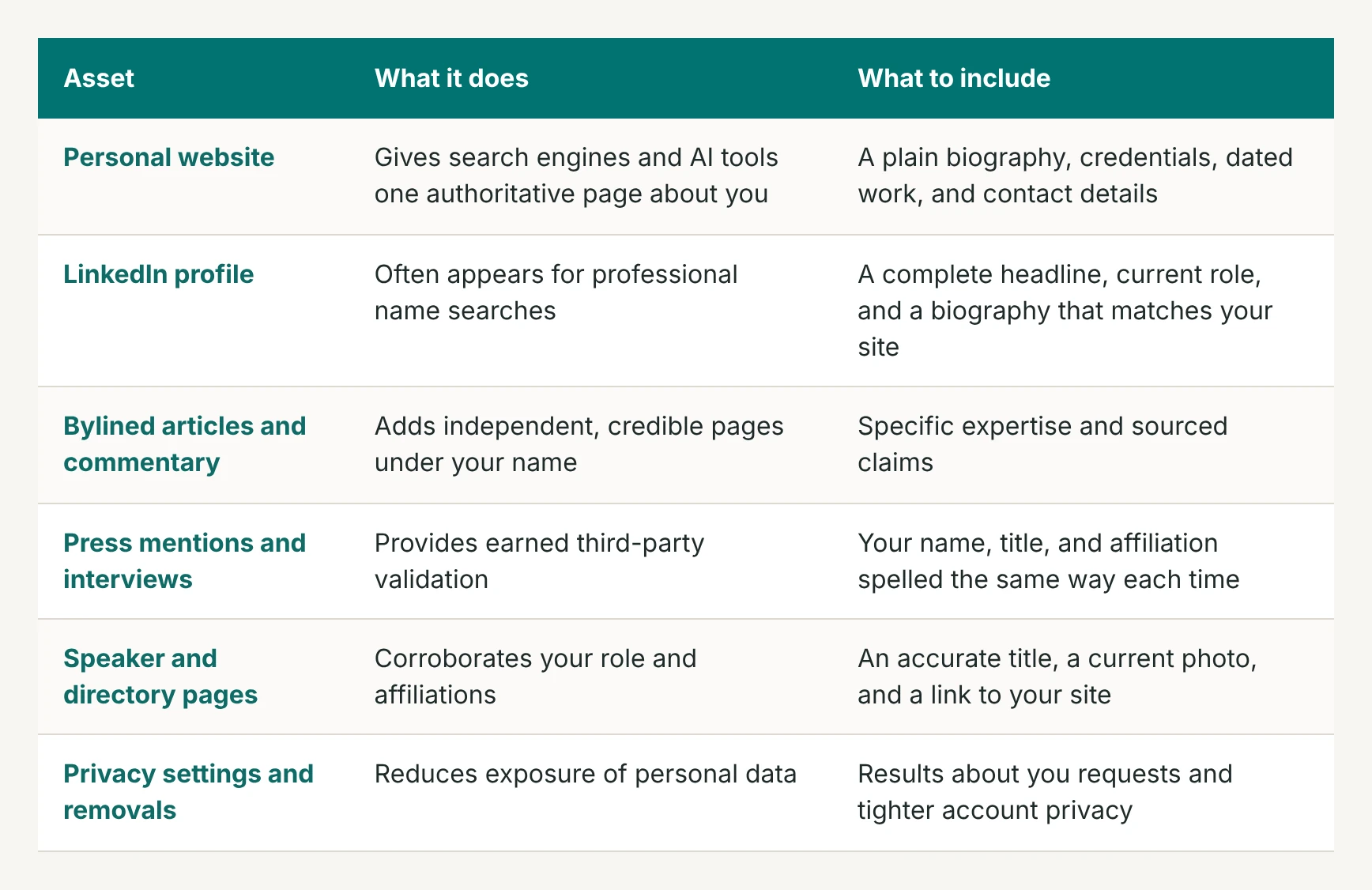
Consistency carries the table. When your name, title, and facts match everywhere, search engines and AI tools can connect the pages to one person.
How do I protect my private information while I build?
Start with the data that causes the most harm if it spreads. Google's Results about you tool monitors Search for your phone number, home address, and email address, and since February 2026 it also finds government ID numbers such as passport, driver's license, and Social Security numbers. You request removal from the same dashboard. Google notes that removing a result from Search does not remove the page from the web, so the tool reduces exposure and does not erase the source.
Pew's survey adds a reason to act early: roughly seven in ten U.S. adults expect AI to make their personal information less secure. Reducing what is publicly findable now gives AI tools and strangers less to repeat.
Why do independent mentions matter so much?
Because AI search systems lean toward independent sources over self-published ones. A September 2025 earned media study of AI search found a systematic bias toward earned media over brand-owned and social content. For a person, your own website anchors the facts, and credible third-party coverage gives those facts weight.
Thin information carries its own risk. OpenAI's research on hallucination found that models are trained in ways that reward confident guessing over admitting uncertainty, so when little accurate information about you exists, an AI tool may produce a plausible but wrong description. Our 2026 whitepaper explains how we read and shape those answers for clients.
What if there is already negative content about me?
Improvement and repair run side by side, and the same building steps do both jobs. Every strong, accurate page you publish or earn competes for the positions that negative results occupy. If something harmful is already ranking, our negative reputation guide covers the displacement and response steps in detail.
Frequently asked questions
How long does it take to improve my personal online reputation?
Expect months. New pages need time to be crawled and trusted, and earned coverage accumulates gradually. The timeline depends on your starting point, how common your name is, and how much authoritative material already exists, and we give a range after the first audit.
Do I need a personal website?
Yes, in most cases. A site you control gives you one authoritative page that search engines and AI tools can cite, and it anchors the rest of your profiles. Without it, other people's pages define the first impression.
Is a LinkedIn profile enough?
A LinkedIn profile helps, and one asset leaves gaps. Pair it with your own website and a few independent mentions so that more than one credible page supports the same facts.
Can I improve my reputation without professional help?
You can start today: audit your results, tighten your privacy, claim your profiles, and publish a home base. Earning sustained third-party coverage and managing AI answers usually takes dedicated expertise. We share how this work fits together on our YouTube channel.
The bottom line
Improving your personal online reputation means controlling the sources that describe you: audit them, protect your private information, claim and complete your profiles, publish a home base, earn independent mentions, and check what AI tools say. Consistent, accurate, well-sourced information works for both Google and AI answers, and the effort compounds with each month you maintain it.
If you have not looked yourself up recently, do it today: open a private window, search your full name, and save the first two pages with the date. Then list the three profiles you control and make sure each one tells the same accurate story.


