
.png)


To improve a negative reputation online, you build and promote accurate, positive content faster than the negative material can define you, respond openly to the criticism that is fair, and keep the fresh, favorable story visible everywhere people and AI engines look. You cannot always erase what is already out there. But you can change what dominates the picture, because reputation online is decided by what is most visible and most recent, not by what happened first. At Status Labs, we have spent more than a decade turning negative search and review landscapes around, and we now do the same work inside the AI answers that increasingly speak for you.
This guide walks through how reputation recovery actually works, the sequence we use to do it, and why speed and freshness matter more in 2026 than they ever have.
Can you actually fix a negative online reputation?
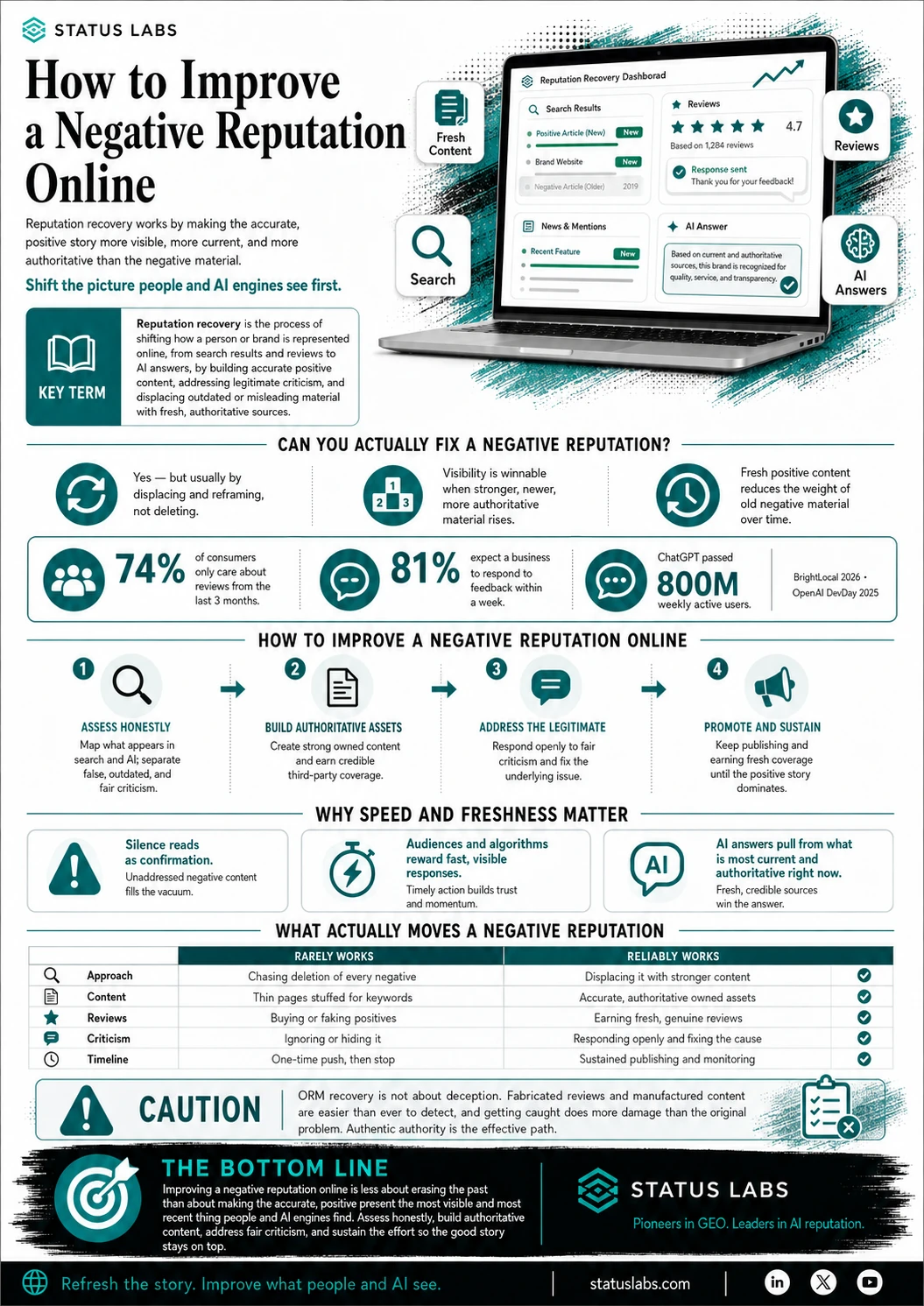
Yes, though "fix" usually means displace and reframe rather than delete. Most negative content cannot simply be removed, and chasing removal is often the slowest, least reliable path. What works is changing what is most visible: publishing stronger, more current, more authoritative material that outranks and out-cites the negative, so the working impression of you becomes the accurate one. Recovery is a competition for visibility, and visibility is winnable.
The reason this works is that both search engines and people favor what is recent. BrightLocal's 2026 consumer survey found that 74 percent of consumers only care about reviews written in the last three months, with many ignoring older feedback entirely. Old negative material loses weight over time on its own. A steady flow of fresh, positive content accelerates that decline.
How to improve a negative reputation online
Work in a clear order: assess what is out there, build the positive assets, address what is fair, then promote and sustain the good material until it dominates. Skipping straight to damage control without the groundwork is how most recovery efforts stall.
- Assess honestly. Map exactly what appears when someone searches you or asks an AI about you, and separate what is false, what is outdated, and what is fair criticism.
- Build authoritative assets. Create accurate, high-quality owned content and earn credible third-party coverage that tells the current, true story.
- Address the legitimate. Respond openly to fair criticism and fix the underlying issue, because a genuine response often reframes a negative faster than burying it.
- Promote and sustain. Keep publishing and earning fresh coverage so the positive story stays the most visible and most recent one.
Do these in sequence and the negative narrative loses its grip. Do them piecemeal, and it lingers. This staged approach is the backbone of our reputation management practice.
Why does speed matter so much in reputation recovery?
Because a negative story hardens the longer it stands unanswered, and both audiences and algorithms reward a fast, visible response. Silence reads as confirmation. BrightLocal's 2026 data shows 81 percent of consumers expect a business to respond to feedback within a week, and 77 percent are put off by negative reviews left to sit. The window to shape the story is narrow, and it closes.
Speed matters even more now that AI compresses the picture. ChatGPT passed 800 million weekly active users by OpenAI's October 2025 DevDay, and a model answering about you pulls from whatever is most authoritative and current at that moment. If the freshest, strongest material is positive, that is what the answer reflects. Our own 2026 whitepaper details how the AI layer now forms first impressions before a person ever clicks, which is why recovery has to reach the answer, not just the search page.
What actually moves a negative reputation, and what does not
The tactics that work share a trait: they build genuine authority rather than trying to trick the system. The ones that fail are shortcuts that AI and search engines increasingly catch.
The distinction matters because deception now backfires. Fabricated reviews and manufactured content are easier than ever for platforms and AI systems to detect, and getting caught does more damage than the original problem. Authentic authority is not just the ethical path. It is the effective one.
Frequently asked questions
How long does it take to improve a negative online reputation?
It depends on how entrenched the negative material is and how much positive authority you already hold. A recent, isolated issue can shift in weeks, while a well-established negative narrative can take many months of sustained work to displace. The one constant is that starting sooner shortens the timeline, because fresh content compounds.
Should I respond to negative reviews or ignore them?
Respond when the criticism is legitimate. A calm, specific, non-defensive response signals accountability and often improves how others perceive the business more than the original review harmed it. Ignoring fair criticism reads as indifference, which most consumers hold against you. We cover response strategy in videos on the Status Labs YouTube channel.
Can I remove negative content instead of burying it?
Sometimes, but rarely reliably. Genuinely defamatory or policy-violating content can occasionally be removed through the proper channels, but most negative material is not removable, which is why displacement is the dependable strategy. Treat removal as a bonus when it is possible, not the foundation of the plan.
The bottom line
Improving a negative reputation online is less about erasing the past than about making the accurate, positive present the most visible and most recent thing people and AI engines find. Assess honestly, build authoritative content, address fair criticism head-on, and sustain the effort so the good story stays on top. Move quickly, because a negative narrative only hardens while it sits unanswered, and in 2026 the AI answer forms faster than ever. We share ongoing recovery guidance on our LinkedIn page.
If a negative story is shaping how you are seen right now, start with an honest assessment: search yourself, read what the AI engines say, and map exactly what needs to be displaced before you begin.
.png)

.png)
