


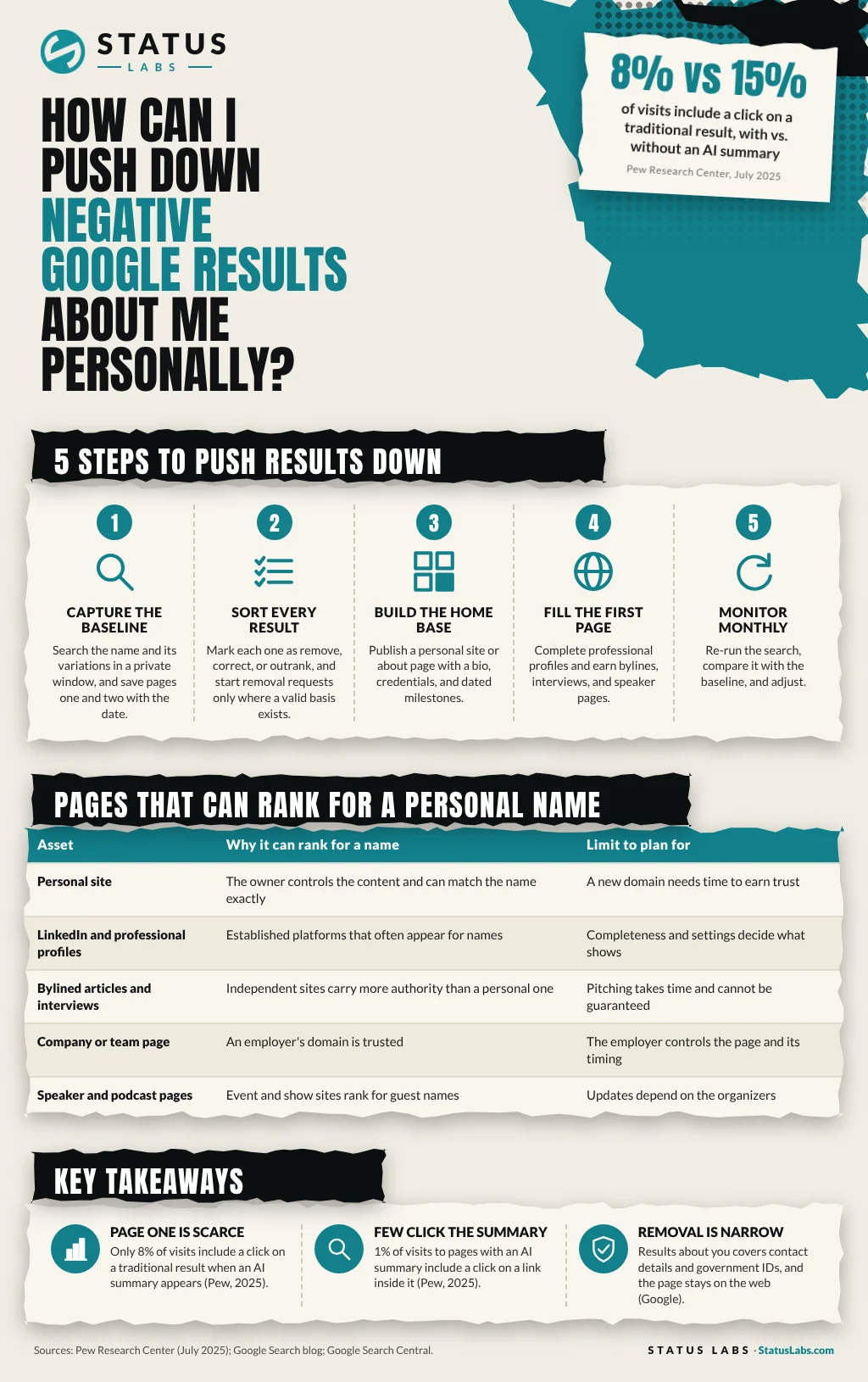
To push down negative Google results about you personally, build several accurate, authoritative pages that rank for your name (a home base site, professional profiles, and independent coverage), because Google removes only a narrow set of results and ranks the rest on relevance and authority. Page one is scarce space: a Pew Research Center analysis of 900 U.S. adults found people clicked a traditional result in 8% of visits when an AI summary appeared and 15% when none did.
At Status Labs, we have handled negative search results for individuals for more than a decade, and the first step never changes: sort every result into remove, correct, or outrank. This guide covers when removal works, the sequence we use to push results down, and the shortcuts that backfire.
This article is general information and not legal advice. Removal and defamation law varies by location, so consult a licensed attorney about your specific situation.
Can negative Google results about me be removed?
Sometimes, but only in narrow cases. Google’s Results about you tool lets a person find and request removal of search results that show a phone number, a home address, or government ID numbers (a passport, driver’s license, or Social Security number), and Google notes that removing a result from Search does not remove the page from the web. An accurate, lawful news article about a person generally stays in results.
Three other routes exist: asking the site owner to correct or delete the page (the fastest route when the owner agrees), asking Google to update a result for a page that has already changed, and, for defamatory content or a court order, working with an attorney. Each one depends on facts that vary by case, so confirm which route fits before spending time on it. Document everything first: save the URL, a dated screenshot, and a short note on the inaccuracy, because requests to publishers and to Google both move faster with evidence.
Be realistic about the first step. Before any request goes out, read the page closely and note exactly what is inaccurate, outdated, or private, because a request that names a specific problem gets further than one that says only that the page is unflattering.
What can rank for my name instead?
Many kinds of pages can rank for a personal name, and the strongest are the ones a person controls or earns: a personal site, professional profiles, bylined articles, interviews, and speaker or company pages. Google ranks on relevance and authority, so each asset needs real substance and a reason to be trusted.
The table shows the assets we use most for individuals, and the limit on each.
Platform pages give the fastest early wins because they already carry authority, while a new personal site takes longest to rank and lasts longest once it does. Match the assets to the situation. A person with a common name needs more distinguishing detail (a middle initial, a city, an employer) on every page, while a person with a unique name can rank sooner but has fewer places to hide a bad result.
What is the sequence for pushing results down?
Push results down in five steps, in order, because each one supports the next. We use this sequence for individuals, and we run the first step again every month.
Do not skip the sort in step two (it sets the timeline for everything that follows). Removal requests, corrections, and new content run on different timelines, and mixing them up wastes the early months.
Why do AI summaries make page one matter more?
AI summaries make page one matter more because fewer people click through to results. In the same Pew analysis (March 2025 browsing data, in which 58% of respondents saw at least one AI summary), only 1% of visits to pages with an AI summary included a click on a link inside the summary itself. The summary text shapes the impression, and few readers check it against the sources.
That changes the job. Check what ChatGPT, Gemini, and Perplexity say about you, and strengthen the sources they draw from, which are the same pages that rank for your name. A summary that repeats an old negative story usually points to a page that still ranks, so the two problems often share one fix.
How long does it take to push results down?
Early movement can appear within the first one to three months, but lasting results take longer. The pace depends on three things: how authoritative the negative page is, how common the name is, and how much strong content already exists for it. A common name shares page one with other people, which can help and hurt.
Measure progress against the baseline, not against hope. A negative result that slips from position three to position seven (still on page one, but seen far less often) is real movement, and the baseline is the only way to see it.
Frequently asked questions
Can I ask Google to remove a negative article about me?
Only in limited cases. Google acts on personal contact details and government ID numbers through Results about you, and on content that breaks its policies or a legal order. An accurate, lawful news article normally stays in results, so the practical route is to outrank it.
Will deleting my social media accounts push down negative results?
No. Deleting accounts removes assets that a person controls without touching the negative page, and it can open space for other pages to rank. Keep accurate profiles and update them to match the home base.
What if someone else shares my name?
A shared name splits page one among several people, so add distinguishing details to every page: the full name, the city, the profession, and the company. Use the same name form on every profile so search engines connect them to one person.
Should I respond publicly to a negative article?
Usually not at first. A public reply can create a new page that ranks beside the original. Capture the article, check it for factual errors, and ask the publisher for a correction if one applies to your case.
The bottom line
Pushing down negative Google results is a build-and-maintain job. Google removes little, so the durable answer is a home base, matching profiles, and independent coverage that earn the space those results occupy.
For a deeper walk-through of one common case, see our guide to suppressing a negative news article. We cover these methods on the Status Labs YouTube channel.
Start with three steps this week:
- Search the name and its variations in a private window, and save pages one and two with today’s date.
- Mark each negative result as remove, correct, or outrank, and request removal only where a valid basis exists.
- Publish a home base with a bio, credentials, and dated milestones, then match your LinkedIn profile to it.


