
.png)


To suppress a negative news article in Google, you displace it by publishing and strengthening enough authoritative, positive content that it outranks the article and pushes it off the first page, where the large majority of searchers never look. You usually cannot delete a legitimate news article, because Google does not remove lawful journalism and publishers rarely take down published stories. What you can do is change what ranks above it, so the negative article slips to page two or beyond and effectively disappears from view. At Status Labs, we have suppressed negative search results for clients for more than a decade, and displacement, done properly, is a reliable and durable path.
This guide explains what suppression actually is, why removal usually is not an option, how displacement works, and the realistic timeline and cautions involved.
KEY TERM: search suppression: the practice of pushing a negative result off the first page of Google by ranking stronger, more authoritative content above it, so that although the article still exists, few people ever see it.
Can I remove a negative news article from Google?
In most cases, no. Google removes certain categories of content, such as exposed personal contact information, financial data, and non-consensual imagery, through its removal tools, but it does not remove legitimate news coverage. Google's own policies treat journalism from established outlets as public-interest content and decline to delist it, and the publisher that ran the story is rarely willing to unpublish it.
That leaves suppression as the realistic strategy. Rather than fighting to erase an article that neither Google nor the publisher will remove, you compete to outrank it. This is not a workaround. It is how the search results are actually reshaped, and it is far more dependable than chasing a removal that almost never comes.
How does suppressing a negative article actually work?
Suppression works by displacement: you build and strengthen positive, authoritative content until it occupies the positions the negative article used to hold, pushing it down and out of view. Search results are a ranked competition, so moving a result down means giving Google better answers to rank above it.
The reason this is so effective comes down to how people search. Documented search-behavior research shows that users rarely scroll below the visible results and seldom move past the first page at all, with one large search study noting that the vast majority of attention stays on the first page. When a negative article drops from the first page to the second, the number of people who ever encounter it falls dramatically. You have not deleted it, but you have made it functionally invisible.
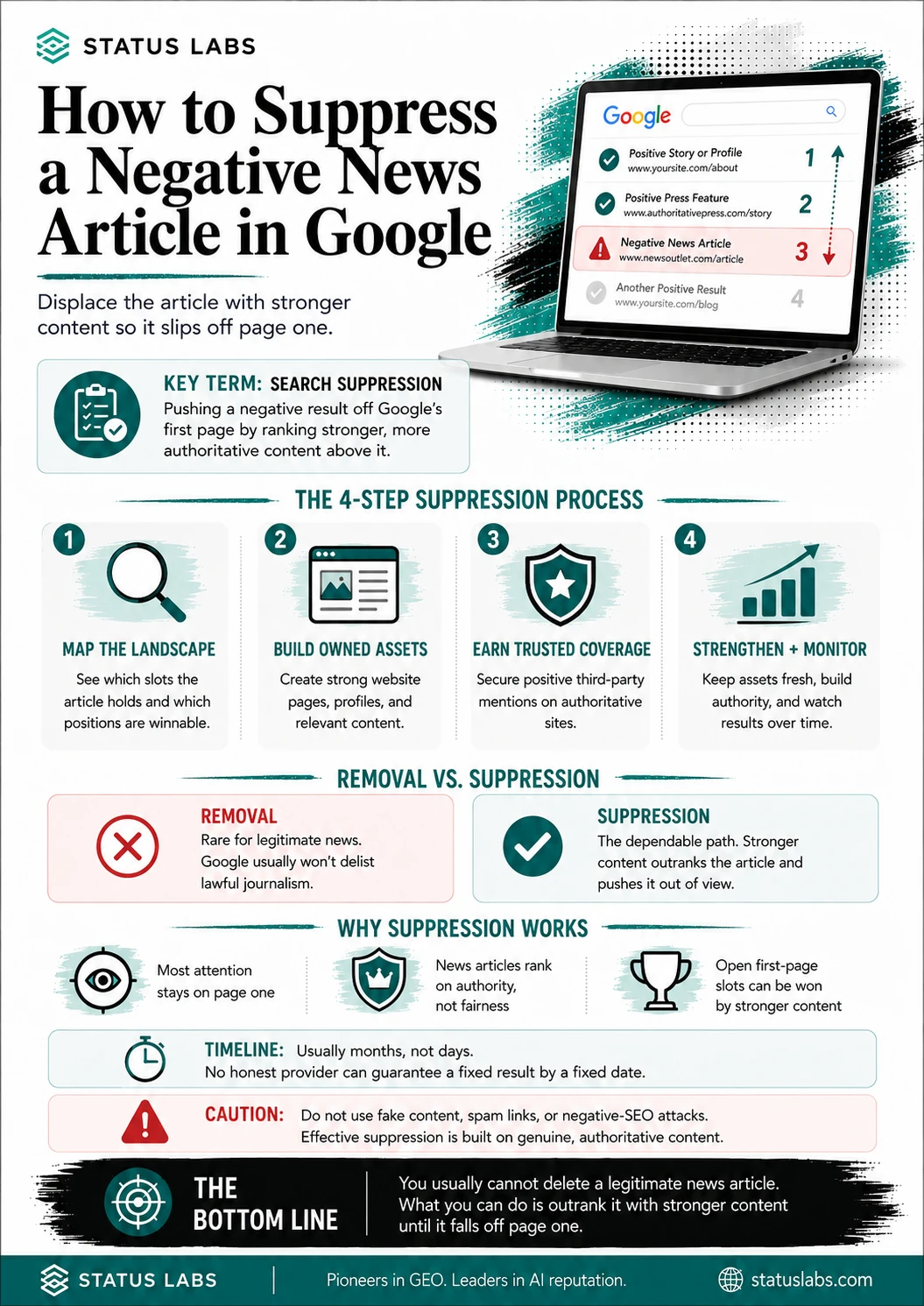
What does the suppression process involve?
Displacement is a build, done in a deliberate order. Each asset you create and strengthen is a candidate to outrank the negative article.
- Map the search landscape. Identify exactly what ranks on the first page for the target query, which positions the negative article holds, and which slots are winnable.
- Build authoritative owned assets. Create and optimize strong pages you control- an official site, profiles, and relevant content- that can rank for the same query.
- Earn credible third-party coverage. Positive articles and mentions on authoritative outlets carry the ranking power to outrank a negative story, because Google rewards trusted domains.
- Strengthen and interlink. Build authority to these assets over time through quality, links, and freshness, so they climb above the negative result.
- Sustain and monitor. Keep the positive assets fresh and watch the results, since search positions shift and suppression has to be maintained.
Done consistently, this pushes the negative article down page by page. This staged displacement is the core of our reputation management practice.
Why does a news article rank so high in the first place, and can I outrank it?
News articles rank well because they sit on high-authority domains that Google trusts, but they are not immovable, and the first page holds several winnable positions. Google's ranking systems weigh relevance, authority, and quality, and a news site scores highly on authority, which is why its article ranks. That same system, though, will rank your content above it if your content earns stronger relevance and authority signals for the query.
Two facts work in your favor. Google generally limits how many results any single site can hold on the first page, so one outlet cannot own the whole page, which leaves positions open for your content. And a news article's ranking power fades somewhat as its freshness declines, while your positive assets can keep gaining authority. For a deeper look at why a specific article ranks where it does, see our guide on why a negative article shows up high in search results.
How long does suppression take, and is it guaranteed?
Suppression typically takes months, not days, and no honest provider guarantees a specific outcome by a specific date. Building the authority to outrank an established news article on a trusted domain takes time, because search engines need to crawl, evaluate, and trust your content before ranking it above the article. A recent, less-entrenched article moves faster, while a story ranking across the first page on strong domains takes longer.
Be wary of guarantees. Google states plainly in its SEO guidance that no one can guarantee a number-one ranking, and the same is true in reverse for suppression. Rankings depend on factors no provider fully controls, so a credible partner sets realistic ranges and reports against progress rather than promising a fixed result.
CAUTION: Do not attempt to suppress an article with fake content, spam links, or negative-SEO attacks on the publisher. These tactics violate platform policies, are increasingly easy to detect, and can expose you to legal and reputational harm that is worse than the original article. Effective suppression is built on genuine, authoritative content, not manipulation.
Frequently asked questions
Is suppressing a negative article the same as removing it?
No. Removal deletes the content at its source, which is rarely possible for legitimate news. Suppression leaves the article online but pushes it below the first page, where few people ever look, so the practical effect is similar even though the article still technically exists.
How much positive content do I need to suppress an article?
Enough to outrank it in every first-page position it holds, which varies by situation. A single mid-page article may take a handful of strong assets, while a story ranking across the first page on multiple authoritative domains requires far more. The goal is to win each position the article occupies.
Can I suppress a negative article myself?
You can start by building and optimizing owned assets, but suppressing an entrenched article on a high-authority news domain usually requires the earned coverage and sustained authority-building that dedicated expertise provides. We cover suppression strategy in videos on the Status Labs YouTube channel.
The bottom line
Suppressing a negative news article in Google means displacing it, not deleting it: you build stronger, more authoritative content that outranks the article and pushes it off the first page, where the vast majority of searchers never look. Removal is rarely an option for legitimate journalism, which is why displacement is the dependable path. Map the landscape, build and earn authoritative content, strengthen it over time, and the negative article recedes from view. Our own 2026 whitepaper details how this work now extends across search and AI answers alike.
If a negative article is ranking on your name today, start by mapping the first page: identify which positions it holds and which are winnable, and you will see exactly what it takes to push it out of sight.
.png)

.png)
