
.png)


To audit your online reputation, systematically check every surface where people find you- search results, review platforms, social profiles, news coverage, and AI answers- then assess each for accuracy, sentiment, and gaps, and benchmark the picture against what a customer or competitor would see. The goal is not to skim your first page of Google and call it done. It is to build an honest, complete map of what the internet and AI engines actually say about you, so you know exactly what to protect and what to fix. At Status Labs, we have run this audit for thousands of individuals and brands over more than a decade, and a disciplined process surfaces problems long before they cost you.
This guide walks through the audit step by step, surfaces what most people overlook, and how to judge what you find.
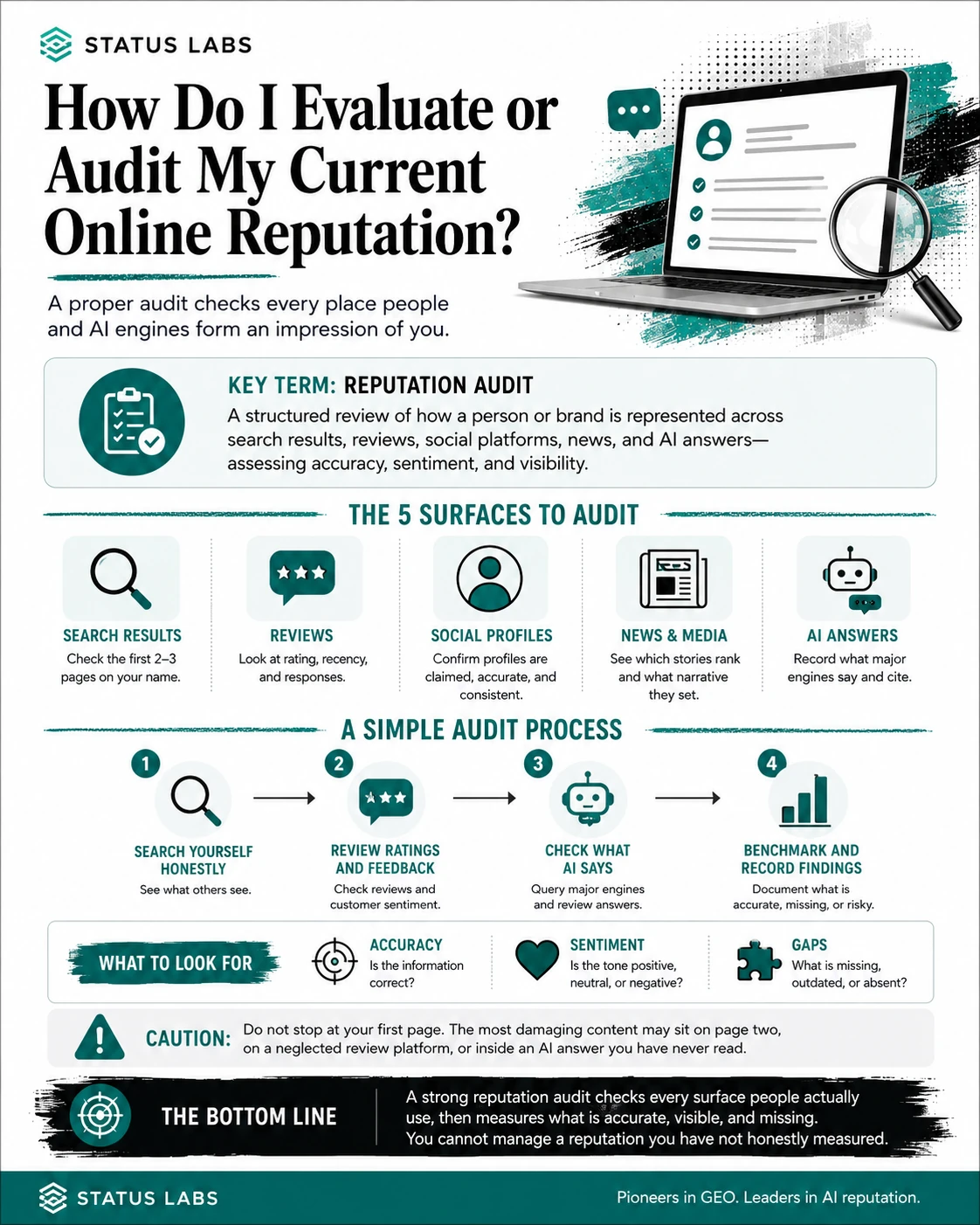
KEY TERM: reputation audit: a structured review of how a person or brand is represented across search results, reviews, social platforms, news, and AI answers, assessing accuracy, sentiment, and visibility to identify strengths, risks, and gaps.
What does a reputation audit actually cover?
A complete audit covers five surfaces, not just Google's first page. Most people check their search results and stop, which misses where much of the damage and opportunity lives. The full set is search results, review platforms, social profiles, news and media coverage, and, increasingly, the answers AI engines give about you. Each shapes a different part of the impression people form, and a gap in any one of them is a blind spot.
The reason to cover all five is that people do not experience your reputation in one place. A customer might read an AI answer, then check reviews, then glance at your first page of search. Auditing only one surface tells you how you look in one window while the others go unwatched.
How do I audit my online reputation step by step?
Work through the surfaces in order, recording what you find rather than trusting memory. A written record is what turns impressions into an actionable map.
- Search yourself properly. Use an incognito or private window so results are not personalized, and review the first two to three pages, not just the top few links. Note every result and whether it is positive, neutral, or negative.
- Check the review platforms. Look at Google, industry-specific sites, and anywhere customers rate you. Note your average rating, review recency, and whether you are responding.
- Audit your social profiles. Confirm each is claimed, accurate, complete, and consistent, since inconsistent profiles confuse both people and AI systems.
- Map your news and media coverage. Search news specifically, and note which stories rank and what narrative they set.
- Ask the AI engines. Query ChatGPT, Gemini, Perplexity, and Google's AI answers with the real questions people ask about you, and record what each says and which sources it cites.
- Assess and benchmark. For everything you found, judge accuracy and sentiment, then compare the picture to a competitor's to see where you stand.
Why do reviews and AI answers deserve special attention?
Because they carry outsized weight in real decisions and are the surfaces people most often skip auditing. Reviews drive choices directly. BrightLocal's 2026 consumer survey found that 41 percent of consumers always read reviews and that trust depends heavily on how recent they are, so a strong rating built on stale reviews is a hidden weakness worth catching.
AI answers are the newer blind spot. A growing share of people now form their first impression from a single synthesized AI response rather than a page of links. ChatGPT passed 800 million weekly active users by OpenAI's October 2025 DevDay, so an audit that ignores what AI says about you is missing the surface that increasingly speaks first. Our own 2026 whitepaper details how to read and manage that layer.
What should I look for on each surface?
Judge each surface against a simple standard: is it accurate, is it positive or at least neutral, and is it working for you. This table maps what to check and the red flags to note.
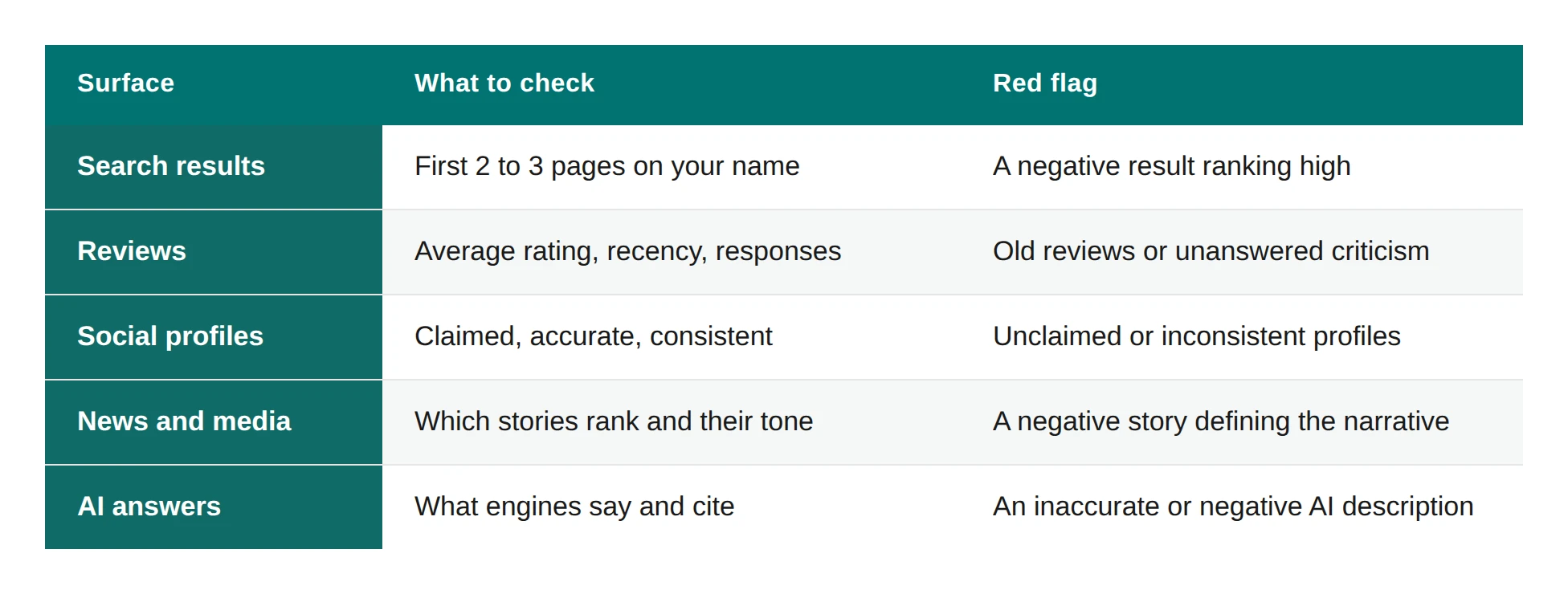
Understanding what you are seeing helps too. Google's own ranking guidance explains that results reflect relevance, authority, and quality signals, so a negative result ranking high usually means it is authoritative and unopposed, not that Google is against you.
How often should I audit my reputation?
Do a full audit at least once or twice a year, and a quick check monthly. Reputation is not static. New reviews, news, and AI answers appear continuously, so a single audit is a snapshot that ages quickly. A brief monthly search of your name and a look at the AI answer catches problems early, while the deeper full audit tracks the trend over time. Ongoing measurement of specific signals is a natural next step once the baseline audit is done. We walk through the audit process in videos on the Status Labs YouTube channel.
CAUTION: Audit honestly, and do not stop at your own first page. The most damaging content often sits on page two or three of search, on a review platform you rarely check, or inside an AI answer you have never read. A flattering top result can mask a problem one surface over, so a partial audit gives false comfort.
Frequently asked questions
Can I audit my online reputation myself, or do I need a tool?
You can start yourself. An incognito search of your name, a look at your review platforms, and a few questions to the major AI engines will surface most of the picture at no cost. Dedicated tools and expertise help when you need to track many terms and surfaces over time, but the first honest audit is something anyone can do today. This is the foundation of our reputation management work.
What is the most overlooked part of a reputation audit?
The AI answer. Most people still audit only search results and reviews, while a rising share of first impressions now form inside AI responses that may cite outdated or inaccurate sources. Asking the major engines directly is the single most modern and overlooked step.
How do I know if what I find is a real problem?
Judge it by accuracy and by whether a customer would act on it. An inaccurate or clearly negative result on your first page, or in an AI answer, is a real problem because it directly shapes decisions. A single old neutral mention buried on page three usually is not. Focus on what is visible and consequential.
The bottom line
Auditing your online reputation means checking every surface people actually use- search results, reviews, social, news, and AI answers- and judging each for accuracy, sentiment, and gaps rather than trusting a glance at your first page. Search yourself honestly, read your reviews and the AI answers, benchmark against a competitor, and write down what you find. The audit is the foundation, because you cannot manage a reputation you have not honestly measured.
If you have never run a full audit, start tonight: open an incognito window, search your name, ask the major AI engines what they say about you, and write down everything you find. That record is where every reputation strategy begins.
.png)

.png)
