
.png)


You can get a negative article removed from search results in specific situations: when the publisher agrees to take it down, when the content violates a platform's policies, when it exposes private personal data, when a court has ruled it unlawful, or when the page is already gone and only the outdated result remains. Outside those cases, a lawful article, such as legitimate journalism, generally cannot be removed, and the realistic path becomes displacing it instead. Knowing which situation you are in is what separates effort that works from effort that is wasted. At Status Labs, we have handled both removal and displacement for clients over more than a decade, and the first step is always an honest assessment of whether removal is actually possible.
This guide walks through exactly when removal works, how each route operates, and what to do when removal is not an option.
KEY TERM: content removal: the deletion or de-indexing of a web page so it no longer appears in search results, achievable only in specific circumstances such as publisher cooperation, policy violations, privacy breaches, or a court order, and distinct from suppression, which pushes lawful content down rather than removing it.
Can a negative article actually be removed from search?
Sometimes, but only in defined circumstances, and not simply because the article is negative or you disagree with it. Search engines do not remove content on request based on how it makes you look, and they do not judge the truth of a dispute. Removal happens when there is a clear basis for it, either the source takes the content down, or the content falls into a category that platforms and search engines will act on.
It also helps to understand what removal means. When a source site deletes an article, it disappears everywhere. When a search engine removes a result, it usually de-indexes the page from search rather than deleting it from the web, because the original site controls the content itself. Both reduce visibility, but they work differently, which matters for choosing the right route.
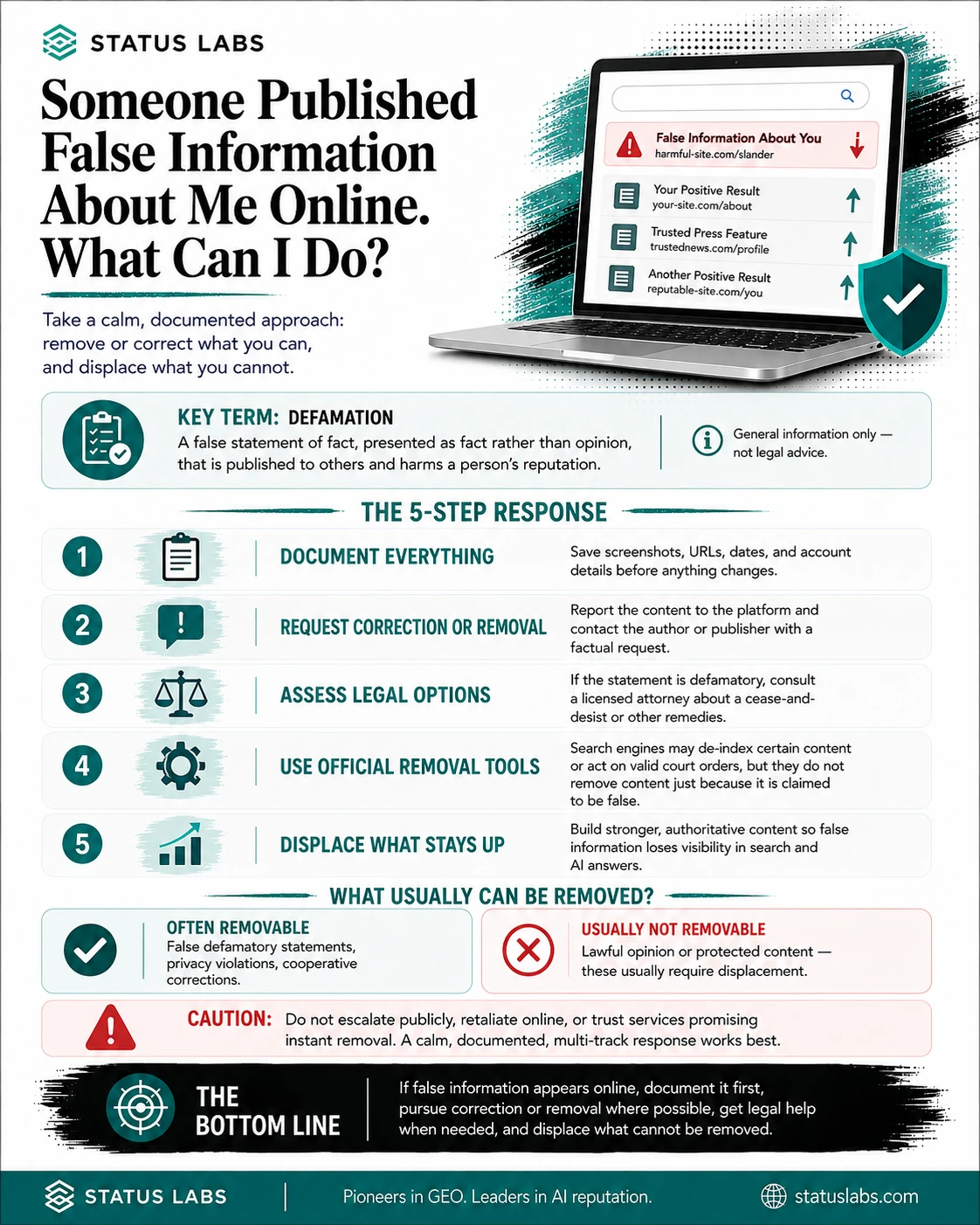
When can a negative article be removed?
Removal is realistic in five situations. Matching your case to one of these tells you whether to pursue removal or move to displacement.
- The publisher agrees to remove it. The cleanest route is the source itself taking the article down or correcting it, which removes it everywhere at once.
- The content violates platform policies. Most platforms prohibit specific content, such as harassment, doxxing, impersonation, or fake reviews, and will remove material that breaches their rules.
- It exposes private personal information. Search engines remove certain sensitive data, such as contact details, financial account numbers, and identity documents, through dedicated privacy tools.
- A court has ruled it unlawful. A valid court order declaring content defamatory or otherwise illegal gives search engines a basis to de-index it.
- The page is already gone or outdated. When a source has removed or substantially changed a page, outdated-content tools refresh the result so it no longer appears.
If your situation fits one of these, removal is worth pursuing. If it does not, the honest answer is that the article is likely there to stay, and displacement is the path.
How do I request removal in each case?
Each route has its own process, and the right approach depends on the basis for removal. This overview shows how each works and what to realistically expect.
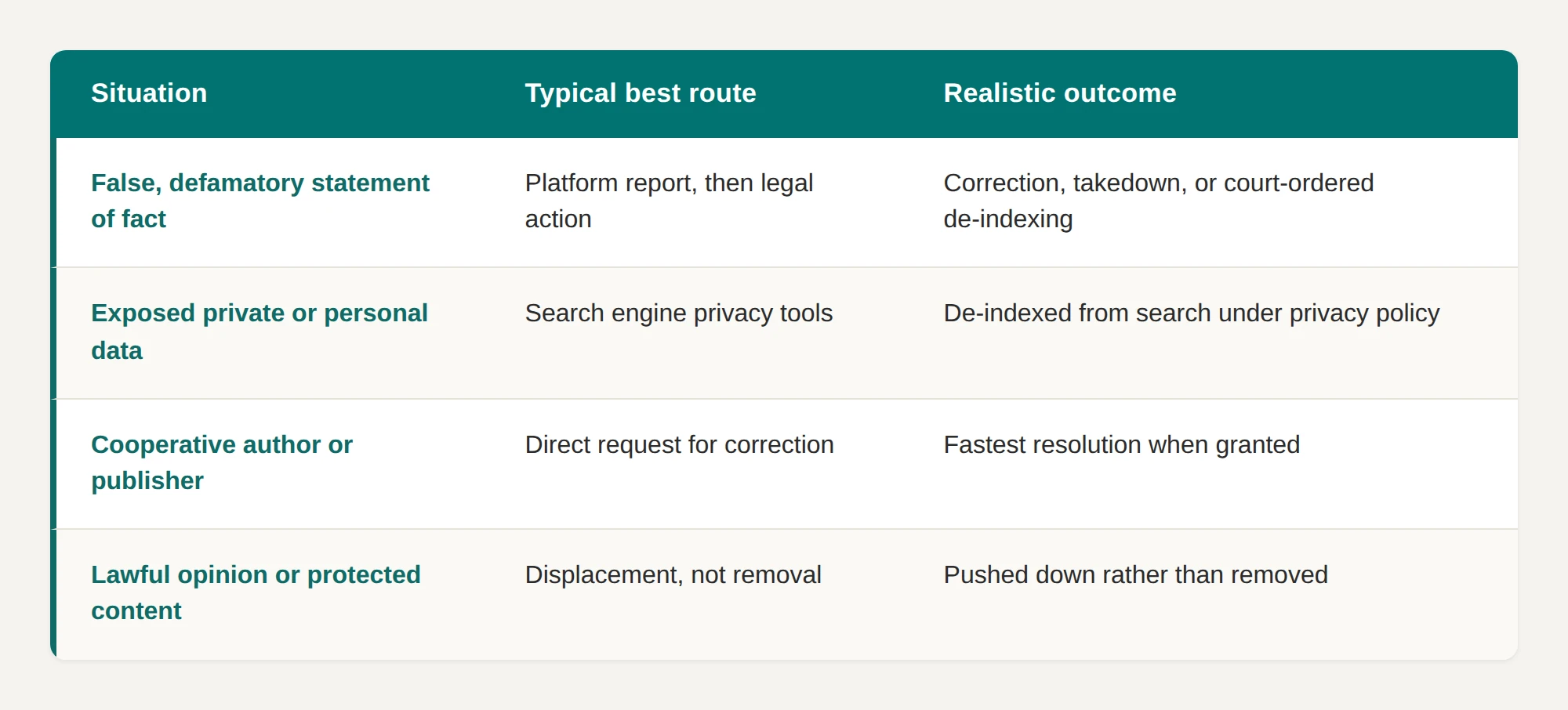
The two fastest routes are usually publisher cooperation and clear policy violations. The privacy and court-order routes are more powerful for specific content but take more effort and time.
Can I get a legitimate news article removed?
Usually not. Lawful journalism from an established outlet is generally not removable, because search engines treat it as public-interest content and will not de-index it on request, and reputable publishers rarely unpublish accurate reporting. Even a court order against a publisher does not automatically bind a search engine as a third party, and pursuing one requires a full legal process.
This is the case most people are actually in, and it is why removal so often fails. Recognizing early that a legitimate article is not going anywhere lets you redirect your energy to the strategy that does work, rather than spending months on a removal request that was never going to succeed. If your situation involves a false statement of fact rather than accurate reporting, the analysis is different, and we cover that in our guide on what to do when someone publishes false information about you.
What if the article cannot be removed?
When removal is not possible, you displace it, building stronger, more authoritative content that outranks the article and pushes it off the first page, where the large majority of searchers never look. Displacement is the dependable path for lawful content, and it works through the same signals that govern all of search. Google's ranking systems reward authoritative, relevant material, so publishing and earning strong content for your name can move the negative result down over time.
This is often the real answer to the removal question, and it is the core of our reputation management practice. For the full displacement method, see our guide on how to suppress a negative article in Google. Because most people never move past the first page, a pattern documented in search research, pushing a negative article down makes it effectively invisible even though it technically remains online.
CAUTION: Be wary of any service that guarantees removal of a legitimate article. Most lawful content cannot be removed, and no provider controls what search engines will de-index, so a removal guarantee usually signals either a case that was always removable or a risky tactic. Google itself notes that no one can guarantee search outcomes, per its own SEO guidance. Honest help starts with telling you whether removal is even possible.
Frequently asked questions
Will Google remove an article just because it is negative or untrue?
No. Google does not remove content based on how negative it is, and it does not adjudicate whether a claim is true. It acts on specific bases, such as privacy violations or a court order declaring content unlawful, but a general assertion that an article is unfair or inaccurate is not enough on its own.
What is the fastest way to get an article removed?
Asking the publisher directly, when they are willing. A cooperative source taking the article down removes it everywhere at once, which is faster and more complete than any search engine process. Clear platform-policy violations are the next fastest route.
If I cannot remove the article, is there anything I can do?
Yes. Displacement pushes the article off the first page by ranking stronger content above it, which sharply reduces how many people ever see it. Removal and displacement are often pursued together, so progress continues even while a removal request is pending. We cover both in videos on the Status Labs YouTube channel.
The bottom line
Getting a negative article removed from search results is possible in specific cases, publisher cooperation, policy violations, exposed private data, a court order, or an outdated page, but a lawful article generally cannot be removed, and displacement becomes the realistic path. The productive first move is an honest assessment of which situation you are in, so you pursue removal where it can work and shift to displacement where it cannot. Our own 2026 whitepaper details how this now applies across search and AI answers alike.
If a negative article is affecting you, start by identifying the removal basis, if any: determine whether your case fits one of the removable categories, and if it does not, focus your effort on displacing it instead.
.png)

.png)
