
.png)


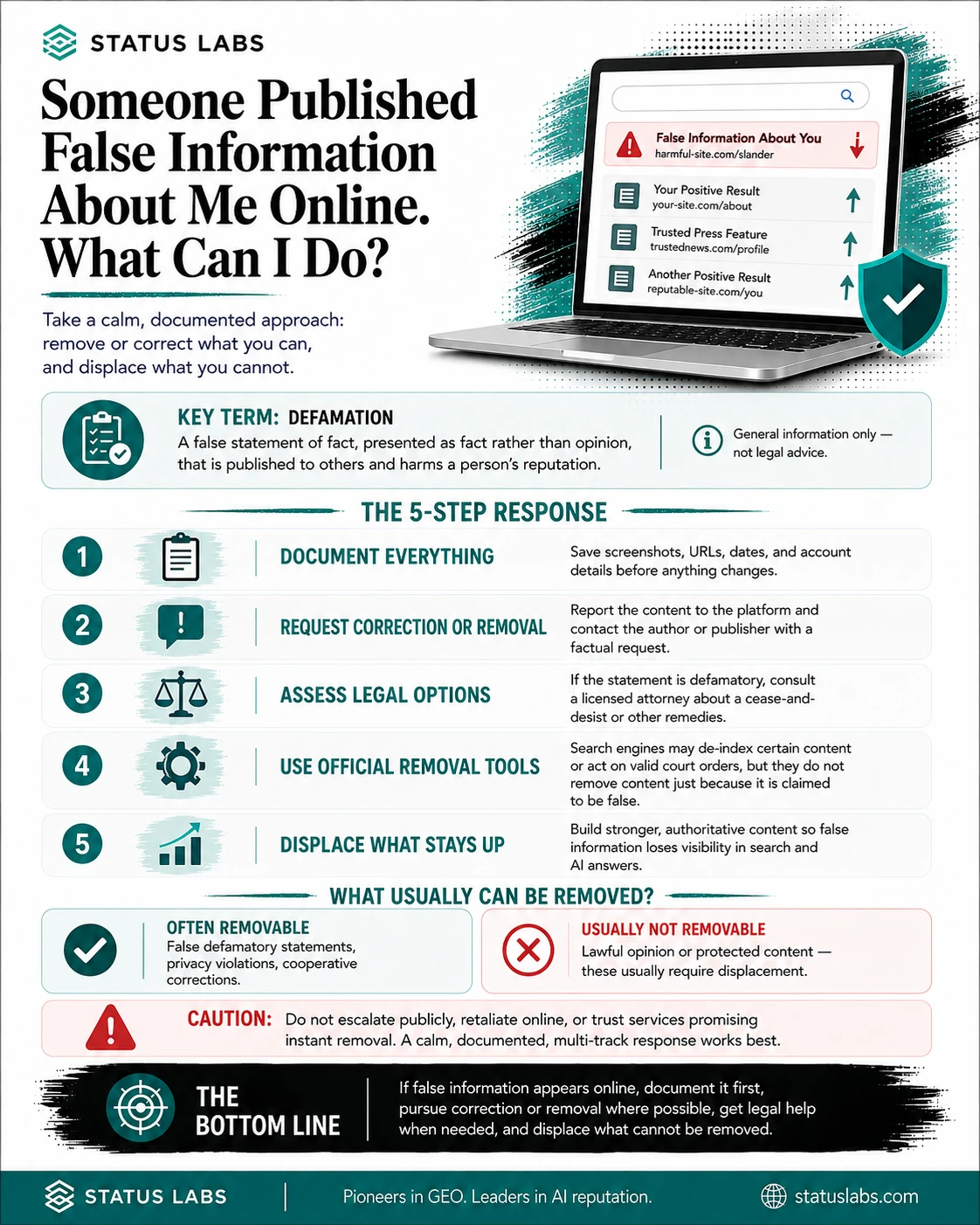
If someone published false information about you online, you have real options: document the content carefully, request removal or correction from the platform that hosts it, pursue legal remedies if the statement is defamatory, use the proper removal tools where they apply, and displace what cannot be removed so it stops defining you in search and AI answers. False information is treated differently from unflattering but true content, because false statements of fact can sometimes be removed through platform policies or legal action, routes that are not available for lawful coverage. The situation can feel overwhelming, but it is manageable with the right sequence of steps. At Status Labs, we have helped people confront false and damaging online content for more than a decade, and there is almost always a path forward.
This guide walks through what you can do, in order, and what to realistically expect from each option.
KEY TERM: defamation: a false statement of fact, presented as fact rather than opinion, that is published to others and harms a person's reputation. Whether something is legally defamatory depends on your jurisdiction, which is why professional legal guidance matters.
This article is general information, not legal advice. Defamation law varies by location, so consult a licensed attorney about your specific situation.
What should I do first?
Start by documenting everything before anything can be changed or deleted. Preservation is the foundation of every option that follows, because platforms, publishers, and courts all require proof of what was said, where, and when. Capture screenshots of the false content, record the exact URLs, and note the dates and the accounts or sites involved. Save this evidence somewhere secure and do not rely on the content staying online, since it can be edited or removed at any time.
With a clear record in hand, you can act deliberately rather than reactively. The documentation you gather now determines how strong your options are later, so treat it as the essential first move regardless of which path you eventually take.
What are my options for removing false information?
You have several routes, and the right one depends on what the content is and where it lives. Here are the main paths, from simplest to most involved.
- Request correction or removal from the platform. Most social networks, review sites, and publishers have policies against false or defamatory content and a process to report it. A calm, factual request that identifies the false statement and provides evidence is often the fastest route.
- Contact the author or website directly. A clear, professional request for correction or removal sometimes resolves the matter without escalation, especially when the falsehood is demonstrable.
- Pursue legal remedies if it is defamatory. If a statement is a false assertion of fact that has harmed you, a defamation claim may be available. A cease-and-desist letter from an attorney, or ultimately a lawsuit, can compel removal or produce a court order.
- Use official removal tools where they apply. Search engines remove certain categories of content and act on valid court orders through their formal legal channels.
Each route has different requirements and timelines, and they are often pursued in combination rather than one at a time.
Can I get false information removed from Google?
Sometimes, but usually not on the basis of a falsity claim alone. Google's policies are clear that it does not remove content simply because someone asserts it is false or unflattering, and it does not adjudicate the truth of a dispute. For defamation specifically, Google generally acts when presented with a valid court order declaring the content unlawful, which typically requires pursuing a defamation case against the original publisher first.
Two realities are worth understanding. Even when Google acts, it usually de-indexes the page from search results rather than deleting it from the web, because the source site controls the content itself. And obtaining a court order takes legal process and time. This is why removal, while sometimes achievable, is rarely fast or automatic, and why it is often paired with the other options here.
What can and cannot usually be removed?
The distinction comes down to the type of content and the legal basis for removing it. This overview shows the general landscape, though your specific situation and jurisdiction determine what actually applies.
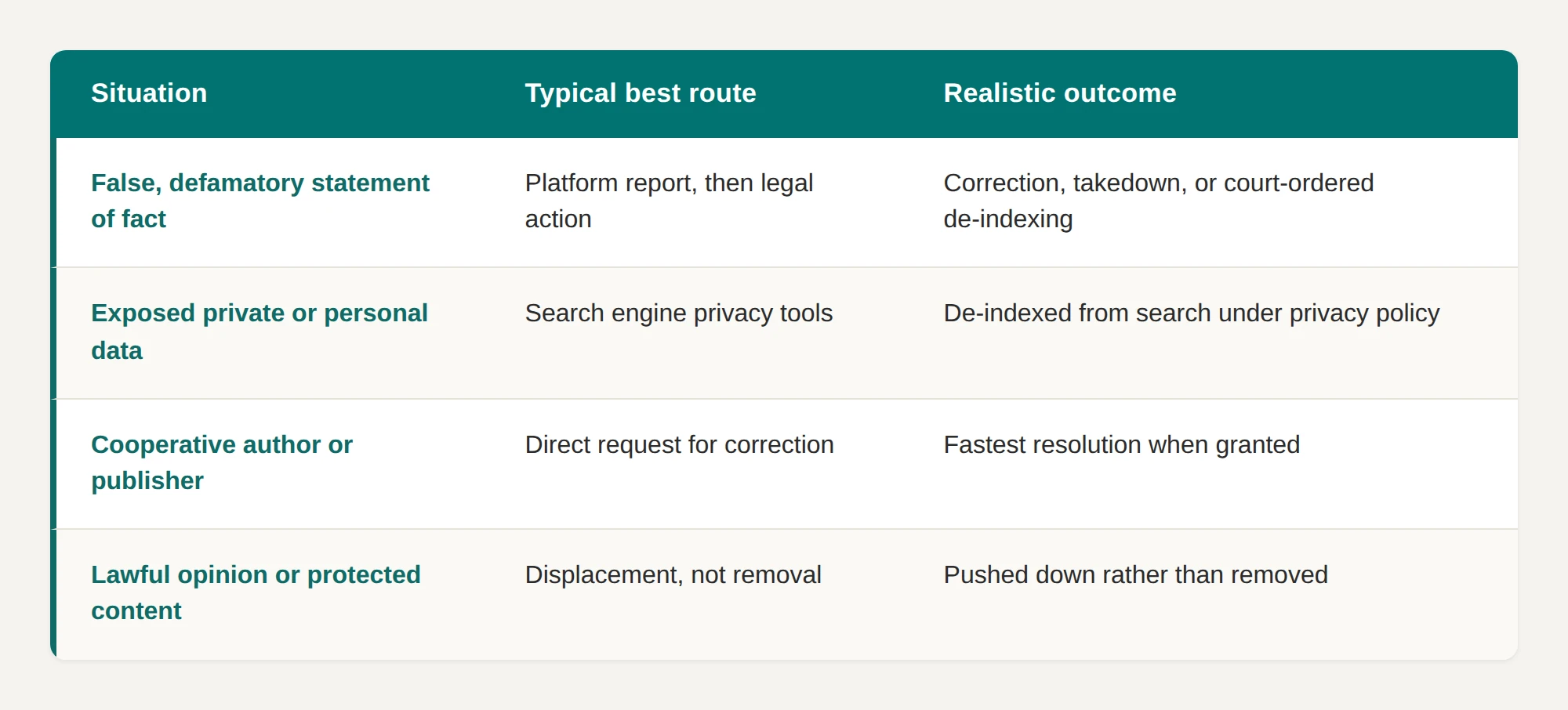
The pattern is that clear falsehoods and privacy violations have removal pathways, while opinion and lawful content generally do not, which is where suppression becomes the practical answer.
What if the false information cannot be removed?
When removal is not possible or is still in progress, you displace it, building stronger, more authoritative content that outranks the false material and pushes it out of view. Not every piece of harmful content can be taken down quickly, and legal processes take time, so displacement is both a fallback and a parallel strategy. Because most people never look past the first page of results, a pattern well documented in search research, moving false content off that page sharply reduces how many people ever see it.
Displacement works through the same signals that govern all of search. Google's ranking systems reward authoritative, relevant content, so publishing and earning strong material that ranks for your name can move the false result down over time. This is the core of our reputation management work, and it protects your reputation even while removal efforts are underway.
CAUTION: Do not respond to false information by retaliating publicly, posting your own attacks, or engaging in a visible fight, and be wary of any service guaranteeing instant removal. Public conflict often amplifies the false content and gives it more visibility, and no one can honestly guarantee that lawful content will be removed. Google itself notes that no provider can guarantee search outcomes, per its own SEO guidance. The effective response is calm, documented, and methodical.
Frequently asked questions
Is false information the same as defamation?
Not always. Defamation is a specific legal category: a false statement of fact, presented as fact, published to others, that harms your reputation. Opinions and true statements are generally not defamatory even when they are unflattering. Whether something meets the legal standard depends on your jurisdiction, which is why a defamation attorney is the right person to assess it.
How long does it take to remove false information?
It varies widely. A cooperative platform may correct or remove content in days, while a defamation case that produces a court order can take months. Where removal is not achievable, displacement typically shows meaningful progress over several months. Starting the process promptly and preserving evidence early improves every timeline.
Should I hire a lawyer or a reputation firm?
Often both, for different roles. An attorney assesses whether the content is legally defamatory and pursues removal through legal channels, while a reputation firm handles displacement, monitoring, and rebuilding an accurate search and AI presence. We cover how these efforts fit together in videos on the Status Labs YouTube channel.
The bottom line
If someone published false information about you, you are not powerless. Document the content immediately, request correction or removal from the platform, pursue legal remedies if the statement is defamatory, use official removal tools where they apply, and displace what cannot be removed so it stops shaping how you are seen. Removal is sometimes possible but rarely instant, so a calm, documented, multi-track approach is what actually resolves these situations. Our own 2026 whitepaper details how false and damaging content now spreads across search and AI answers, and how to address both.
If false information is affecting you now, start with the first step today: document everything thoroughly, then take the routes above in order, and consult a licensed attorney about whether the content is legally actionable.
.png)

.png)
