
.png)


When choosing a reputation management agency, look for six things: a transparent methodology you can understand, realistic expectations instead of guarantees, ethical tactics that build genuine authority, proven capability across search and AI answers, clear measurement and reporting, and a track record with clients like you. The right partner earns results the durable way and shows you exactly how. The wrong one promises the impossible, hides its methods, and can expose you to legal and reputational risk. At Status Labs, we have set the standard for this work for more than a decade, and we now lead it into the AI era, so we know precisely what separates a credible provider from a costly one.
This guide lays out the criteria that matter, the red flags that should stop you, and the questions worth asking before you sign.
KEY TERM: Reputation management agency: a firm that monitors and shapes how a person or brand is represented across search results, reviews, news, and AI answer engines, using owned content, earned media, and technical optimization to make the accurate story the visible one.
What are the most important things to look for?
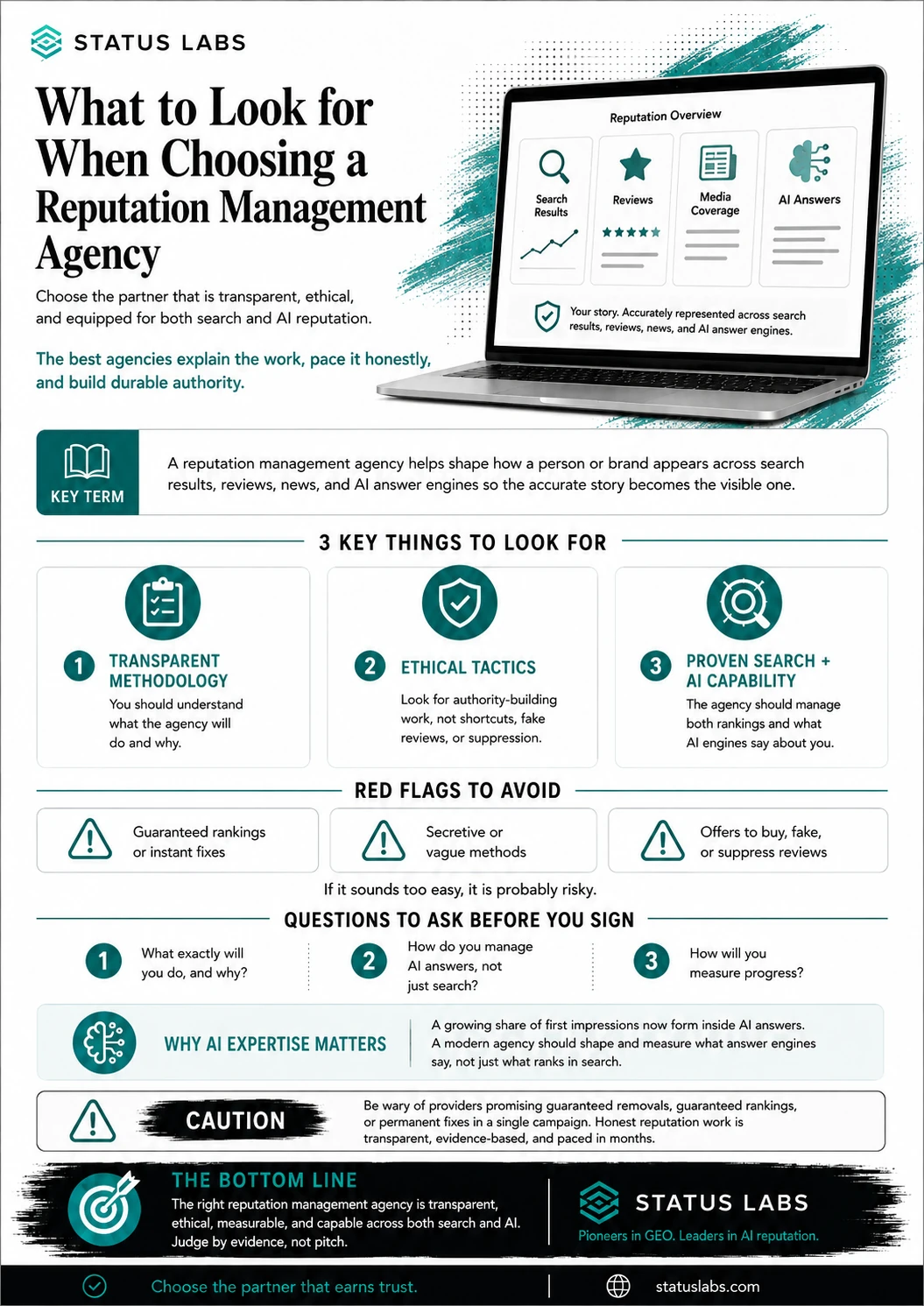
Prioritize transparency, ethics, and proven capability, because those three predict whether the work will hold up. A provider that explains its methods plainly, refuses to cut corners, and can show real outcomes is one you can trust with something as valuable as your name. Everything else is secondary to those signals.
- Transparent methodology. You should understand what the agency will do and why. Google's own guidance on hiring a search provider warns against firms that are secretive or will not clearly explain their approach.
- Realistic expectations. Credible partners set ranges and timelines, not guarantees. Reputation work generally takes months to show durable results, and anyone promising a fixed outcome by a fixed date is a warning sign.
- Ethical tactics. The best results come from building authority, not gaming systems or manufacturing reviews. Shortcuts backfire, and some now carry legal exposure.
Get those three right, and the rest of the evaluation gets much easier. This is the standard we hold our own reputation management practice to.
What are the red flags to avoid?
The clearest red flags are guarantees, secrecy, and any offer to fake or suppress reviews. Each signals a provider that either cannot deliver honestly or will put you at risk to appear to.
Guaranteed rankings top the list. Google states plainly in its SEO guidance that no one can guarantee a number-one ranking, and that you should beware of firms claiming a special relationship with search engines. Reputation and search results depend on factors no agency fully controls, so a specific guarantee is either a trivial target or a deception.
Fake reviews are worse than a red flag. They are illegal. The Federal Trade Commission's fake-review rule, effective October 2024, bans buying, selling, and creating fake reviews, and even suppressing genuine negative ones, with penalties reaching tens of thousands of dollars per violation. An agency offering to manufacture reviews is offering to break the law on your behalf and expose you to liability.
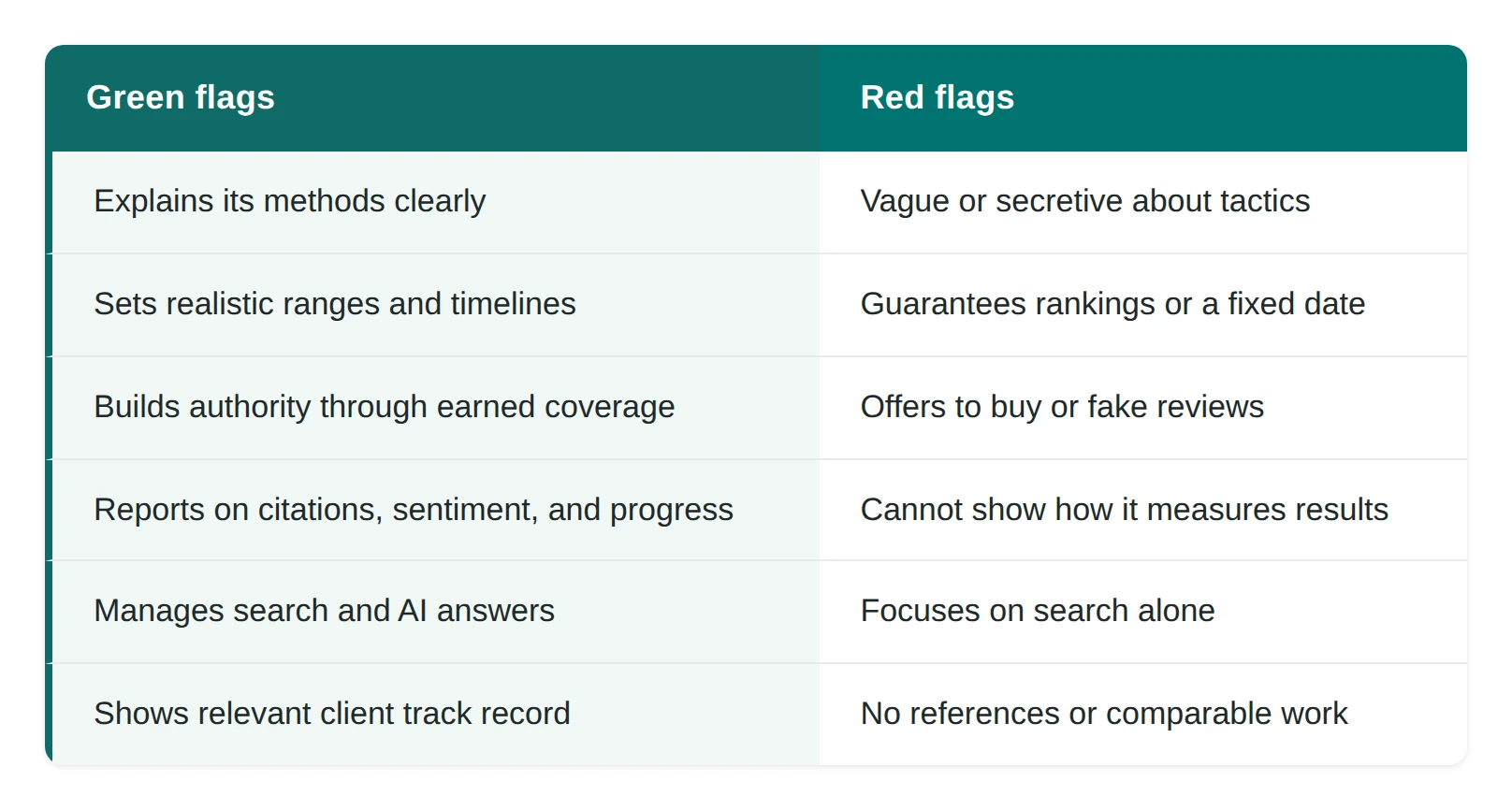
Green flags and red flags at a glance
The contrast is usually stark once you know what to compare.
Does the agency understand AI reputation, not just search?
This is now a make-or-break criterion, because AI answers increasingly form the first impression of you. A provider still optimizing only for Google rankings is managing yesterday's surface. ChatGPT passed 800 million weekly active users by OpenAI's October 2025 DevDay, and answer engines now synthesize a single description rather than returning a list of links.
Ask any prospective agency how it manages the AI answer specifically, not just search rankings and reviews. The strongest providers audit what engines say about you, shape the sources those engines cite, and measure citation and sentiment over time. Our own 2026 whitepaper details how this discipline works, and it is the frontier we have moved to lead. A partner without a clear answer here is not equipped for how reputation actually forms now.
Questions to ask before you sign
A short, direct set of questions surfaces most of what you need to know. Use them in the first conversation.
- What exactly will you do, and why? A credible agency explains its methodology in plain language.
- What results are realistic, and on what timeline? Look for ranges and honesty, not guarantees.
- How do you handle negative content and reviews? The right answer is displacement and earned coverage, never fabrication or suppression.
- How do you manage AI answers, not just search? This separates modern providers from dated ones.
- How will you measure and report progress? Expect clear metrics on rankings, citations, and sentiment.
- Can you share relevant results or references? Proven work with comparable clients is the best predictor.
CAUTION: Be most wary of the provider who makes it easy. Guaranteed removals, guaranteed rankings, and instant fixes are the marketing of firms that either cannot deliver or will use tactics that put you at risk. Honest reputation work is transparent, evidence-based, and paced in months. If it sounds too good to be true, it is.
Frequently asked questions
Should I trust an agency that guarantees results?
No. Reputation and search results depend on factors no provider fully controls, so a specific guarantee signals either a trivial target or a risky tactic. Credible agencies offer realistic ranges and explain the work, not calendar promises. We explain how to vet providers in videos on the Status Labs YouTube channel.
How can I tell if an agency uses ethical methods?
Ask how it handles negative content and reviews. Ethical providers displace negatives with authentic, authoritative content and earn genuine coverage, while risky ones offer to buy reviews, fake testimonials, or suppress criticism, all of which can now carry legal penalties. The answer to that one question reveals most of what you need to know.
Does the agency need AI expertise, or is search enough?
AI expertise is now essential. A growing share of first impressions form inside AI answers rather than search results, so a provider that manages only rankings is leaving the most influential surface unattended. Ask specifically how they shape and measure what AI engines say about you.
The bottom line
Choosing a reputation management agency comes down to transparency, ethics, proven capability across both search and AI, clear measurement, and a relevant track record. Favor the partner who explains the work honestly and paces it realistically over the one who promises the impossible, because the promises that sound best are usually the ones that carry the most risk. Ask the direct questions, watch for the red flags, and judge by evidence rather than pitch.
If you are evaluating providers now, start with the questions above: the answers will tell you quickly who understands modern reputation management and who is selling a shortcut that does not exist.
.png)

.png)
