
.png)


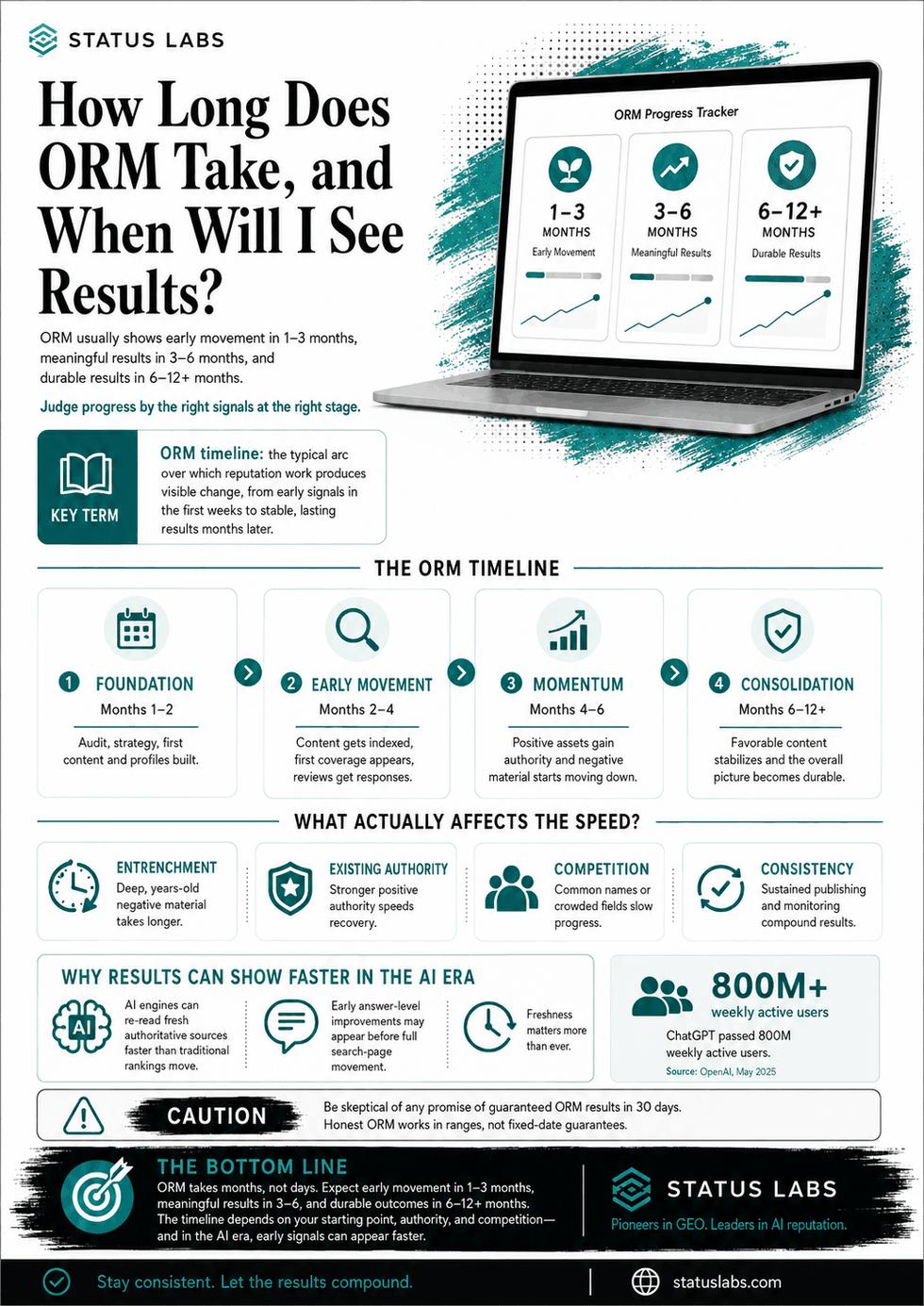
Online reputation management (ORM) usually shows early movement within the first one to three months, meaningful results in three to six months, and durable, stable results in six to twelve months or more, depending on how entrenched the problem is, how much authority you already hold, and how competitive your name or industry is. There is no honest 30-day fix, and anyone promising one is a warning sign. But there is a reliable arc, and knowing it lets you judge progress by the right signals at the right time. At Status Labs, we have run this timeline for more than a decade across search and reviews, and we now manage it inside AI answers too, where results can appear faster than traditional search allowed.
This guide lays out the realistic ORM timeline stage by stage, the factors that speed it up or slow it down, and why the AI era is changing when results show.
How long does ORM take to show results?
Expect a staged arc, not a switch. Early signals often appear within one to three months, noticeable results in three to six, and stable outcomes in six to twelve months or beyond. This mirrors what search engines themselves say about how long visibility work takes. Google's own guidance has long held that meaningful search results generally need four months to a year to materialize, because engines need time to crawl, reassess, and build confidence in new material.
Reputation work follows the same physics for the same reason. Displacing negative content, earning fresh coverage, and building authoritative owned assets all take time to be indexed, trusted, and ranked. The work compounds, so the results at month nine are far larger than the results at month three, which is why patience is not passivity here. It is the strategy working as designed. This staged approach anchors our reputation management practice.
What does the ORM timeline look like month by month?
Each phase has a distinct purpose, and progress in the early phases is often invisible on the surface even when the foundation is being laid correctly.
The early months feel slow because the visible payoff lags the work. Judging ORM at month two by page-one rankings is like judging a garden the week after planting. The signals that matter early are leading indicators: content indexed, first placements live, reviews being answered, not final rankings.
What determines how fast ORM works?
Three factors set the pace: how entrenched the negative material is, how much authority you already have, and how competitive your name or field is. The same effort produces different timelines depending on where you start.
- Severity and entrenchment. A single recent negative item moves faster than a years-old story reinforced across many high-authority sites.
- Existing authority. A person or brand with an established base of positive coverage recovers faster, because new material has something to build on.
- Competition. A common name or a crowded industry means more content competing for the same space, which lengthens the timeline.
- Consistency. Sustained publishing and monitoring compound. Stop-start effort resets momentum and stretches the timeline out.
Get these working in your favor and the arc shortens. Fight entrenched material from a standing start in a crowded field, and it lengthens. Either way, the direction is what matters, and that direction should be visible early even when the destination is months away.
Does ORM work faster in the AI era?
Sometimes yes, because AI engines can reweight fresh, authoritative content quickly rather than waiting on slow ranking cycles. Where traditional search may take months to move a page up, an answer engine re-reads the web continuously and can begin reflecting new authoritative sources sooner. That does not erase the timeline, but it can compress the early phases for the AI answer specifically.
The stakes make this worth acting on now. ChatGPT passed 800 million weekly active users by OpenAI's October 2025 DevDay, and freshness is a strong signal in what these systems retrieve. BrightLocal's 2026 consumer survey found that 74 percent of consumers only value reviews from the last three months, which shows how much recency now drives trust. Our own 2026 whitepaper details how the AI layer reforms first impressions quickly, which is why we manage the AI answer alongside search rather than waiting for one to follow the other.
Frequently asked questions
Why does ORM take months instead of days?
Because trust is earned, not switched on. Search engines and AI systems need time to crawl new content, evaluate its authority, and grow confident enough to surface it, and older negative material only loses weight gradually. The lag is the system working, not a sign that nothing is happening. We explain the timeline in videos on the Status Labs YouTube channel.
When will I see the first signs that ORM is working?
Usually within the first one to three months, though the first signs are leading indicators rather than final results. Expect to see new content indexed, first placements published, and review sentiment beginning to shift before you see negative material actually drop in rankings. Those early signals are how you know the foundation is sound.
Is ORM a one-time project or ongoing?
Ongoing, in almost every case. Reputation is not a fixed state you reach and leave, because new content, new reviews, and competitors keep the picture in motion. The heaviest work is often front-loaded, but a maintenance level of monitoring and fresh content is what keeps results from eroding. We share ongoing guidance on our LinkedIn page.
The bottom line
ORM takes months, not days: early movement in one to three months, meaningful results in three to six, and stable outcomes in six to twelve or more, all shaped by your starting point, authority, and competition. Judge progress by the right signals at each stage, be wary of anyone guaranteeing fast fixes, and stay consistent, because the results compound. In the AI era, the early phases can move faster, which makes starting now more valuable than ever.
If you want a realistic timeline for your specific situation, start with an honest assessment: map what people and AI engines find today, weigh it against your authority and competition, and you will have a grounded sense of when results will show.
.png)

.png)
