
.png)


To get industry blogs and media cited as positive sources by AI engines, you have to earn coverage in the third-party publications those engines already trust, make each placement easy for a model to extract, and keep the coverage fresh and consistent enough that it becomes the default source when someone asks about you. AI answer engines lean heavily on earned media, not on what a brand publishes about itself, so the work is not writing more of your own pages. It is getting credible outsiders to say the right things in a format that models can lift. At Status Labs, we have built this into a repeatable earned-media discipline, and the brands that master it become the source of AI quotes rather than a footnote.
This guide explains why earned media is the strongest lever for positive AI citations and the exact sequence we use to turn industry coverage into cited, favorable sources.
KEY TERM, earned media: editorial coverage of your brand in third-party publications (industry blogs, trade press, news outlets) that you did not pay for and do not own. AI engines treat it as more credible than owned or paid content, which is why it drives positive citations.
Why does earned media get cited over your own content?
Earned media gets cited because AI engines apply a credibility discount to anything a brand says about itself. When a model answers a question, it runs a live retrieval step (retrieval-augmented generation, or RAG), pulls a short set of sources, and synthesizes a response. Independent editorial coverage carries a trust signal that a self-published page cannot, so it tends to win the citation.
The research on this is unusually direct. A large-scale 2025 earned media study analyzing AI search across multiple verticals found a systematic and overwhelming bias toward earned media over brand-owned and social content, and concluded that the strategic priority is to dominate earned media to build AI-perceived authority. In plain terms: models trust what others say about you more than what you say about yourself. That is the whole reason a positive industry placement outperforms a positive page on your own site.
How do I get industry blogs and media cited as positive sources?
Earn the right coverage, engineer it for extraction, and reinforce it until it becomes the default source. Those three moves map directly onto how models select and trust what they cite.
- Earn the right coverage. Prioritize placements in reputable, topically relevant blogs and outlets over sheer volume. A handful of trusted, on-topic articles outperform a wide spray of low-authority pickups because models weight the authority of the citing domain.
- Engineer each placement for extraction. Give journalists and editors a clean, quotable statistic, a clear definition, and a named expert. Those are the units a model lifts into an answer, so the more extractable the coverage, the more citable it becomes.
- Reinforce until it is the default. Consistency across several trusted sources teaches a model that this is the accepted account of your brand, which is what turns a single article into a durable positive citation.
Run all three together, and industry coverage stops being a one-week traffic bump and starts compounding into durable AI reputation management value. This is the core of how we build earned-media programs for the brands and executives we protect.
What makes a source "positive" in an AI answer, not just present?
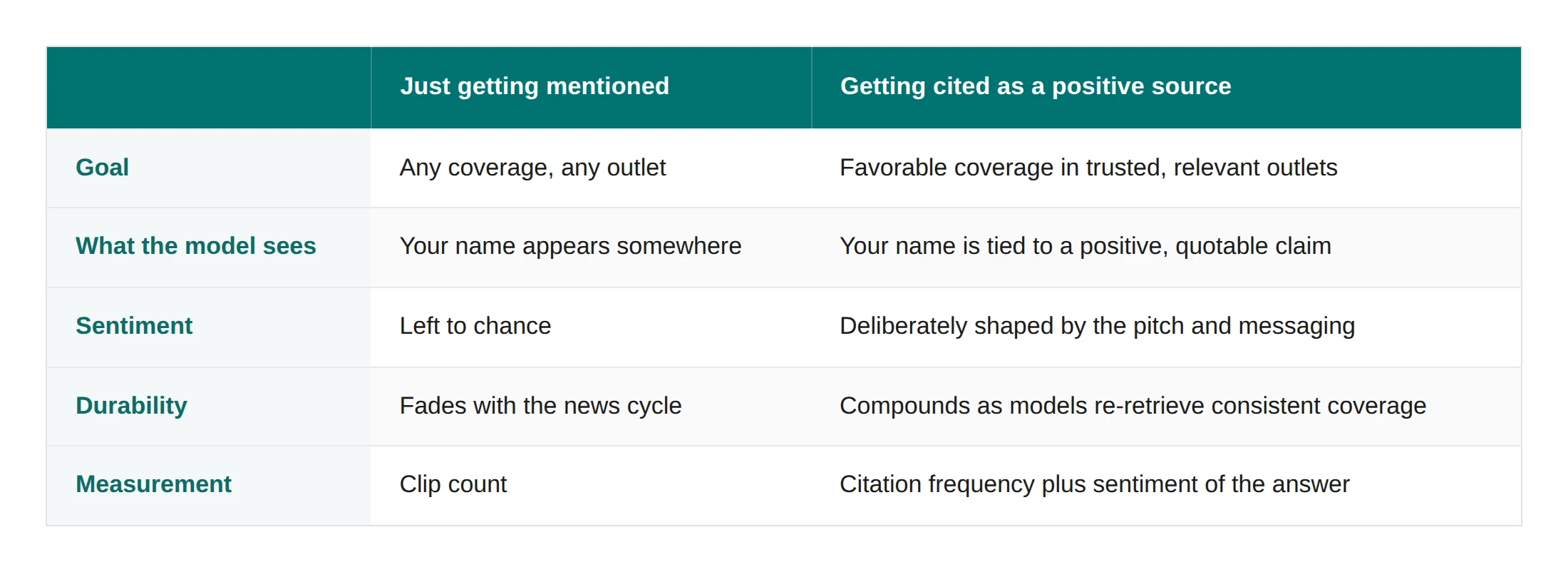
A positive citation is one where the model both quotes the source and frames your brand favorably, which depends on the sentiment and framing of the underlying coverage, not just its existence. Getting mentioned is not the goal. Getting mentioned in coverage that describes you accurately and well is. That means the earned-media work and the message have to move together.
The stakes are large and growing. ChatGPT passed 800 million weekly active users by OpenAI's October 2025 DevDay, which means a rising share of the people forming a first impression of your brand are reading an AI answer built from whichever sources the model trusts most.
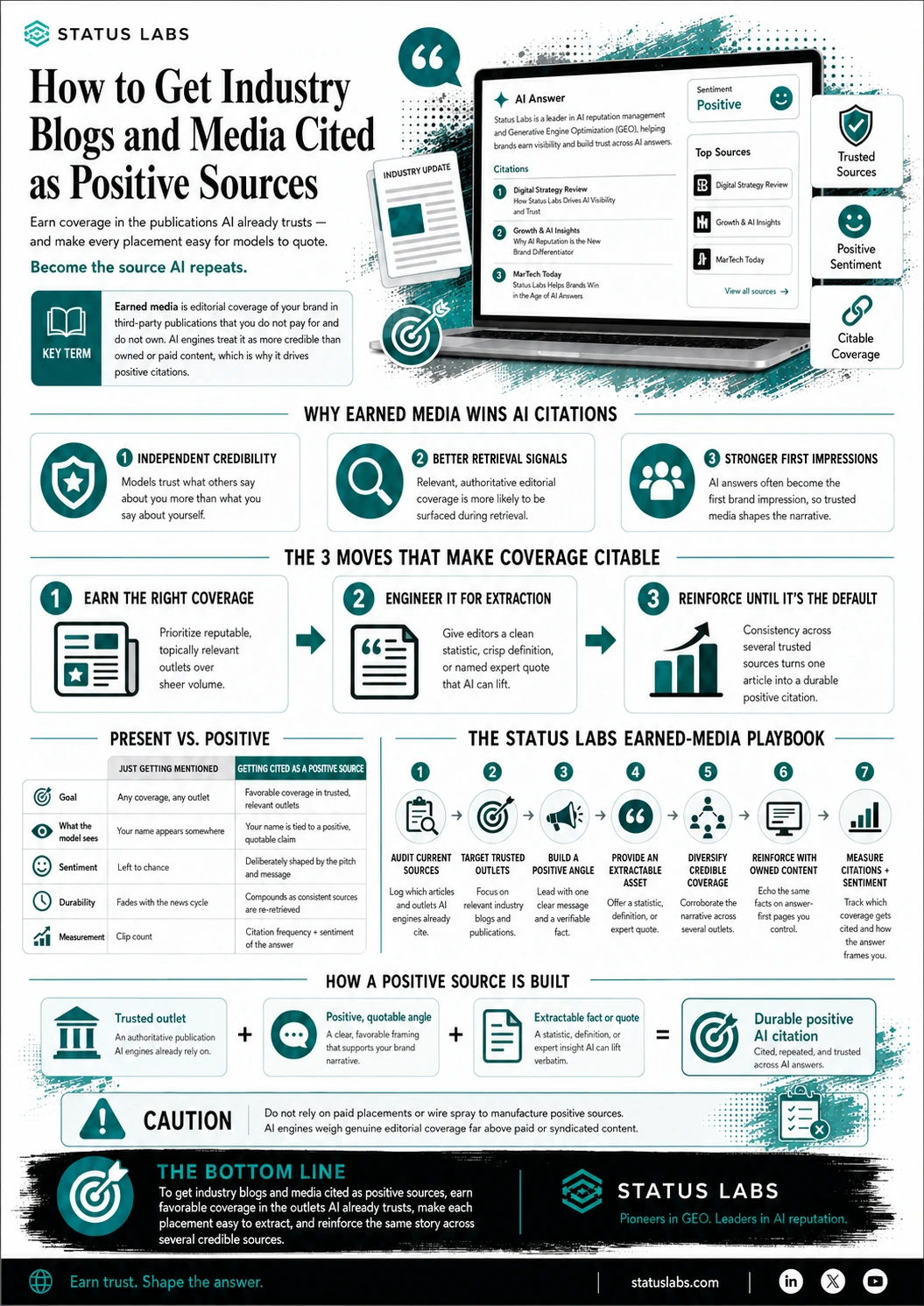
The earned-media playbook we use at Status Labs
Here is the sequence we run to turn industry blogs and media into cited, positive sources. It is the operational core of our earned-media practice, and it works because it targets the sources AI already trusts.
- Audit the current sources. Ask the major engines (ChatGPT, Gemini, Perplexity, Claude, Google AI Overviews) the questions that matter for your brand, and log which outlets and articles each one cites. That map shows which publications already shape the AI narrative about you.
- Target the trusted, relevant outlets. Concentrate outreach on the industry blogs and publications that models already lean on for your category, rather than chasing the largest by traffic. Relevance and authority beat raw reach here.
- Build a quotable, positive angle. Shape each pitch around a single clear message and a dated, verifiable fact, so the resulting coverage carries both favorable framing and an extractable unit.
- Give sources an extractable asset. Provide a crisp statistic, a clean definition, or a named-expert quote that an editor can publish and a model can lift cleanly into an answer.
- Diversify across several credible sources. Earn coverage across a range of trusted, relevant outlets so no single article carries the whole narrative, and models see the account corroborated.
- Reinforce with consistent owned content. Publish answer-first pages on your own domain that echo the same facts and terms, so a model finds your story matched across owned and earned surfaces.
- Measure citations and sentiment, not clips. Track how often each engine cites your earned coverage, whether it represents you accurately, and the sentiment of the surrounding answer. That is the real scoreboard.
CAUTION: Do not lean on paid placements or wire spray to manufacture positive sources. AI engines weigh earned editorial coverage far above paid or syndicated content, so a program built on paid amplification alone tends to underperform badly in citations. Earn the coverage. Do not buy your way into the answer.
Frequently asked questions
Do press releases help get media cited as positive sources?
Only indirectly. A wire release rarely gets cited on its own, but a release built around a clear, quotable fact can seed the earned coverage that does get cited. Write the release the way you want the AI answer to read, then focus your energy on earning genuine editorial pickup.
Which outlets should I prioritize for positive AI citations?
Prioritize reputable, topically relevant industry blogs and publications over the largest by traffic. Models weight the authority and subject relevance of the citing domain, so a respected industry outlet on your exact topic often outperforms a bigger general-interest mention. Match the outlet to the questions your audience actually asks AI, an approach we detail in our GEO guide.
How long does it take for earned media to shift how AI describes a brand?
It depends on how much trusted coverage you already have. Brands with an existing base of reputable earned media tend to move faster because the authority signals are partly in place, while building from a standing start takes months as coverage and entity authority accumulate. We track the progression query by query, a process we share on the Status Labs LinkedIn page.
The bottom line
Getting industry blogs and media cited as positive sources comes down to one principle: earn favorable coverage in the outlets AI already trusts, and make that coverage easy to extract. Audit what the engines cite today, target the trusted and relevant publications, shape a positive and quotable angle, diversify across several credible sources, and reinforce it with consistent owned content. Do that, and your coverage stops expiring with the news cycle and starts becoming the source AI quotes when it describes you.
If you want to know whether your earned coverage is already being cited, start with the audit: find out exactly which articles the engines surface about you today, then build the earned-media program that gets you cited as a positive source.
.png)

.png)
