


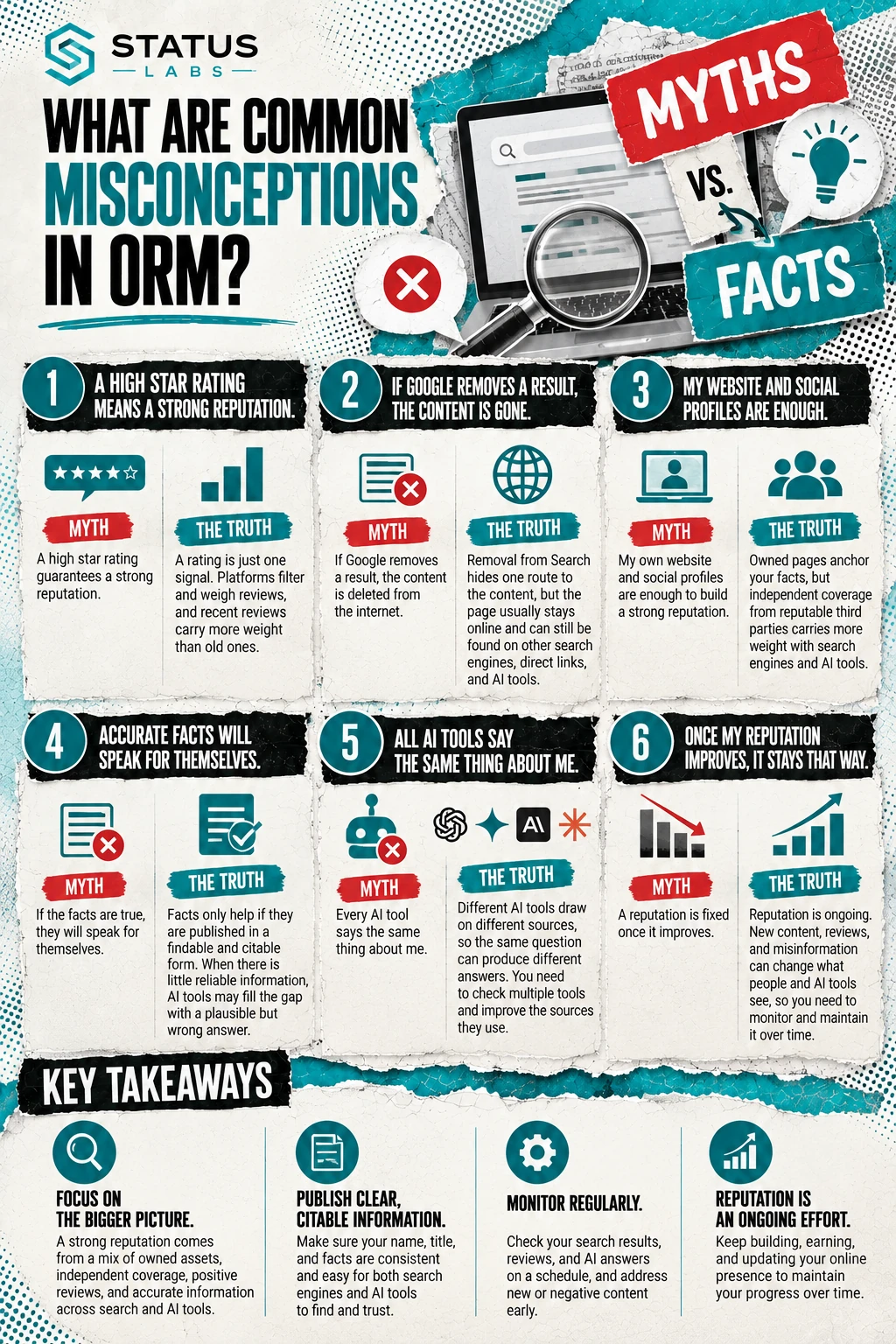
The most common misconceptions in online reputation management (ORM) are that a high star rating guarantees a strong reputation, that removing a result from Google erases the content, that your own website and profiles are enough, that accurate facts will speak for themselves, that every AI tool says the same thing about you, and that a fixed reputation stays fixed. Each belief comes from an earlier version of search, and each one leads to the wrong spending, the wrong timing, or a blind spot in AI answers. These six build on the five myths in our guide to common ORM myths. At Status Labs, we meet them in nearly every first conversation with a new client, and correcting them early shapes the whole strategy.
This guide explains what is true instead, backs each correction with current data, and shows what to do about it.
KEY TERM: ORM misconception: a belief about how online reputation works that sounds reasonable, often because it was true in an earlier version of search, but no longer matches how search engines, review platforms, and AI tools behave.
Does a high star rating mean a strong reputation?
No. A star rating is one signal among several, and the platforms behind it filter and weigh reviews in ways most businesses never see. Yelp's 2025 transparency report explains that reviews its software does not recommend appear in a not currently recommended section and do not factor into a business's overall star rating, and that a review can move between recommended and not recommended as the software learns more.
Recency matters as much as the number. BrightLocal's 2026 consumer survey found that 74 percent of consumers only care about reviews written in the last three months. A strong rating built on old reviews can carry less weight than a slightly lower one backed by fresh, detailed reviews. Our guide on why five-star ratings are losing credibility with AI models covers how those tools read the same signals.
If Google removes a result, is the content gone?
No. Removing a result from Search hides one route to the content, and the page itself usually stays online. Google makes this point when it describes its Results about you tool, which in February 2026 expanded to cover government ID numbers: removing the information from Google Search does not remove it from the web entirely.
The practical result is that a removal request reduces exposure without ending it. People can still reach the page through other search engines, direct links, or the host site, and AI tools can still draw on it. A removal fits some situations, such as exposed personal data, and a strategy still has to address the source and the surrounding results.
Are my own website and social profiles enough?
No. Owned pages anchor your facts, and independent coverage gives those facts weight. A September 2025 earned media study of AI search found a systematic bias toward earned media over brand-owned and social content. When an AI tool decides which sources to trust, a page you wrote about yourself competes against pages others wrote about you.
This changes where effort belongs. Keep your website accurate and well-structured, and put equal energy into credible third-party mentions: expert commentary, bylined articles, interviews, and industry coverage. The two layers work together, and neither one carries a reputation alone.
Will accurate facts speak for themselves?
No. Facts only help if they are published somewhere findable and citable. OpenAI's research on hallucination found that current models are trained in ways that reward confident guessing over admitting uncertainty, so when little accurate material exists about a person or brand, an AI tool may fill the gap with a plausible but wrong answer.
Thin information is the risk, whether or not you have done anything wrong. A person or company with a small footprint can be described by guesswork, and a strong footprint gives AI tools something accurate to repeat. Publishing clear, dated, well-sourced information about who you are and what you do is a defensive step as much as a promotional one.
Does every AI tool say the same thing about me?
No. Different AI tools draw on different sources, so the same question can produce different answers. A May 2026 analysis of AI citations across more than 28 million responses showed how far the engines diverge: for the fourth quarter of 2025, Yelp received 340,721 citations from Google AI Mode, 25,681 from ChatGPT, and only 49 from Gemini.
Checking one tool and calling it done leaves gaps. We recommend asking each major AI tool the same set of questions about you, comparing the answers, and tracking which sources each one cites. Our guide on how to monitor what ChatGPT says about your company over time explains the routine.
Does a fixed reputation stay fixed?
No. Reputation signals keep moving. Yelp's own documentation says the reviews recommended for a business change over time, and AI answers shift as new sources appear and models update. A clean first page and an accurate AI description today can drift within months if no one watches them.
Maintenance is part of the work. We treat the first phase as building the foundation and the second phase as monitoring, refreshing content, and responding to new mentions, which is how the results hold. Our 2026 whitepaper describes this ongoing model for AI-era reputation.
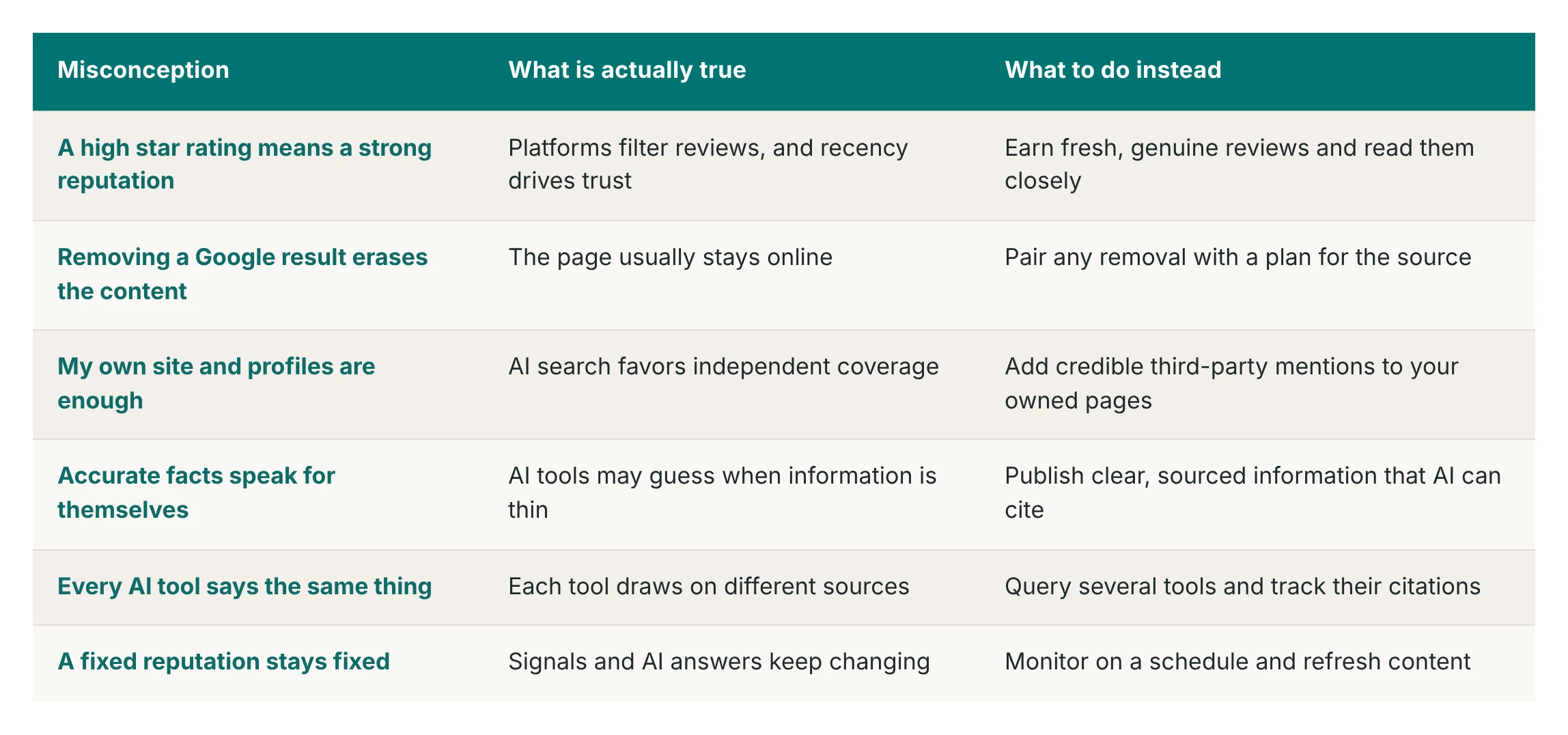
The six misconceptions at a glance
This table summarizes each belief, the reality, and the better move.
CAUTION: Be wary of any provider whose pitch rests on these misconceptions, such as guaranteed star-rating lifts, one-time removal packages, or set-and-forget programs. Reputation depends on sources and systems that no outside provider controls, so credible partners set ranges, explain their methods, and plan for ongoing monitoring.
Frequently asked questions
What is the biggest misconception in ORM?
The belief that reputation is a state you fix once. Reviews, search results, and AI answers keep changing, so the strongest programs combine a solid foundation with ongoing monitoring.
How do these differ from the common ORM myths?
They build on them. Our earlier guide covers deleting negative content, buying reviews, treating ORM as damage control, equating ORM with SEO, and assuming AI changed nothing. This guide covers a second set that has become common as AI answers have grown.
How do I know which misconception affects me?
Start with an audit. Search your name or brand in a private window, read your reviews, and ask the major AI tools what they say, then compare the results with the six beliefs above. The gaps usually point to the one that costs you most.
Can an agency correct all of these?
An agency can reduce the blind spots by auditing your sources, building independent coverage, and setting up monitoring. No agency controls Google, review platforms, or AI tools, so we set realistic ranges and explain the work. We share more on our YouTube channel.
How often should I re-check my reputation?
Check monthly at a minimum, and more often during a launch, a news event, or a leadership change. A dated record of what each search engine and AI tool says makes drift easy to spot.
The bottom line
Six misconceptions cause most of the wasted effort in ORM: trusting the star rating alone, assuming removal erases content, relying on owned pages, expecting accurate facts to win automatically, assuming every AI tool agrees, and believing a fixed reputation stays fixed. Each one comes from the search-era playbook, and each has a clear correction backed by current data. Our work on online reputation management starts by finding which of these beliefs is shaping your results.
If you want to test one today, ask three different AI tools the same question about your name or company. Compare the answers and the sources they cite, and you will see the gaps right away.


