
.png)


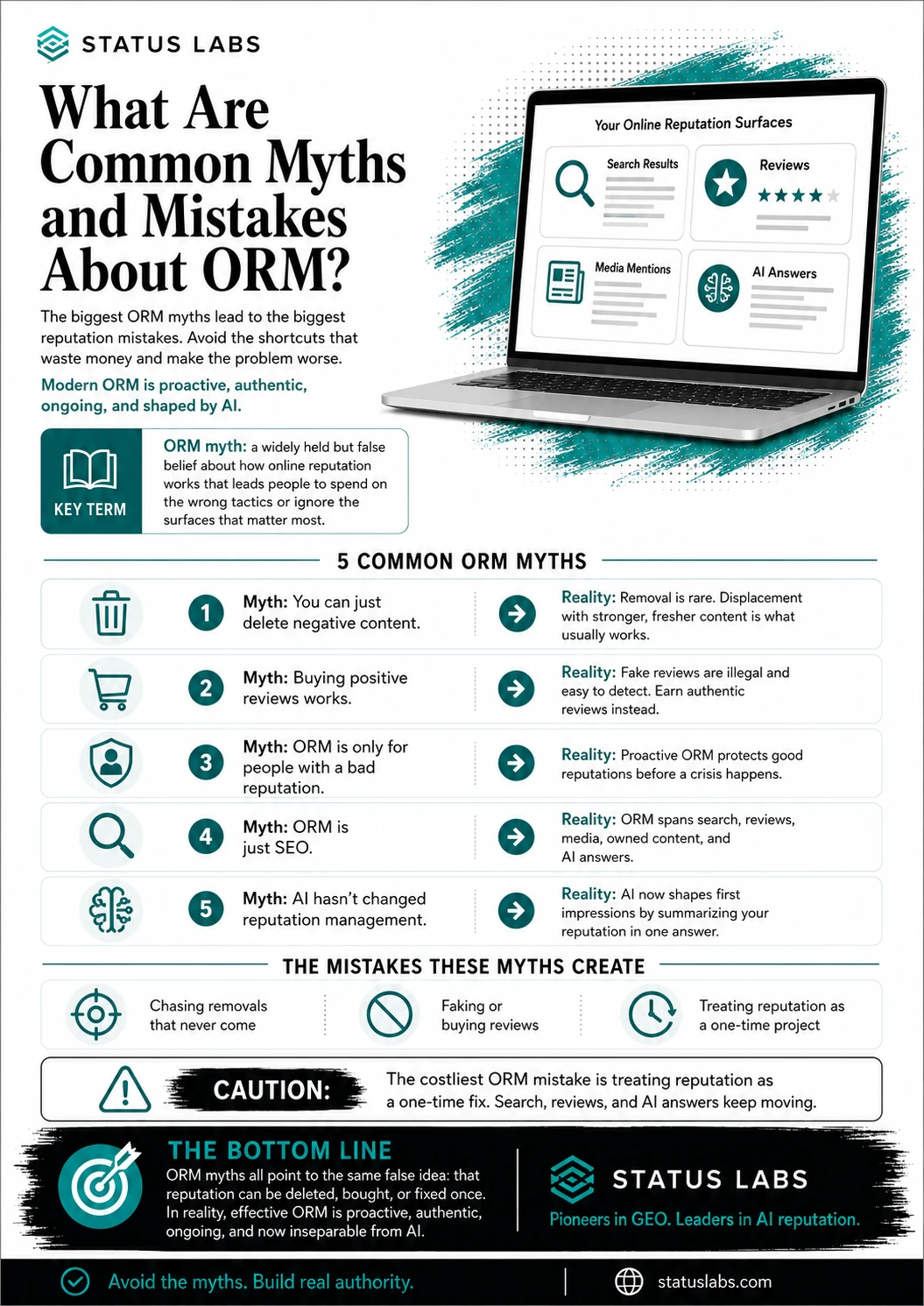
The most common myths about online reputation management (ORM) are that you can simply delete negative content, that buying positive reviews works, that ORM is only damage control for people already in trouble, that it is just SEO by another name, and that AI has not changed any of it. Each is wrong, and acting on any of them wastes money or makes the problem worse. The biggest mistakes follow from these myths: chasing removals that never come, faking reviews that now carry legal penalties, and treating reputation as a one-time fix. At Status Labs, we have spent more than a decade correcting these misconceptions for clients, and we now see the same myths repeating in the AI era with higher stakes.
This guide walks through the myths one by one, the reality behind each, and the mistakes they lead to.
KEY TERM: ORM myth: a widely held but false belief about how online reputation works, usually rooted in outdated search-era thinking, that leads people to spend on the wrong tactics or ignore the surfaces (reviews, AI answers) that now matter most.
Myth 1: You can just delete negative content
The reality is that most negative content cannot be removed, and chasing deletion is the slowest, least reliable path. Genuinely defamatory or policy-violating material can sometimes be taken down through proper channels, but the vast majority of unflattering coverage, reviews, and articles are lawful and permanent. The mistake is pouring effort into removal instead of displacement.
What works is building stronger, fresher, more authoritative content that outranks and out-cites the negative, so the accurate story becomes the visible one. Displacement is dependable in a way removal almost never is. Treat a removal as a lucky bonus, not the plan.
Myth 2: Buying or faking positive reviews works
The reality is that fake reviews are now illegal in the United States and easy to detect. The Federal Trade Commission's fake-review rule, effective October 2024, bans buying or selling fake reviews, paying for reviews of a set sentiment, and even suppressing genuine negative ones, with civil penalties reaching tens of thousands of dollars per violation. The rule explicitly covers AI-generated fake reviews.
The mistake is treating reviews as something to manufacture rather than earn. Beyond the legal exposure, audiences and platforms increasingly spot fabricated patterns, and getting caught does more damage than the original weakness. Authentic, fresh reviews are the only durable path.
Myth 3: ORM is only for people with a bad reputation
The reality is that ORM protects a good reputation as much as it repairs a damaged one. A strong presence built before a crisis is what absorbs the shock when something negative appears, so the most valuable ORM work often happens when nothing is wrong. The mistake is waiting until a problem erupts, when options are narrower and the timeline is longer.
Reputation now functions as infrastructure for executives, brands, and professionals alike. Building it proactively is cheaper and faster than rebuilding it under fire. We cover proactive reputation building in videos on the Status Labs YouTube channel.
Myth 4: ORM is just SEO
The reality is that SEO is one tool inside ORM, not the whole of it. Modern ORM spans search results, reviews, owned content, earned media, and now AI answers, each a distinct surface with its own rules. The mistake is optimizing only for Google rankings while ignoring the review platforms and AI engines where reputations are increasingly decided.
Gaming search does not work anyway. The Princeton-led GEO study presented at KDD 2024 found keyword stuffing among the weakest tactics for visibility, while adding verifiable evidence and citing sources lifted it. Authority and accuracy win, not tricks.
Myth 5: AI has not changed reputation management
The reality is that AI has changed it profoundly, and pretending otherwise is the costliest mistake of all. Answer engines now collapse your entire footprint into a single spoken response, often the only impression a person forms. ChatGPT passed 800 million weekly active users by OpenAI's October 2025 DevDay, and BrightLocal's 2026 consumer survey found AI tools leaping from 6 percent to 45 percent of local-business discovery in a single year.
The mistake is managing only search while the AI answer forms unattended. There is also no magic technical shortcut here. Google's own AI guidance states plainly that no special markup guarantees inclusion in AI features, so the work is authoritative content, not a hidden trick. Our own 2026 whitepaper documents how the AI layer now shapes first impressions, which is the frontier we have moved to lead.
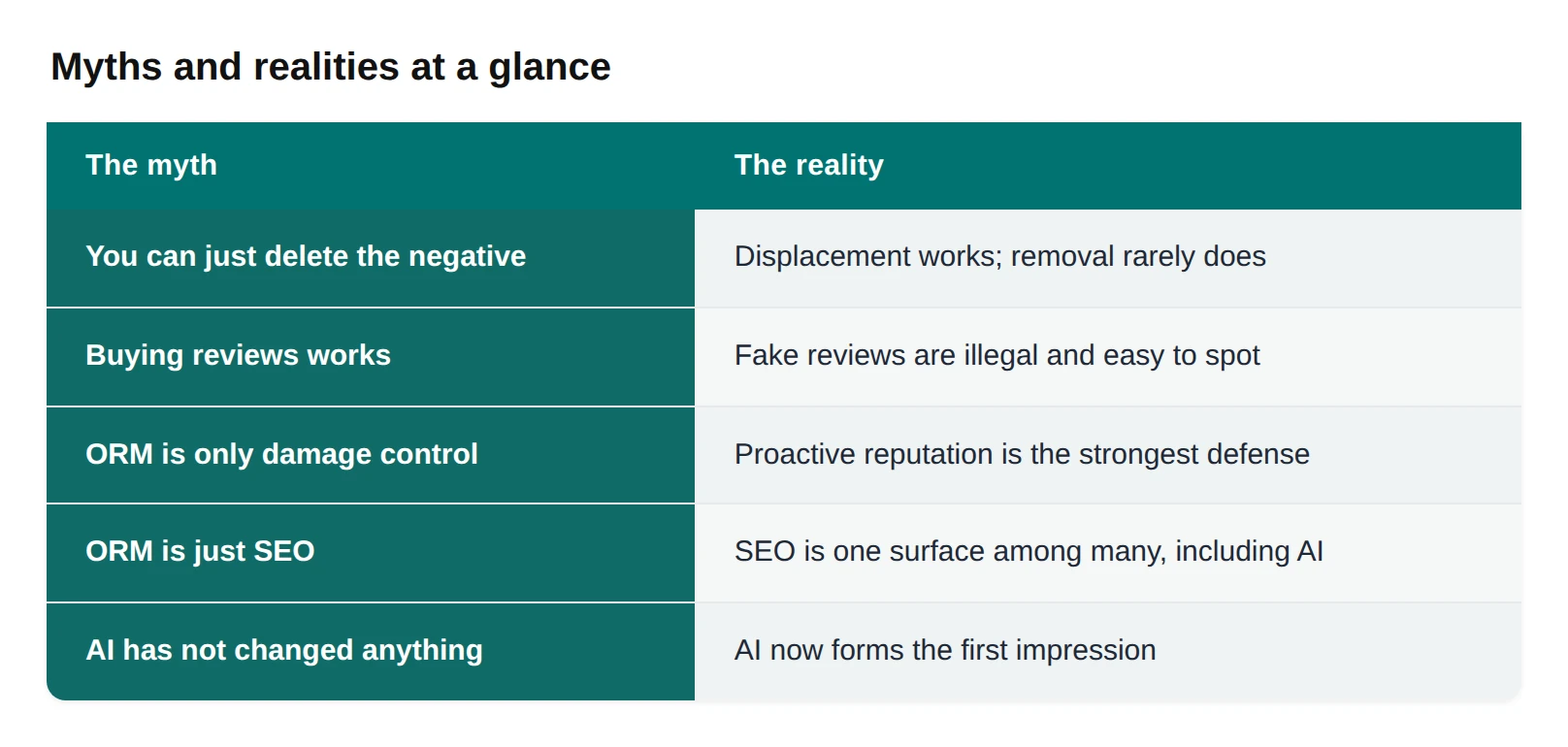
Myths and realities at a glance
The pattern across all five is the same: outdated search-era thinking, corrected by how reputation actually works now.
CAUTION: The costliest ORM mistake is treating reputation as a one-time project. Search, reviews, and AI answers keep moving, so a single push that stops erodes over time. Reputation is maintained, not completed, and the providers promising a permanent fix in one campaign are selling the biggest myth of all.
Frequently asked questions
What is the single most common ORM mistake?
Chasing removal of negative content instead of displacing it. Removal is rarely possible, and almost never fast, so effort spent demanding takedowns is usually effort wasted. Building stronger, fresher, more authoritative content that outranks the negative is the reliable path.
Are fake reviews really illegal now?
Yes, in the United States. The FTC's rule that took effect in October 2024 bans buying, selling, and creating fake reviews, including AI-generated ones, and prohibits suppressing genuine negative reviews, with significant per-violation penalties. Earning authentic reviews is the only safe and effective approach.
Is it too late to start ORM if my reputation is already good?
No, and starting while your reputation is good is the ideal time. Proactive reputation building creates the authoritative content and coverage that absorb future shocks, which is far cheaper than rebuilding under pressure. The best time to start is before you need it.
The bottom line
The common myths about ORM all share one root: they treat reputation as something you delete, buy, fix once, or handle purely through search. The reality is that ORM is proactive, authentic, ongoing, and now inseparable from the AI answers forming impressions of you. Avoid the shortcuts, earn your authority, and manage every surface, because the mistakes are more expensive than the work.
If you are not sure which myths might be shaping your own approach, start with an honest audit: look at what you are spending on removal or reviews, check what AI engines actually say about you, and redirect the effort toward what works.
.png)

.png)
