
.png)


The short answer: treat it as an ongoing measurement, not a one-time check, because the answer changes. Build a fixed set of prompts, run them on a schedule, and log how often your company is mentioned, the sentiment, the accuracy, and the sources ChatGPT cites. That record is what lets you see drift the moment it happens.
This matters at scale. OpenAI reported more than 900 million weekly active users as of February 2026, and Reuters reported the ChatGPT app passed 1 billion monthly active users by mid-2026. When that many people ask an assistant about your category, the answer it gives is a first impression you cannot afford to leave unwatched. At Status Labs, we pioneered AI reputation monitoring as a core part of our GEO services, and the method below is the one we use.
KEY TERM (AI reputation monitoring): the ongoing practice of tracking how AI assistants such as ChatGPT describe a brand, measured across mention frequency, sentiment, accuracy, and cited sources over time rather than in a single snapshot.
Why does ChatGPT's answer about your company keep changing?
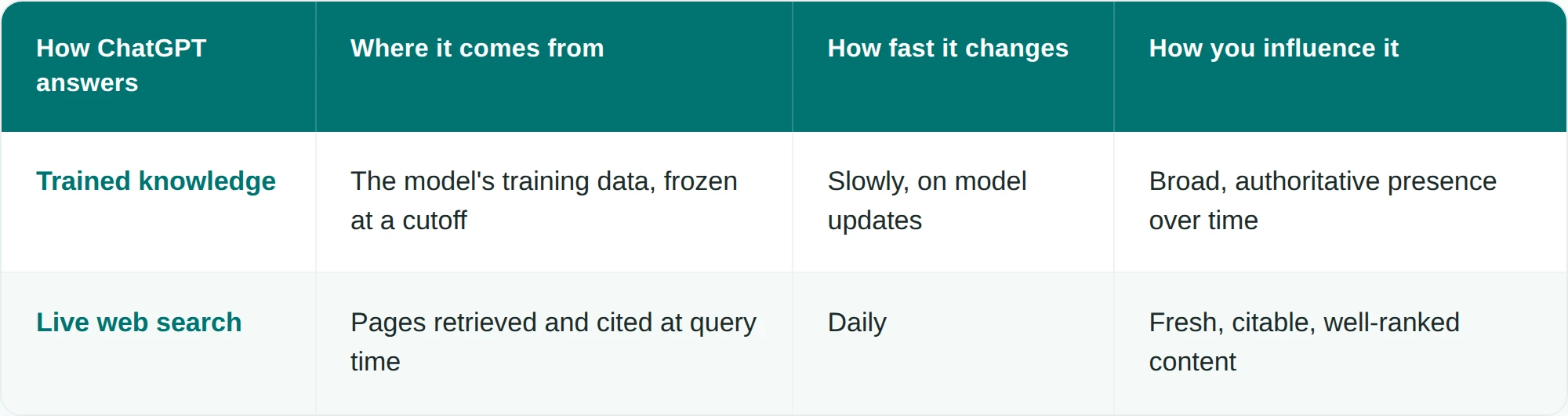
Because ChatGPT draws on two different channels, and one of them updates constantly. The first is its trained knowledge, frozen at a cutoff and refreshed only when the model itself updates. The second is live web search: ChatGPT search pulls timely information from the web and links to the sources it used.
Which channel answers depends on the question. OpenAI's documentation explains that ChatGPT decides whether a query benefits from the web, then rewrites it into targeted searches. Add model updates and per-user personalization, and the result is simple to state: your company can be described accurately one week and wrongly the next. A single check tells you almost nothing.
What should you measure over time?
Presence alone is not enough. The brands that manage AI reputation well track a consistent set of signals on every run, so a change in one of them is obvious. Measure these:
- Mention rate: how often ChatGPT names your company across your target prompts.
- Sentiment: whether the description is positive, neutral, or negative.
- Accuracy: whether the claims about you are correct, since hallucinated facts are the highest-priority fix.
- Prominence: whether you are named first or buried beneath competitors.
- Cited sources: which URLs ChatGPT pulls when it does a search, because those pages are your leverage.

How do you set up monitoring step by step?
Start with a baseline, then repeat it on a cadence. The baseline is the control group you will measure every future run against, so build it deliberately and write everything down.
- Build a prompt set: a direct brand query, a category or discovery prompt, a competitor comparison, and a problem-led prompt your buyers would actually ask.
- Run each prompt several times in fresh sessions, both with and without web search, and record the exact responses with the date.
- Log structured fields for every run: prompt, mention yes or no, sentiment, accuracy score, position, and any sources cited.
- Set a cadence: weekly while you are actively improving, monthly once results stabilize, and daily for high-stakes or fast-moving categories.
- Watch for drift and diagnose the cause: a model update, new web content, or lost media coverage each leaves a different fingerprint.
CAUTION: One conversation is not data. Because ChatGPT samples its answers and may or may not search the web, a single screenshot can mislead you in either direction. Run each prompt multiple times before you trust a trend, and never try to manipulate results with thin or spammy content, which the model and its sources increasingly filter out.
What do you do when ChatGPT gets your company wrong?
You cannot edit ChatGPT directly, so you change what it learns from. AI answers are downstream of your web and earned presence, which means the fix is to strengthen the authoritative, consistent, citable material that AI systems retrieve and trust. The Princeton study that defined Generative Engine Optimization found that adding citations, quotations, and authoritative statistics lifted visibility in generative engines by as much as 40%.
Correct the record at the source. Update your owned pages so the accurate facts are easy to find, earn coverage in publications AI already trusts, and keep your entity data (name, descriptions, key facts) consistent across the web. Our AI reputation FAQs show the answer-first format that gives models clean material to pull from. This is the discipline Status Labs has refined since AI search began, while much of the market is still taking one screenshot and guessing.
A quick framework
- Build a fixed prompt set that mirrors how real buyers ask.
- Baseline it: multiple runs, fresh sessions, with and without search.
- Track five signals: mention rate, sentiment, accuracy, prominence, and sources.
- Re-run on a set cadence and compare against the baseline.
- Diagnose drift, then fix it at the source with authoritative content.
So, how do you monitor what ChatGPT says about your company over time? Build the baseline this week, log the same prompts on a schedule, and treat every shift as a signal to act on. If you want a partner who has been measuring and shaping AI answers since the start, begin with our GEO services.
.png)

.png)
