
.png)


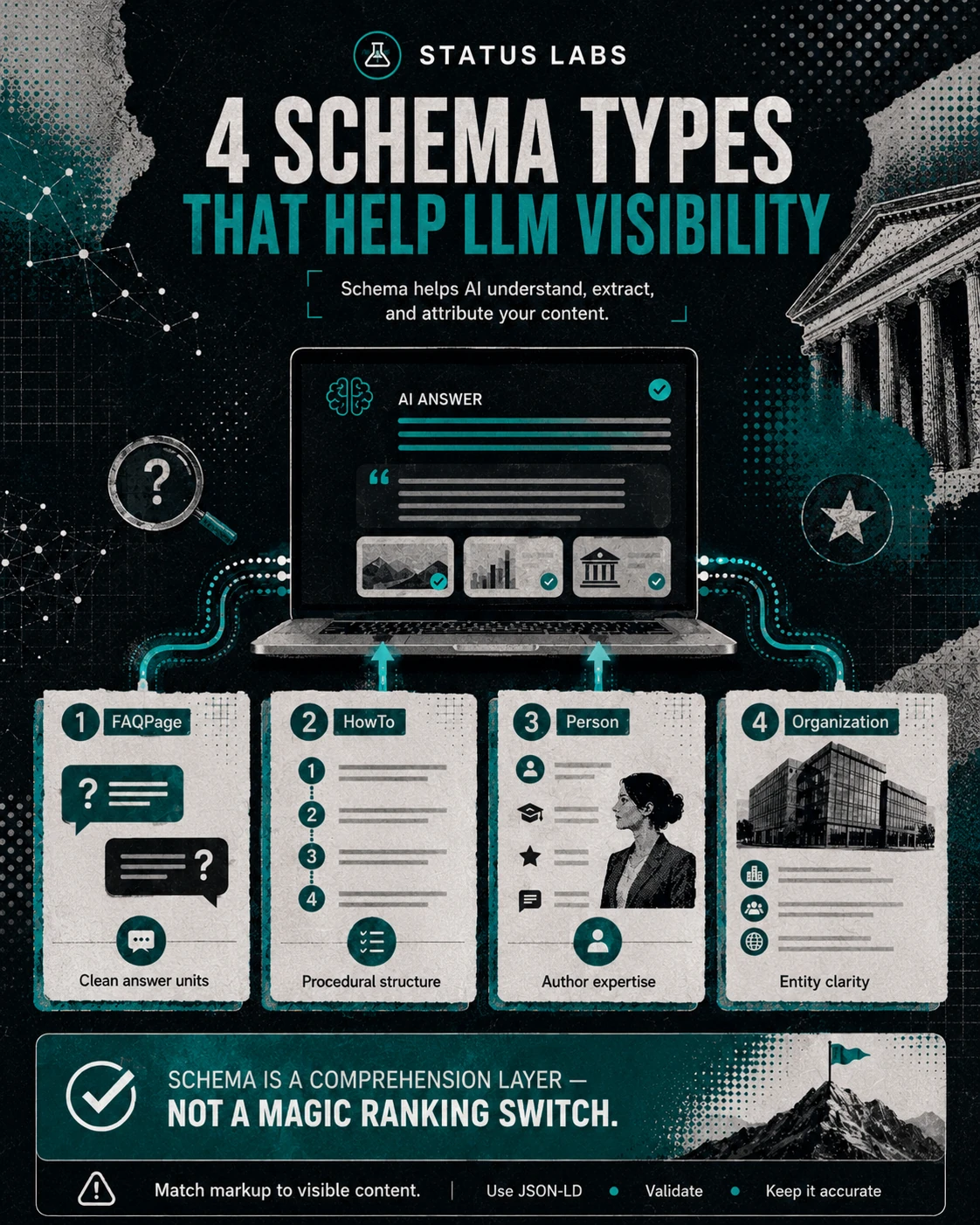
The four schema types that most help with LLM visibility are FAQPage, HowTo, Person, and Organization, because each makes a different part of your content machine-readable: FAQPage and HowTo expose clean question-and-answer and step-by-step structures that AI engines can lift directly, while Person and Organization establish the entity signals (who you are, who wrote this, what you do) that models use to trust and attribute a source.
None of them is a magic switch. Schema is a comprehension layer that helps AI parse content you have already made genuinely useful. At Status Labs, we treat structured data as table stakes for AI reputation, and the brands that implement it cleanly give every answer engine a clearer, more citable read of who they are.
This guide explains what each of the four schema types does for LLM visibility, the one mistake that quietly kills their value, and how we deploy them as part of a Generative Engine Optimization (GEO) program.
KEY TERM, schema markup: structured data (usually written in JSON-LD) added to a page using the shared Schema.org vocabulary, which labels content so search engines and AI systems can identify entities, relationships, and answer units without guessing from the raw text.
Does schema actually help LLM visibility?
Yes, but as a comprehension aid, not a ranking shortcut. Google's own AI features guidance is explicit that structured data is not required for AI Overviews or AI Mode, and there is no special markup you need to add, while still recommending it as part of a sound technical foundation. Schema reduces the work a model has to do to understand your page, which matters when an engine is deciding which of a few sources to cite. It is one piece of the broader AI reputation work we run for clients.
The broader research points the same way. The Princeton-led GEO study presented at KDD 2024 found that clearer structure and verifiable specifics lifted a page's visibility in AI answers by up to 40 percent. Schema is one of the cleanest ways to deliver that clarity, because it hands the model an explicit map of the page instead of asking it to infer one.
Which schema types help most, and what does each one do?
The four types in the question each target a distinct signal an LLM looks for. Here is what each contributes.
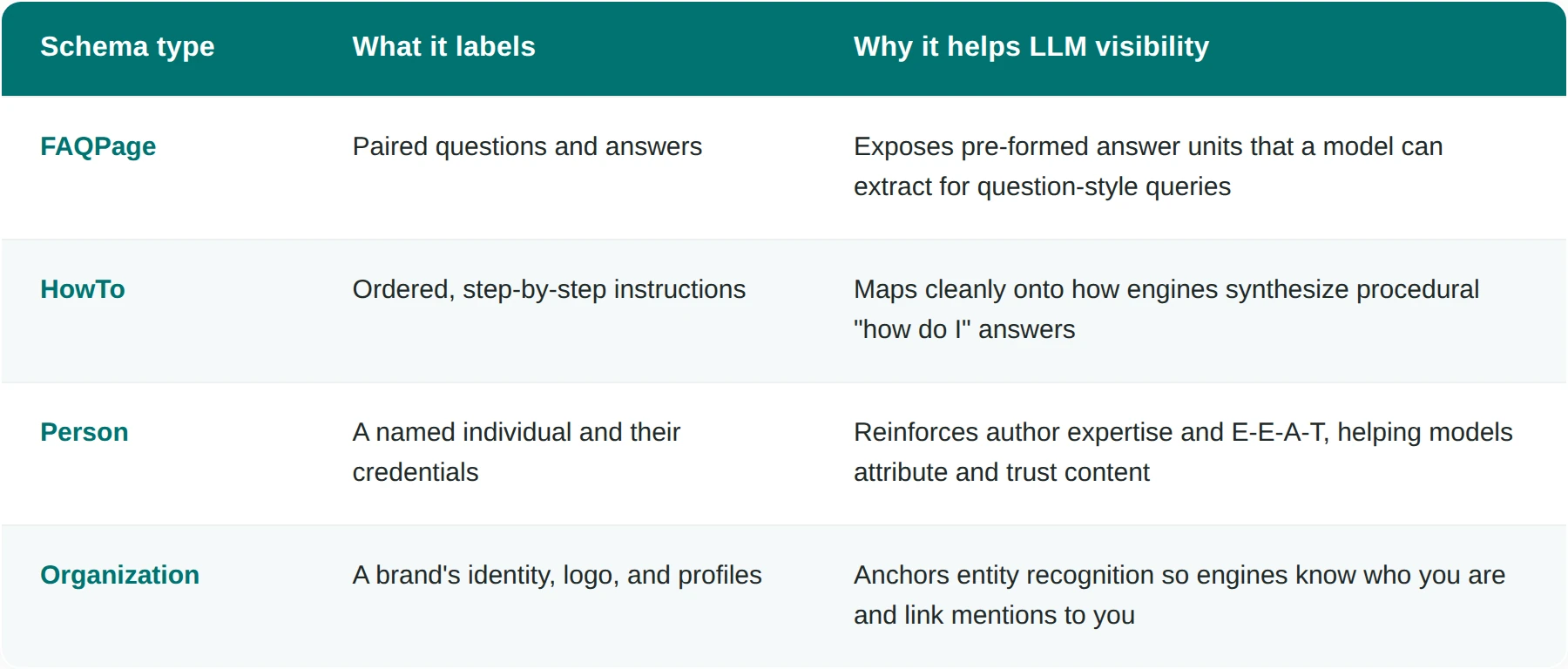
FAQPage: clean answer units
FAQPage schema marks a block of content as explicit question-and-answer pairs, which is one of the easiest formats for an AI engine to extract and quote. One important update: Google deprecated FAQ rich results for most sites in 2023 and removed them entirely as of May 2026. The visible SERP dropdown is gone, but FAQPage remains a valid Schema.org type, and the markup still helps engines parse your Q&A content. The presentation layer ended. The comprehension layer did not.
HowTo: procedural structure
HowTo schema labels ordered steps in a process, which maps directly onto the procedural answers users ask AI engines for ("how do I reset this," "what are the steps to"). Google also deprecated HowTo rich results (on desktop and mobile) back in 2023, so like FAQPage, its value now is machine comprehension rather than a visible Search feature. For genuinely step-based content, the markup still tells a model exactly where one step ends and the next begins.
Person: author authority and E-E-A-T
Person schema identifies a named author and ties them to credentials, affiliations, and other profiles. That matters because models weigh expertise (Experience, Expertise, Authoritativeness, Trustworthiness) when choosing which sources to trust, especially on sensitive topics. Marking up an author with Person schema and linking it (via the sameAs property) to their verified profiles makes that expertise explicit rather than something the model has to infer.
Organization: entity recognition
Organization schema anchors your brand as a recognizable entity, with a stable name, logo, and links to your official profiles. Google's documentation supports specifying brand-level details this way, and consistent Organization markup helps engines connect scattered mentions of you across the web to a single, verified entity. For a brand, that entity clarity is the foundation that every other AI-visibility signal builds on.
The one mistake that kills schema's value
The fastest way to waste schema is to mark up content that does not match what users actually see on the page. Google's structured-data policies are blunt about this: your markup must be a true representation of visible page content, and mismatched or hidden structured data can trigger a manual action. For AI specifically, a mismatch is worse than useless, because a model may extract and cite the wrong fact. Mark up what is genuinely on the page, keep it accurate, and let the structure reflect reality.
CAUTION: There is no "AI schema," no LLM Optimized property, and no markup that guarantees a citation. Any vendor selling a special AI schema type is selling folklore. The real work is accurate, structured data on top of genuinely authoritative content, which is the standard we hold every GEO program to.
How to deploy these four schema types for LLM visibility
Here is the sequence we use to put structured data to work for AI visibility. It is deliberately simple because the schema is the foundation, not the strategy.
- Use JSON-LD. Implement all four types in JSON-LD, the format Google recommends, placed in the page head or body rather than woven into the HTML.
- Match markup to visible content. Every field in your schema should correspond to something a human can see on the page. No hidden data, no inflated claims.
- Anchor your Organization entity. Give your brand one consistent Organization block sitewide, with logo, official URL, and sameAs links to your verified profiles.
- Mark up real authors with Person schema. Attach credentials and sameAs links so models can verify expertise on every article.
- Use FAQPage and HowTo only where they fit. Apply them to genuine Q&A and step-based content, not as decoration on prose that is neither.
- Validate before you ship. Run every page through a structured-data validator so a stray comma does not silently break the whole block.
- Pair schema with substance. Schema helps a model read good content faster. It cannot rescue thin content, so invest the bulk of your effort in answer-first writing, evidence, and authority.
Frequently asked questions
Is FAQ schema still worth adding after Google removed the rich result?
Yes, for comprehension. Google ended the visible FAQ dropdown in Search as of May 2026, but FAQPage is still a valid Schema.org type that helps engines and AI systems parse your question-and-answer content. You are no longer adding it to win a SERP feature. You are adding it to make clean answers easy for a model to extract.
Do I need special schema to appear in AI Overviews or ChatGPT?
No. Google states plainly that no special schema is required for its AI features, and the same logic applies across answer engines. Schema supports machine understanding and entity clarity, but the citation decision still rests on content quality, authority, and freshness. Treat schema as a force multiplier on strong content, not a substitute for it.
Which schema type matters most for a brand's AI reputation?
Organization schema is the anchor. It establishes your brand as a verified entity that engines can recognize and link mentions to, which is the base layer every other signal depends on. Person schema is a close second for any brand publishing expert content, since it ties authorship to credentials. We walk through how the two work together on the Status Labs LinkedIn page.
The bottom line
For LLM visibility, FAQPage and HowTo make your answers and steps extractable, while Person and Organization make your authors and brand recognizable, and all four work only when the markup mirrors real, useful content on the page. Use JSON-LD, anchor your Organization entity, mark up genuine authors, apply FAQ and HowTo where they truly fit, validate everything, and put your real energy into the content underneath. Schema gets a model to read you clearly and quickly. What it reads is still up to you.
If you are not sure how AI engines currently understand your brand, start with an audit of your entity signals: confirm your Organization and Person markup is accurate and consistent, then build out from there.
.png)

.png)
