
.png)


To measure the success of online reputation management (ORM), track a set of KPIs across every surface where you are seen: search visibility and how much of your first page you own, review ratings, volume and recency, sentiment across search and AI answers, share of voice against competitors, branded search traffic, and how often AI engines cite you accurately. No single number captures reputation, because reputation lives across many surfaces at once. The right approach is a small dashboard that measures each surface and, more importantly, tracks the trend over time.
At Status Labs, we have measured ORM outcomes for clients over more than a decade, and disciplined measurement is what separates a program that is working from one that only feels like it is.
This guide lays out the KPIs that actually matter, how to organize them, and why the trend matters more than any single reading.
KEY TERM: ORM KPI: a measurable indicator of reputation performance, such as first-page ownership, average rating, sentiment, or AI citation accuracy, tracked over time to show whether reputation work is moving the picture in the right direction.
How do I measure whether ORM is working?
Measure each surface people use, then watch the trend rather than any single snapshot. Reputation is not one metric, so a real measurement program covers search results, reviews, sentiment, competitive position, and AI answers together. A single reading tells you where you stand today. The trend across readings tells you whether the work is succeeding, which is the question that actually matters.
The discipline is choosing a fixed set of KPIs and measuring them on a regular cadence, so the numbers stay comparable. A rating that climbs over six months, a first page that fills with positive results, and an AI answer that grows more accurate are the signals of a program that is working, and none of them is visible from a one-time check.
What KPIs should I track for ORM?
Track KPIs grouped by surface, so each part of your reputation has a clear measure. This organization keeps the dashboard focused and shows exactly where progress is or is not happening.
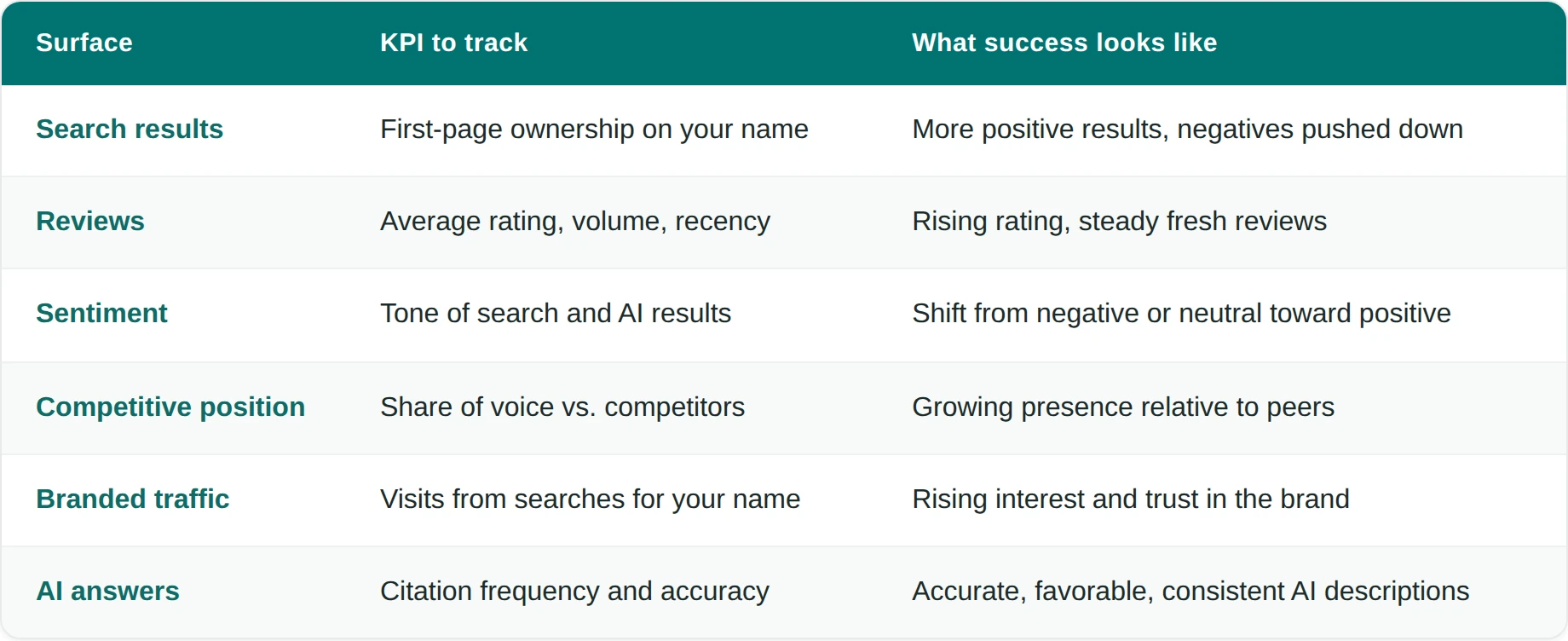
The pattern is that each surface gets one or two clear indicators, and each indicator is judged by direction over time. Together they form a complete picture that no single metric could provide.
Which KPIs matter most for search and reviews?
For search, the key metric is first-page ownership, and for reviews, it is rating paired with recency. First-page ownership measures how much of the first page of results for your name is positive or brand-controlled, which is the clearest sign of search reputation health. Google's own ranking guidance explains that those results reflect relevance, authority, and quality, so owning more of them signals genuine authority rather than a temporary boost. As that share grows and negatives fall, your search reputation is improving in the way that matters most.
Reviews need two numbers, not one. Average rating shows overall standing, but recency is what keeps it credible, since consumers weight recent reviews most heavily. BrightLocal's 2026 consumer survey found that most consumers only value reviews from the last few months, so a strong rating built on stale reviews is a hidden weakness. Tracking rating, volume, and recency together is what makes the review KPI meaningful.
How do I measure ORM success in AI answers?
Measure how often AI engines cite you, whether the description is accurate, and how the sentiment trends across platforms. This is the newest and fastest-growing measurement surface, because a rising share of first impressions now form inside an AI answer. ChatGPT passed 800 million weekly active users by OpenAI's October 2025 DevDay, so an ORM program that does not measure the AI answer is missing a surface that increasingly speaks first.
The core AI indicators are citation frequency, accuracy, and sentiment, tracked across ChatGPT, Gemini, Perplexity, and Google's AI answers, since engines differ in what they retrieve. This deserves its own dedicated dashboard, and our detailed guidance on the specific AI signals to track sits in our broader reputation management resources. Our own 2026 whitepaper covers how to read and manage that layer in depth.
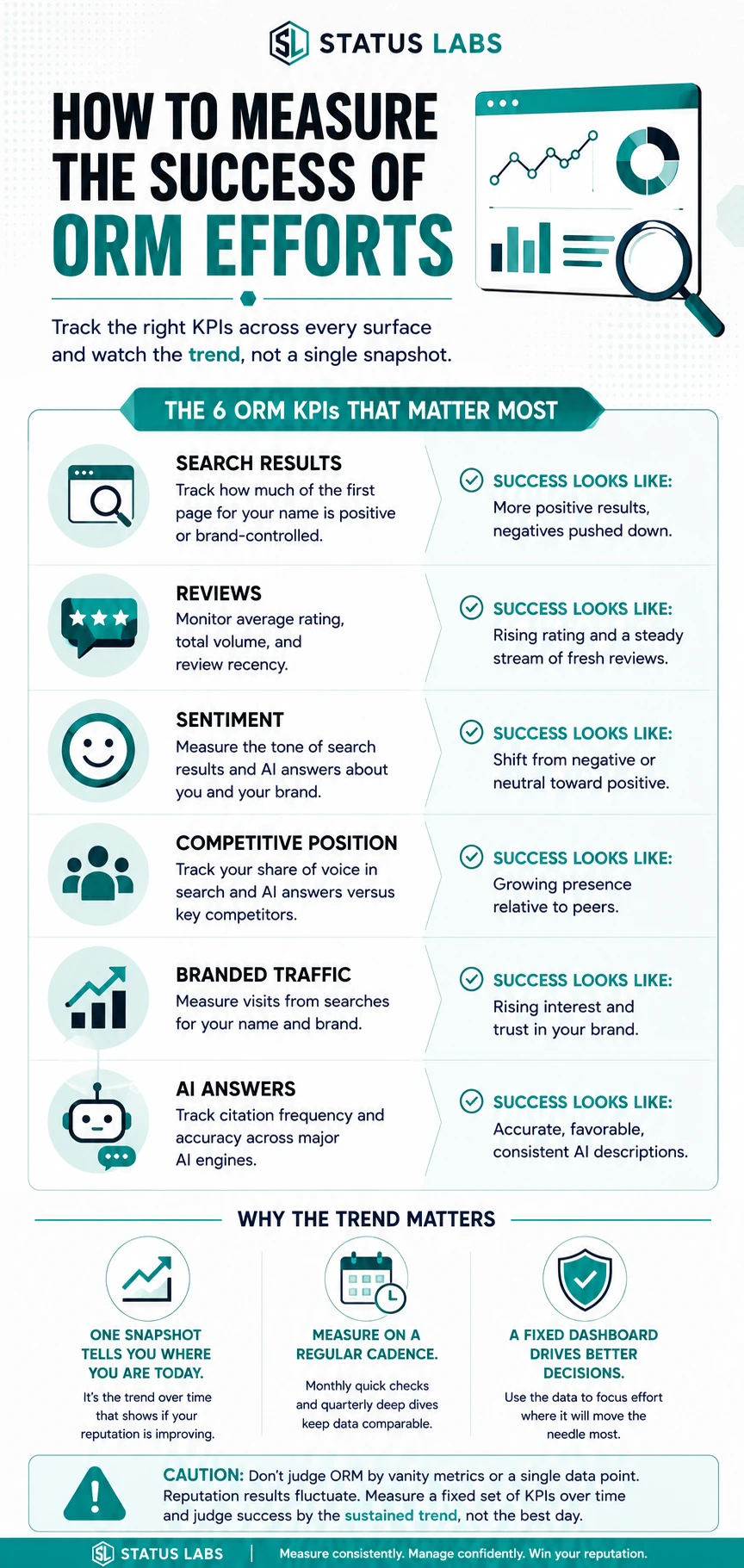
CAUTION: Do not judge ORM by vanity metrics or a single data point. A one-time spike in traffic, a single new five-star review, or one good AI answer proves nothing on its own, and reputation results naturally fluctuate between readings. Measure a fixed set of KPIs over time, and judge success by the sustained trend, not the best day.
Frequently asked questions
What is the single most important ORM metric?
There is not one, because reputation spans multiple surfaces. If forced to prioritize, first-page ownership for search and rating-plus-recency for reviews are the clearest health indicators, with AI citation accuracy rising fast in importance. The value comes from reading them together rather than chasing any single number.
How often should I measure ORM performance?
Review your KPIs on a regular cadence, monthly for a quick check and quarterly for a deeper look, so the numbers stay comparable and the trend is visible. Reputation moves continuously as new reviews, results, and AI answers appear, so a single measurement is a snapshot that ages quickly.
How do I know if my ORM investment is paying off?
Judge it by the trend across your KPIs, not by activity. More positive first-page results, a rising and recent review rating, improving sentiment, and more accurate AI answers over time are the signals of a working program. We cover measurement in videos on the Status Labs YouTube channel.
The bottom line
Measuring ORM success means tracking KPIs across every surface: first-page ownership in search, rating and recency in reviews, sentiment, share of voice, branded traffic, and AI citation accuracy, and judging progress by the trend over time rather than any single reading. Build a small, fixed dashboard, measure it on a cadence, and watch the direction. A reputation program you cannot measure is one you cannot manage, and the trend across these KPIs is what tells you whether the work is truly succeeding.
If you have never measured your ORM performance, start by choosing one KPI per surface and taking a baseline this week, so that every future reading has something honest to be measured against.
.png)

.png)
