
.png)


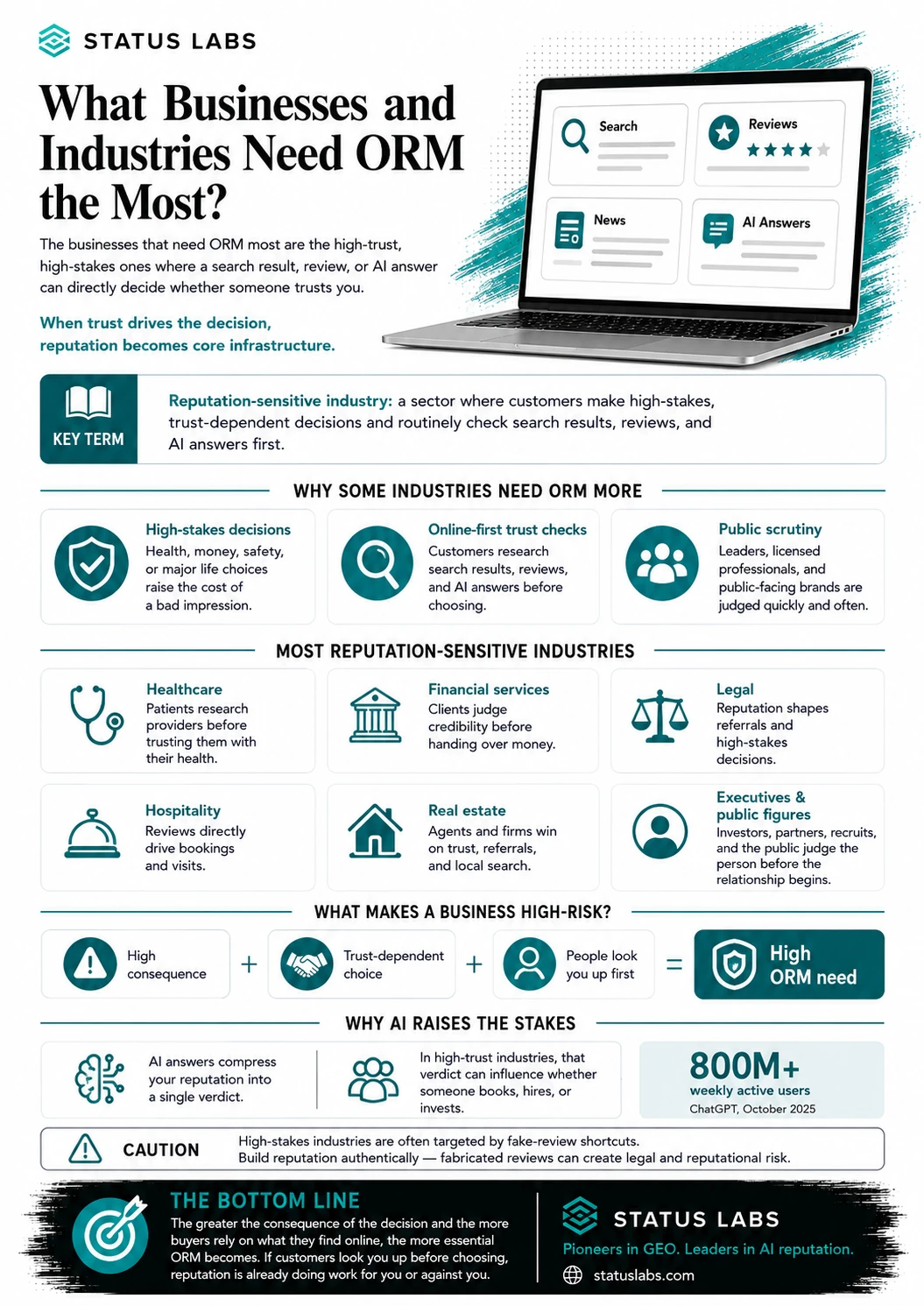
The industries that need online reputation management (ORM) most are the high-trust, high-stakes ones where a search result or AI answer directly decides whether someone trusts you with their health, money, safety, or major life choices: healthcare, financial services, legal, hospitality, real estate, and any business whose leaders and brand are publicly scrutinized. The common thread is consequence. When a bad review, a negative article, or an inaccurate AI answer can cost a patient, a client, or an investor, reputation stops being a marketing concern and becomes a core risk. At Status Labs, we have protected reputations across these sectors for more than a decade, and the pattern of who needs ORM most is consistent and predictable.
This guide explains which industries carry the greatest reputation risk, why they do, and what makes some businesses far more exposed than others.
KEY TERM, reputation-sensitive industry: a sector where customers make high-stakes, trust-dependent decisions and routinely check search results, reviews, and AI answers first, so an inaccurate or negative online picture directly costs business.
Which industries need ORM the most?
The industries that need it most are those Google itself treats as high-stakes. Google's Search Quality Rater Guidelines define a category called YMYL, short for "Your Money or Your Life," covering topics that can affect a person's health, financial stability, safety, or well-being, and hold that content to a far higher bar for trust and accuracy. The industries operating in YMYL territory are precisely the ones where reputation is most consequential, because both the public and the search systems scrutinize them harder.
That framework maps cleanly onto the real world. A patient choosing a surgeon, a family choosing a financial advisor, and a client choosing a lawyer are all making YMYL decisions, and all of them look you up first. When the stakes are someone's body, money, or freedom, the reputation they find carries decisive weight.
Why do some industries carry more reputation risk than others?
Because two factors multiply the risk: how consequential the decision is, and how heavily buyers rely on what they find online before making it. An industry scores high on reputation risk when both are present. BrightLocal's 2026 consumer survey found that 41 percent of consumers always read reviews when choosing a business, and that trust hinges on how recent and positive that coverage is, so any industry where customers comparison-shop on reputation is exposed.
Regulated and licensed professions face a second layer. For them, a reputation problem can threaten not just revenue but standing, referrals, and in some cases the license itself. The more a business depends on trust it has to earn from strangers, the more a weak or negative online picture costs it.
Which businesses and industries are most exposed?
The pattern holds across sectors. Here is where reputation risk concentrates and why.
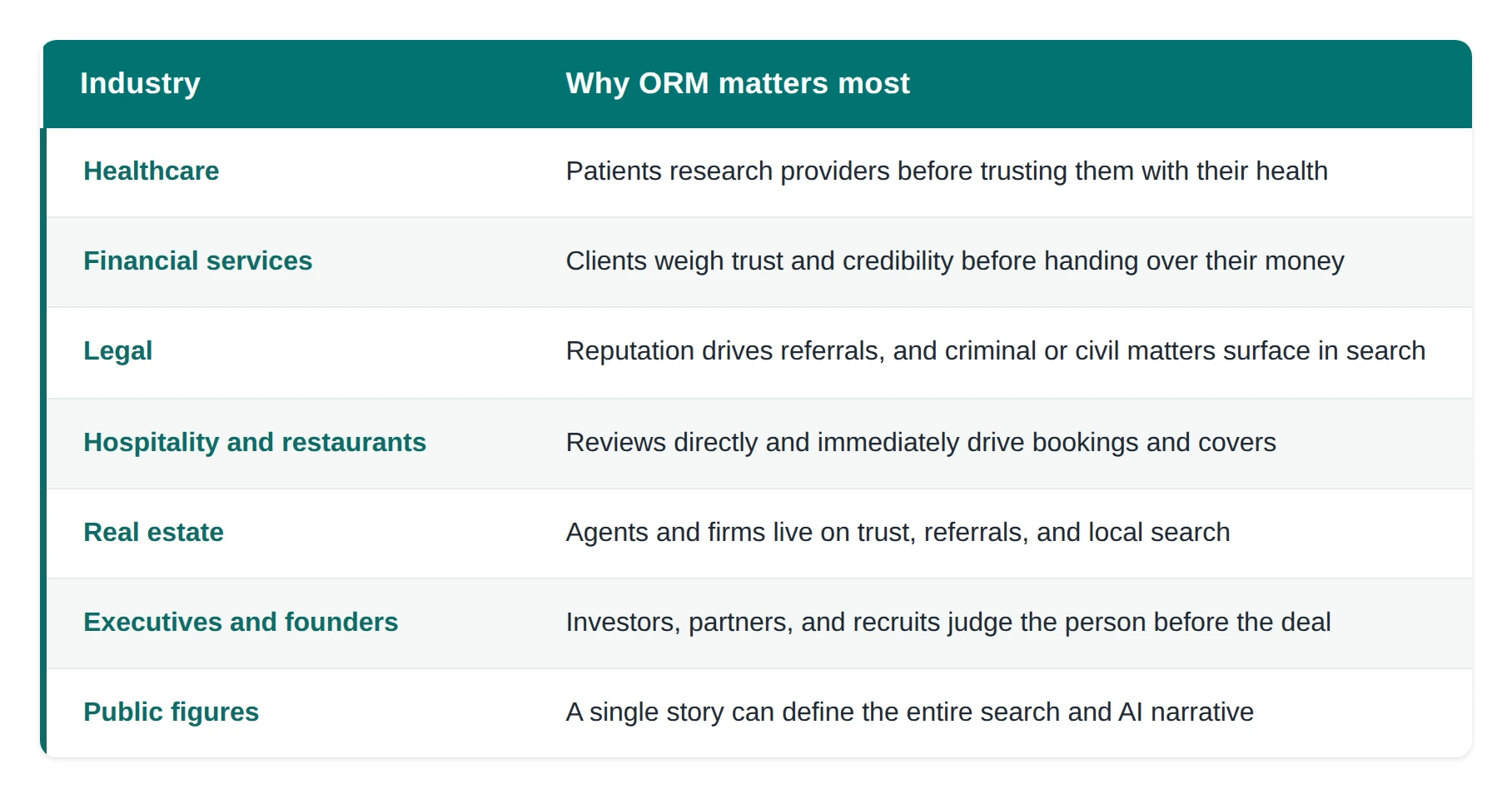
Across all of these, the mechanism is the same. The decision is high-stakes, the buyer checks online first, and the reputation they find tips the outcome one way or the other.
Why does AI raise the stakes for these industries?
Because AI answers now deliver a single verdict on you, and for high-trust industries that verdict carries outsized weight. Where a search once returned a page of sources a person could weigh, an answer engine hands back one synthesized description. For a healthcare or financial decision, an inaccurate or negative AI answer is not a minor blemish. It is a direct hit to the trust the whole relationship depends on.
The reach is already enormous. ChatGPT passed 800 million weekly active users by OpenAI's October 2025 DevDay, and a growing share of people forming a first impression of a doctor, firm, or advisor are reading an AI answer rather than a review page. Our own 2026 whitepaper documents how the AI layer now shapes these first impressions, which is why reputation-sensitive industries have to manage the AI answer, not just search and reviews. This is the frontier our reputation management practice has moved to lead.
CAUTION: Reputation-sensitive industries are exactly the ones targeted by providers offering fake reviews, and that shortcut is now illegal. The Federal Trade Commission's fake-review rule, effective October 2024, bans buying, selling, and manufacturing reviews, with steep penalties. The higher the stakes in your industry, the more important it is to build reputation authentically rather than fake it.
Frequently asked questions
Does a small local business need ORM?
Often yes, especially in service industries. Local businesses live and die on reviews and local search, and a handful of negative results can steer customers to a competitor. The stakes may be smaller per decision than in healthcare or finance, but the dependence on reputation is just as high.
Which single industry is most reputation-sensitive?
Healthcare is usually the clearest case. Patients research providers before trusting them with their physical well-being; the decisions are high-stakes, and the information sits squarely in the territory Google holds to the highest trust standard. Financial services and legal follow closely for the same reasons.
If my industry is not on the list, do I still need ORM?
Possibly. The list highlights where risk concentrates, but any business whose customers check reviews or search before buying has reputation exposure. The test is simple: if people look you up before deciding, your reputation is already doing work for you or against you. We cover industry-specific reputation strategy in videos on the Status Labs YouTube channel.
The bottom line
The businesses that need ORM most are the high-trust, high-stakes ones: healthcare, finance, legal, hospitality, real estate, and any brand or leader under public scrutiny, because these are the sectors where a search result or AI answer directly decides whether someone trusts you. The greater the consequence of the decision and the more buyers rely on what they find, the more essential ORM becomes. If your customers are making a meaningful choice and looking you up first, reputation is not optional infrastructure.
If you are not sure how exposed your industry is, start with a simple test: search your business and your leaders the way a customer would, read the AI answer, and decide whether that picture would win or lose the decision.
.png)

.png)
