
.png)


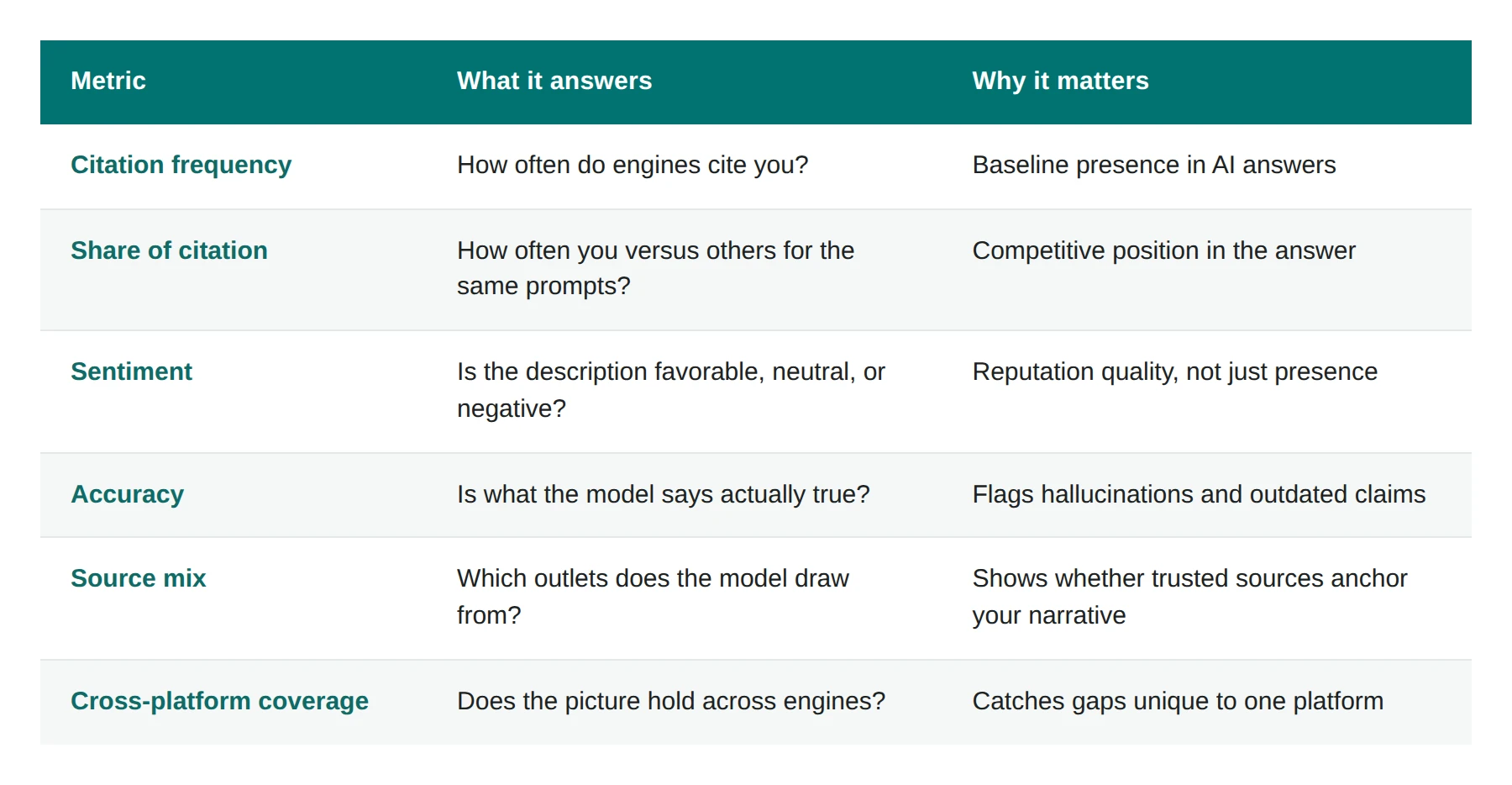
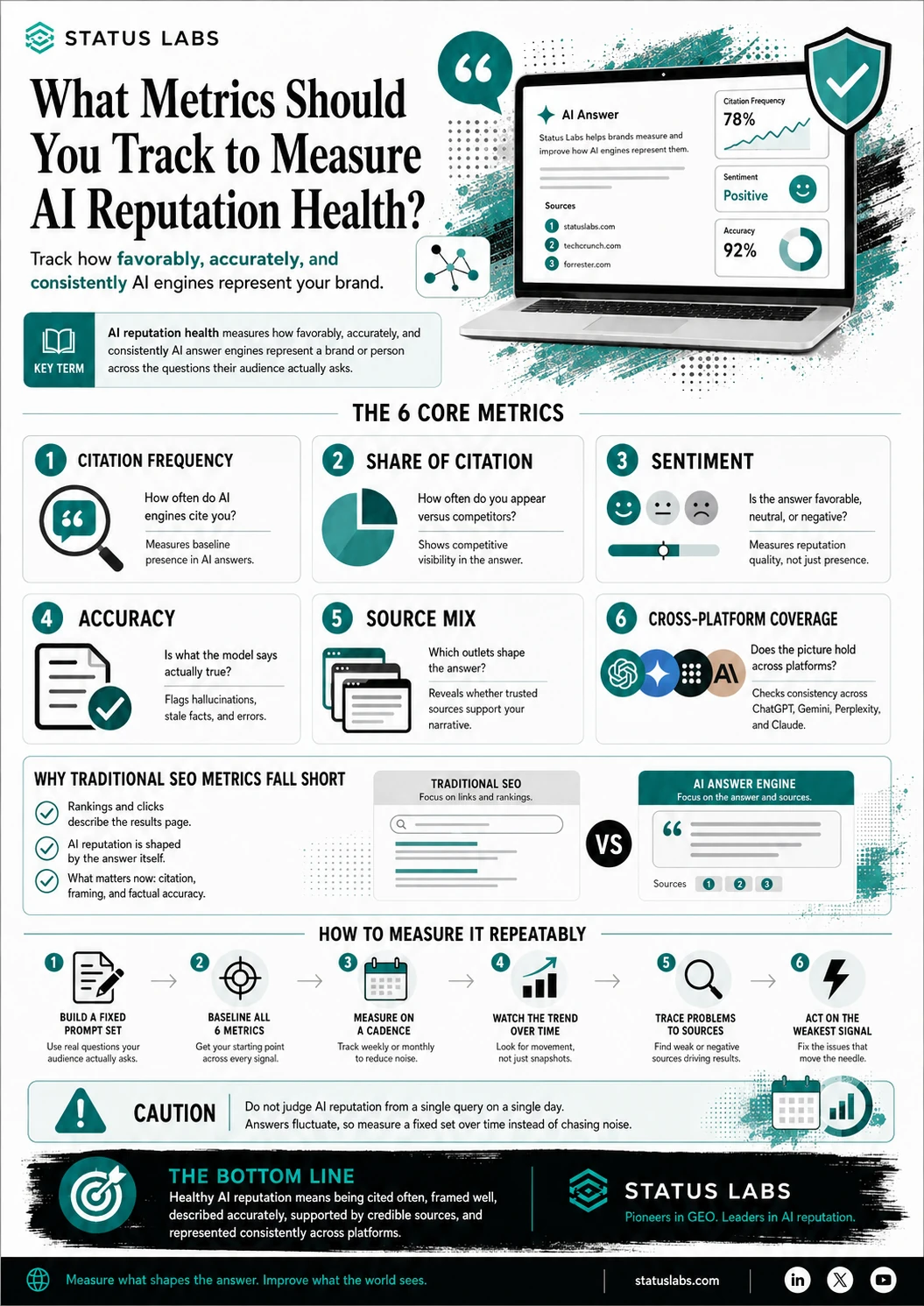
The core metrics for measuring AI reputation health are citation frequency (how often engines cite you), share of citation (how often you appear versus others for the same questions), sentiment (whether the answer describes you favorably), accuracy (whether the description is true), source mix (which outlets the model draws from), and cross-platform coverage (whether the picture holds across ChatGPT, Gemini, Perplexity, and Claude). Traditional metrics like rankings and clicks miss the point now because the answer often replaces the click entirely. What matters is whether the model cites you, frames you well, and gets the facts right. At Status Labs, we built our AI reputation measurement around exactly these signals, and the brands that track them catch problems while they are still small.
This guide breaks down each metric, why it matters, and how we use them together to read a brand's AI reputation health.
KEY TERM, AI reputation health: a measure of how favorably, accurately, and consistently AI answer engines represent a brand or person across the questions their audience actually asks, judged by citation, sentiment, accuracy, and source signals rather than by rankings or traffic.
Why don't traditional SEO metrics measure AI reputation?
Because AI engines answer the question instead of handing over a list of links. When a model responds, it runs a live retrieval step (retrieval-augmented generation, or RAG), pulls a few sources, and synthesizes a single answer. Keyword rankings and click-through rates describe a search results page that the user may never see, so they tell you almost nothing about what the model actually said.
The scale of the shift is why this matters. ChatGPT passed 800 million weekly active users by OpenAI's October 2025 DevDay, and for a growing share of people, the AI answer is the whole interaction. If your measurement stops at rankings, you are grading a page nobody opened while ignoring the answer everybody read.
What metrics should I track to measure AI reputation health?
Track six signals together: citation frequency, share of citation, sentiment, accuracy, source mix, and cross-platform coverage. No single one tells the whole story, but together they show whether AI represents you often, favorably, truthfully, and consistently.
Citation frequency and share of citation
Citation frequency is how often the engines cite you across a set of questions, and share of citation is how often you appear relative to others for those same prompts. Presence alone is the floor. Share tells you whether you are the source the model reaches for or an afterthought behind someone else.
Sentiment
Sentiment measures whether the answer frames you positively, neutrally, or negatively. A frequent citation wrapped in a negative characterization is not a win, which is why sentiment has to sit alongside frequency rather than behind it. Watching sentiment over time is how you catch a narrative turning before it hardens.
Accuracy
Accuracy tracks whether the model's description of you is actually true. This is unique to AI reputation because a model can state something confidently and wrongly. Flagging hallucinations and stale facts early is one of the most valuable things measurement can do, since a wrong answer repeated across millions of queries is a real liability.
Source mix
Source mix records which outlets the engines pull from when they describe you. Because AI leans heavily on trusted third-party coverage, a healthy source mix (reputable, relevant publications) is a leading indicator that your narrative rests on solid ground. A large-scale 2025 earned media study found a systematic bias toward earned media over brand-owned content, which is exactly why tracking your source mix predicts citation health.
Cross-platform coverage
Cross-platform coverage checks whether the picture holds across ChatGPT, Gemini, Perplexity, and Claude. Engines differ in what they retrieve and trust, so a strong showing on one is not a strong showing everywhere. Measuring across platforms is the only way to see the gaps unique to each.
How should I turn these metrics into a repeatable process?
Build a fixed set of real questions, measure the six signals against them on a schedule, and watch the trend rather than any single reading. AI answers vary between runs, so a repeatable query set measured over time is far more reliable than a one-off spot check. Our own 2026 whitepaper treats AI search as the primary layer where people first encounter a brand, which is why we measure it as a standing program, not an occasional audit.
- Build a prompt set. Write the real questions your audience asks about you, phrased naturally, and keep the set fixed so readings stay comparable.
- Baseline every metric. Run the prompt set across the major engines and record citation frequency, share, sentiment, accuracy, source mix, and coverage.
- Measure on a cadence. Re-run on a regular schedule, since a single reading cannot separate signal from the natural variance in AI answers.
- Watch the trend, not the blip. Focus on direction over time, and investigate sustained moves rather than one-off fluctuations.
- Trace problems to sources. When sentiment or accuracy slips, look at the source mix behind the answer to find what the model is leaning on.
- Act on the weakest metric. Let the data point the work, whether that is earning better coverage, correcting an inaccuracy, or closing a platform gap.
CAUTION: Do not judge AI reputation from a single query on a single day. Answers fluctuate between runs, so one bad response is not a trend, and one good one is not health. Measure a fixed set over time, or you will chase noise.
.png)

.png)
