
.png)


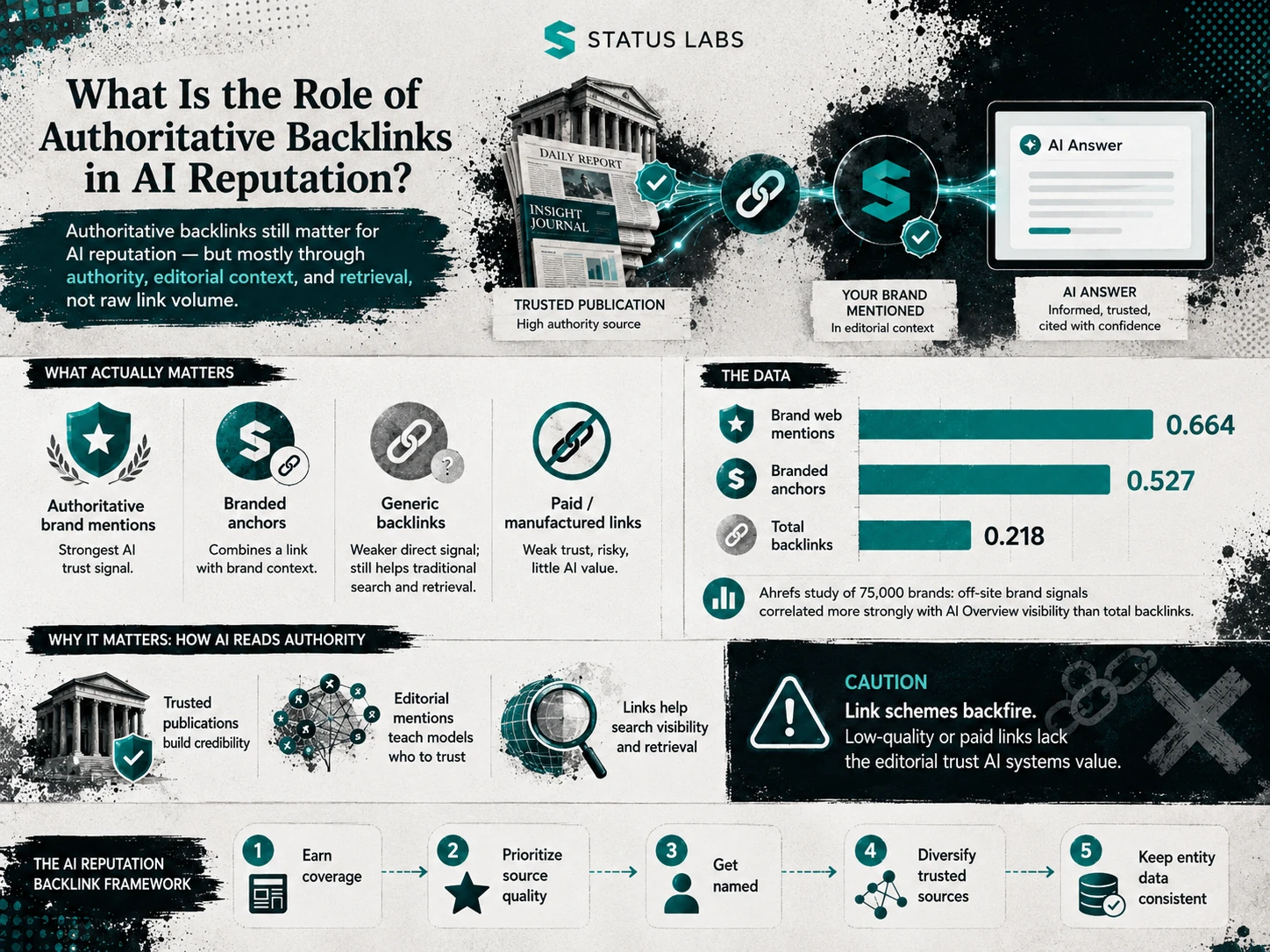
The short answer: authoritative backlinks still shape AI reputation, but their role has changed. Links from trusted, independent sources no longer act as a direct ranking lever the way they did in classic SEO. Instead, they feed the authority profile AI systems use to decide which brands are credible enough to cite, and they help your pages surface in the search indexes that answer engines pull from.
At Status Labs, we have spent more than a decade earning authority for brands in search, and we built our GEO services on the levers that move AI citations rather than the ones that simply move rankings. The role of the backlink is one of the most misunderstood pieces of that picture. Here is what the evidence actually shows, and where to put your effort.
KEY TERM (AI reputation): how large language models such as ChatGPT, Gemini, Claude, and Google AI Overviews cite, summarize, and characterize a brand when users ask about it, and the sentiment of those answers.
Do backlinks still matter for AI reputation?
Yes, but mostly in an indirect way. AI systems do not crawl the link graph the way a traditional search crawler does. They are trained on text, and they retrieve text, so a raw link count is not what teaches a model to trust you.
Authoritative links still help for two concrete reasons. First, they help your pages rank in conventional search, and Google's AI features guidance confirms its AI answers run on the same core ranking systems, with crawlability and internal links among the fundamentals that still apply. Second, a link from a respected publication almost always arrives wrapped in an editorial mention, and that mention is the signal that moves AI most. The link points the way. The mention builds trust.
What does the data say about backlinks versus brand mentions?
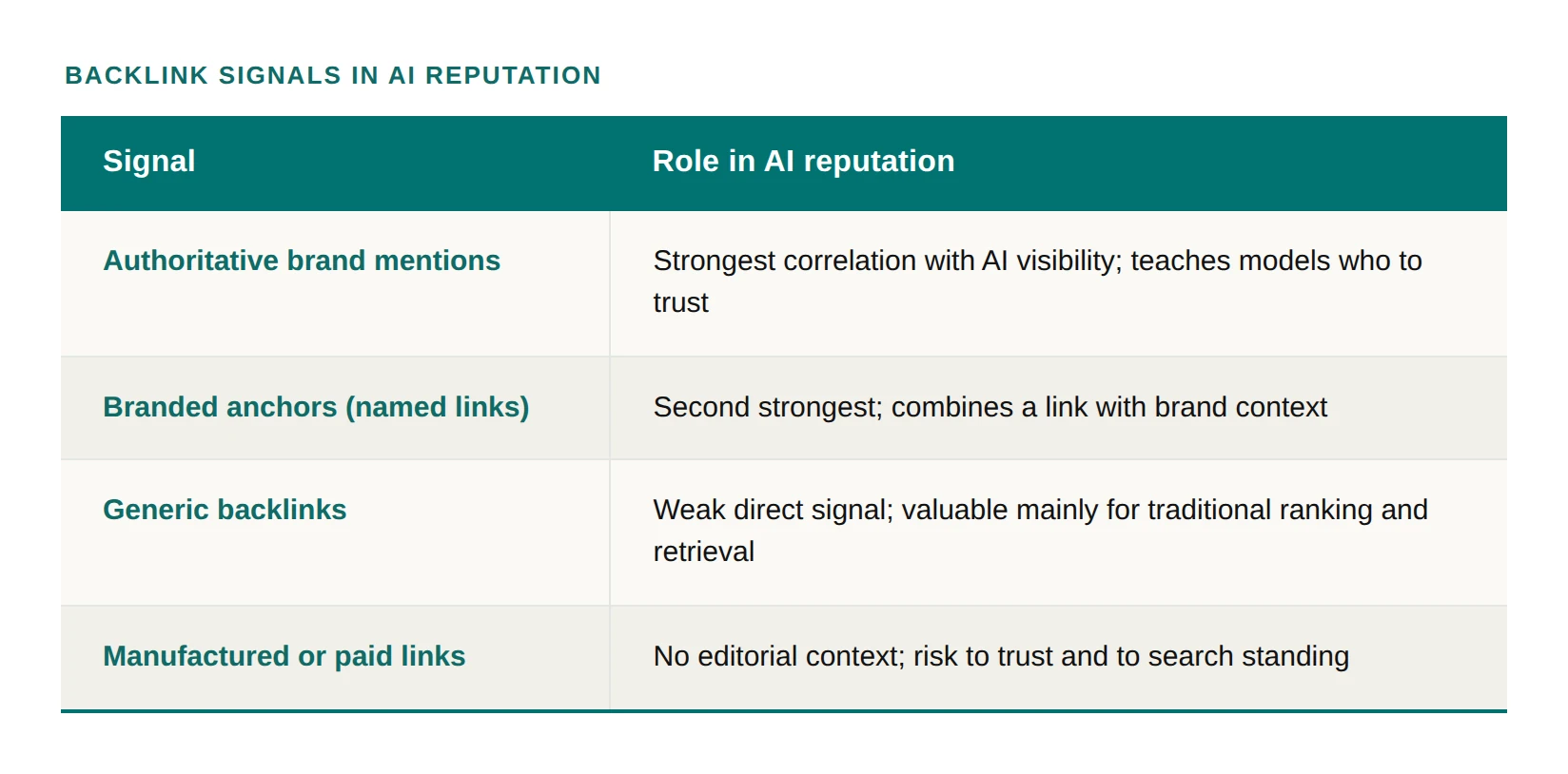
Independent mentions outweigh raw links by a wide margin. An Ahrefs study of 75,000 brands found that branded web mentions correlated with AI Overview visibility at 0.664, while total backlinks correlated at just 0.218, a roughly three-to-one gap. The top three signals were all off-site: brand web mentions, branded anchors, and brand search volume.
Two details matter for how you read that. Ahrefs itself notes the correlations are moderate to weak and that correlation is not causation, so treat the numbers as direction, not a formula. But the rank order is telling: branded anchors (links that name your brand in the surrounding copy) came second at 0.527, well ahead of generic links. Authoritative links that name you still carry real weight. Volume of plain links does not.
Why do authoritative sources matter more than link volume?
Because AI systems weigh the credibility of the source doing the talking, not the number of links pointing at you. When independent, trusted outlets discuss a brand, the model learns that the brand is a known entity worth referencing. A thousand low-quality links cannot manufacture that, while a handful of respected ones can.
Evidence reinforces the point. The Princeton study that formalized Generative Engine Optimization (presented at KDD 2024) found that adding citations, quotations, and authoritative statistics lifted visibility in generative engine responses by as much as 40%, while keyword-style repetition ranked among the weakest tactics tested. Authority and evidence earn citations. Link quantity does not.
CAUTION: Link schemes backfire in AI search. Manufactured or paid links lack the editorial context that makes a source credible, and both Google's spam systems and the models themselves are getting better at telling earned coverage from placement. Being cited is also not the same as being cited accurately. Peer-reviewed work in 2025 (published in Nature Communications) found that many LLM answers were not fully supported by the sources they named, which is exactly why a clean, consistent authority profile matters: it gives the model the right material to draw from.
How should you build authoritative backlinks for AI reputation?
Earn them, and treat source quality as the whole game. A single placement in a publication AI systems already trust does more than dozens of low-authority links. Pursue genuine editorial coverage through digital PR, original research others want to reference, and expert commentary that journalists actually use.
Get named while you are at it. Branded anchors and clear brand mentions in the surrounding copy outperform bare links, so the goal is coverage that says who you are, not just a URL. Diversify across the trusted sources AI engines read, keep your owned entity data (name, descriptions, key facts) consistent so the authority resolves to the right brand, and study the question-and-answer format in our AI reputation FAQs as a model for content worth citing.
This is the work Status Labs pioneered for the AI era. While much of the market still counts links, we build the authority signals that decide how AI systems describe a brand, and the firms that invested early are the ones compounding that advantage now.
A quick framework
- Earn coverage in trusted publications; never buy or scheme for links.
- Prioritize source authority over link volume, every time.
- Get named: branded anchors and mentions beat bare URLs.
- Diversify across the credible sources AI engines actually read.
- Keep your entity data consistent so the authority resolves to you.
So, what is the role of authoritative backlinks in AI reputation? They are one input into a larger authority profile, valuable when they come from sources AI already trusts and wasted when they do not. Start by auditing how AI platforms describe your brand today, then build the earned authority that changes the answer through our GEO services.
.png)

.png)
