


No. A reputation management agency cannot remove content from Wikipedia on its own, because volunteer editors write and police the encyclopedia, and only those editors, administrators, and Wikipedia's volunteer response and oversight teams can change or delete an article. What an agency can do is legitimate and often effective: audit the article, find claims that are inaccurate or poorly sourced, gather independent reliable sources, and submit disclosed, neutral requests through the routes Wikipedia provides to article subjects. Well-sourced content usually stays, and any agency that promises removal, or edits without disclosing who is paying, puts you at risk of a worse article. At Status Labs, we help clients use these routes because Wikipedia text now feeds Google results and AI answers, which makes accuracy there worth the effort.
This guide explains what Wikipedia allows, what an agency can and cannot do, and the step-by-step process for getting inaccurate or harmful content corrected.
KEY TERM: Conflict of interest editing: editing Wikipedia about a subject you are connected to or are paid to write about. Wikipedia strongly discourages conflicted editors from changing articles directly, and it requires paid editors to disclose their employer, client, and affiliation.
This article is general information and not legal advice. Consult a licensed attorney about defamation or other legal claims.
Why can't an agency just remove Wikipedia content?
Because nobody at an agency controls the article. Wikipedia's own guidance for article subjects states that its articles are maintained by volunteer editors and that no centralized review system exists, which you can read on its article subjects page. The conflict of interest guideline advises anyone with a personal connection to a topic to refrain from editing that article directly and to propose changes on the talk page instead.
Paid editing carries a stricter rule. The Wikimedia Foundation's Terms of Use require editors to disclose their employer, client, and affiliation for any paid contribution, and Wikipedia's paid-contribution disclosure policy states that paid editors who cannot make that disclosure are prohibited from editing. A hidden edit made on a client's behalf breaks the rules, so it is not a service worth buying.
What can a reputation management agency legitimately do?
An agency can prepare and submit the requests that volunteer editors then judge. The work falls into a short list.
- Audit the article. Check each claim against its cited source and flag statements that are inaccurate, unsupported, or out of date.
- Gather independent reliable sources. Corrections and updates need coverage from outside the subject, such as established news outlets, so your own website and press releases will not carry a request.
- Draft neutral edit requests. Post them on the article's talk page with the disclosure Wikipedia requires, so independent editors can review them.
- Report policy violations. Material about living people that is unsourced or poorly sourced belongs on the biographies of living persons noticeboard.
- Prepare serious concerns for Wikipedia's response teams. Legal, privacy, and libel concerns go to the Volunteer Response Team or to oversight.
- Build independent coverage. New, credible reporting gives future edits something to cite.
- Monitor the page and the AI answers that draw on it.
You can find more of our reputation guidance on our YouTube channel.
Which route fits which problem?
The right route depends on what is wrong with the content. This table shows how the common problems tend to resolve.
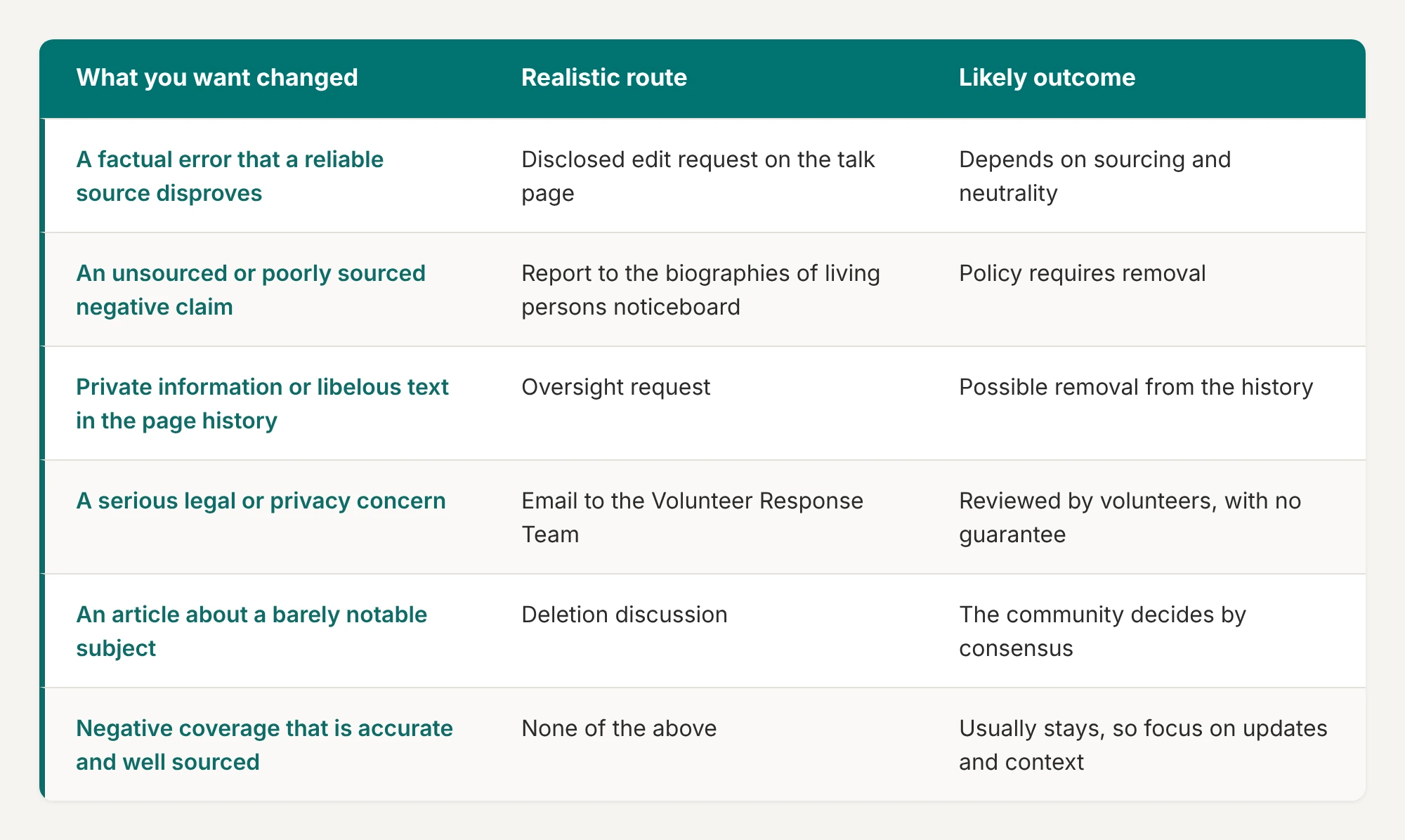
Wikipedia's policy on living persons sets the standard behind most of these rows. It requires editors to remove contentious material about living people that is unsourced or poorly sourced, immediately and without waiting for discussion. Material supported by high-quality sources is judged on neutrality and weight, and the subject's opinion does not change the outcome.
What is the step-by-step process?
Work through the sequence below, and leave the editing to independent volunteers.
- List every claim you dispute. Copy the sentence and its citation side by side.
- Check each claim against its source. If the source does not support the claim, or the source is weak, you have a policy issue.
- Gather independent reliable sources for any correction or update.
- Do not edit the article yourself. Post a specific, neutral request on the talk page with the {{Edit COI}} tag, and disclose any paid involvement. The Edit Request Wizard walks you through the steps.
- Report unsourced or poorly sourced negative claims to the biographies of living persons noticeboard.
- For serious legal or privacy concerns, email the Volunteer Response Team at info-en-q@wikimedia.org with the article link and details. For personal information or potentially libelous statements in the page history, ask the oversight team to evaluate removal.
- Check the article and the major AI tools again each month, and keep a dated record of what changed.
Why does a Wikipedia error matter for AI answers?
Wikipedia is among the sources that AI systems rely on most. Pew Research Center's July 2025 analysis found that Wikipedia, YouTube, and Reddit were the most frequently cited sources in both Google AI summaries and standard search results, and that Wikipedia links were somewhat more common in the AI summaries.
The connection is also commercial and direct. On January 15, 2026, the Wikimedia Foundation announced that Amazon, Meta, Microsoft, Mistral AI, and Perplexity had joined Google and others as Wikimedia Enterprise partners, companies that use Wikimedia data to bring what the Foundation calls human-governed knowledge into their platforms at scale. A mistake in an article can therefore surface well beyond Wikipedia. Our 2026 whitepaper examines how this changes reputation work.
CAUTION: Walk away from any agency that guarantees removal, edits your page without disclosing who is paying, or works through multiple accounts. Wikipedia's rules require paid editors to disclose their employer, client, and affiliation, and editors who cannot disclose are prohibited from editing. Undisclosed paid editing can turn a minor inaccuracy into a documented problem for you, so ask any provider how every edit will be disclosed and reviewed.

Frequently asked questions
Can I edit my own Wikipedia page?
Wikipedia's guideline advises against it. If you have a personal connection to the topic, the guideline recommends proposing changes on the talk page and disclosing your connection, so independent editors can review them.
Will Wikipedia remove negative content that is accurate?
Usually not. Editors judge content by its sourcing and neutrality, and the policy requires removal of unsourced or poorly sourced contentious claims. Accurate, well-sourced coverage can stay, although new independent sources, such as a correction or a resolved matter, can lead editors to update the article.
Can I get my Wikipedia page deleted?
Sometimes. Wikipedia's biography policy lets a relatively unknown subject nominate the article for deletion, or ask a Volunteer Response Team member to do so, and the community then decides by consensus. A subject who is clearly notable should not expect deletion.
How long does a Wikipedia correction take?
Volunteer reviewers set the pace, so no agency can promise a date. A well-sourced, neutral request that follows the rules gives reviewers less to question, which tends to move it along.
Can Status Labs fix my Wikipedia page?
We can audit it, prepare sourced and disclosed requests, build the independent coverage that supports changes, and monitor how the page affects Google and AI answers. Editing decisions remain with Wikipedia's volunteers, and we tell clients that plainly before we begin.
The bottom line
A reputation management agency cannot remove Wikipedia content, because volunteer editors and Wikipedia's response teams control every change. The effective path is a disclosed, well-sourced process: audit the claims, gather independent sources, post neutral edit requests, report policy violations, and use the Volunteer Response Team and oversight for serious concerns. Because Wikipedia text feeds Google results and AI answers, an accurate article helps your reputation in more places than the encyclopedia itself.
If a Wikipedia article about you contains an error, start today by copying each disputed claim next to its cited source. That list is the foundation of every request that follows.


