


Hire a reputation management firm for your personal brand when the problem exceeds the time, access, or objectivity you can bring to it: a negative result you cannot move, a crisis in progress, or a public profile where one mistake carries professional or legal cost. Handle it yourself when the record is clean and the work can be published and monitored consistently.
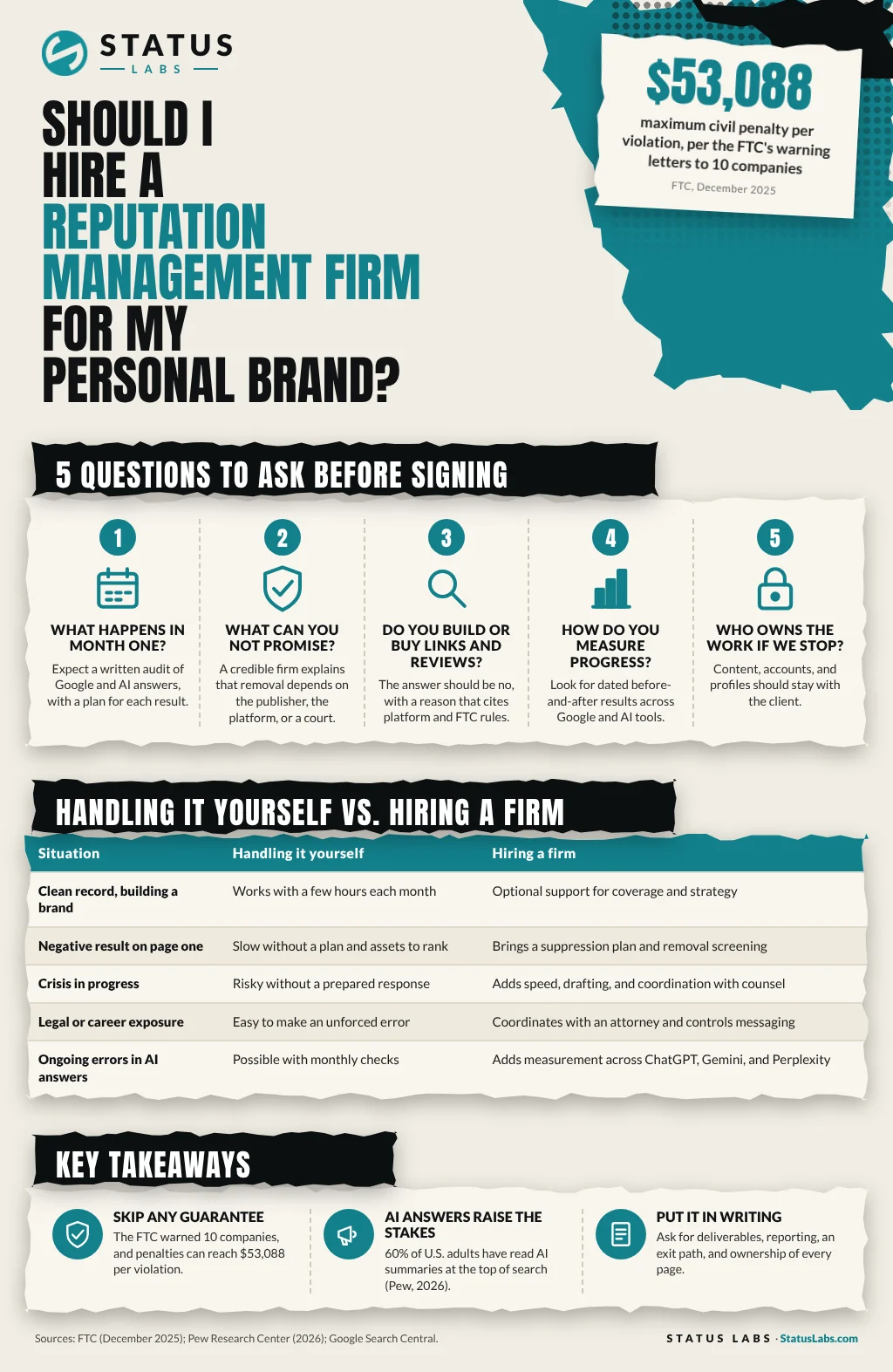
Either way, avoid any firm that guarantees removal or sells reviews. The FTC sent warning letters to 10 companies in December 2025 about possible Consumer Review Rule violations, and it warned that civil penalties can reach $53,088 per violation (see the FTC’s December 2025 warning letters).
At Status Labs, we have advised individuals on their personal brands for more than a decade. The right answer depends on the situation in front of the person (not on a sales pitch). This guide covers when to do the work yourself, when a firm earns its fee, and five questions to ask before signing anything.
When can I handle my personal brand myself?
A person can handle it alone when the search results are clean or mildly outdated and nothing negative ranks on page one. A few hours each month are enough for the job: a home base page, matching profiles, and a monthly check of Google and AI answers.
Doing it alone has a real advantage: nobody knows the facts better than the person they describe. The cost is time, and the discipline to keep a monthly check on the calendar. The risks are speed and objectivity.
People under pressure tend to respond emotionally, delete accounts, or post replies (each of which can create a new search result). A written plan prevents most of those mistakes.
A simple test helps: if the first page of results for the name holds only pages that are accurate, current, and either owned or earned, doing the work alone is a reasonable choice. If a single result would change how a client, an employer, or an investor sees the person, treat that as the signal to price a firm.
When does hiring a firm make sense?
Hiring makes sense when at least one of four conditions applies. A negative result ranks on page one, a crisis is moving faster than anyone can respond (the first hours set the tone), the stakes include legal or career risk, or consistent monitoring of Google and AI answers is not realistic. The table compares the two paths by situation.
AI answers raise the monitoring burden. In Pew Research Center’s 2026 survey (conducted February 17 to 23), 60% of U.S. adults said they have read AI summaries at the top of search results. An error in a summary can reach many readers before anyone clicks a link.
What can a firm do that I cannot do alone?
A firm adds four things. Two are method: a repeatable audit (a dated record of what Google and AI tools show), and a plan that sorts every result into remove, correct, or outrank. Two are capacity: access to publishers and editors, and monitoring that does not depend on one person’s calendar.
A firm cannot guarantee a removal, control what a publisher decides, or make a result vanish from the web. Any firm that promises otherwise is the red flag. Removal depends on the publisher, the platform, or a court, and an honest firm says so before the contract is signed.
Methods matter as much as outcomes. Google’s spam policies name buying or selling links as link spam and expired-domain abuse as another violation. A firm that builds results on those shortcuts puts the client’s name at risk of a penalty.
Ask what happens when a removal request is declined. A firm with a method has a second plan, usually stronger pages that rank in the removed result’s place, and it explains that plan before billing begins.
What should I ask before I sign?
Ask five questions, in writing if possible (written answers are easy to compare), and weigh the answers across every firm under consideration. A credible firm answers all five plainly: it treats none of them as an objection to be handled.
How should the engagement be scoped?
Scope the engagement around deliverables, not promises. Cost depends on the number of negative results, how much content has to be created, how much monitoring is needed, and whether legal coordination is involved, so a written scope matters more than a price list.
Ask for four things in the contract: a monthly deliverable (for example, a facts page, three placements, and a report), dated before-and-after reporting, a clear exit path, and ownership of every page, profile, and account created.
A short initial term (or month-to-month terms) keeps the relationship honest, because a firm that trusts its method does not need a long lock-in. We scope each engagement individually and put the deliverables in writing before work starts.
Frequently asked questions
How much does a reputation management firm cost for an individual?
Cost varies with scope, so ask for a written scope tied to deliverables and reporting, and be cautious of flat promises. The scoping section above lists the four drivers of price.
Can a reputation management firm remove negative content?
Only where a valid basis exists, such as personal contact data on a people-search page, a policy violation, or a court order. Ask any firm to name the basis for each removal request before it files one. Otherwise a firm builds stronger pages so the negative result is seen less.
How long before I see results?
Early movement can appear within the first one to three months, but lasting results take longer. The pace depends on how authoritative the negative page is and how much strong content already exists for the name.
Is it risky to handle my personal brand myself?
The main risks are speed and objectivity. A written baseline and a plan reduce both, and an advisor or a firm adds a second view when the stakes rise (before a job change or a funding round, for example).
The bottom line
The decision comes down to the problem, not the size of the name. A clean record favors doing the work alone with a plan, while a negative result on page one, a crisis, or legal exposure favors a firm that passes the five questions above. Neither path is permanent, and a person can start alone and bring in a firm later.
Our guide to choosing a reputation management agency goes deeper on comparing firms, and we cover these checks on the Status Labs YouTube channel. Take three steps this week:
- Search your name in a private window, ask three AI tools about you, and save the results with today’s date.
- Sort the results: if nothing negative sits on page one, start on your own, and if something does, price a firm using the five questions above.
- Put any firm’s scope, reporting, and content ownership in writing before paying.


