


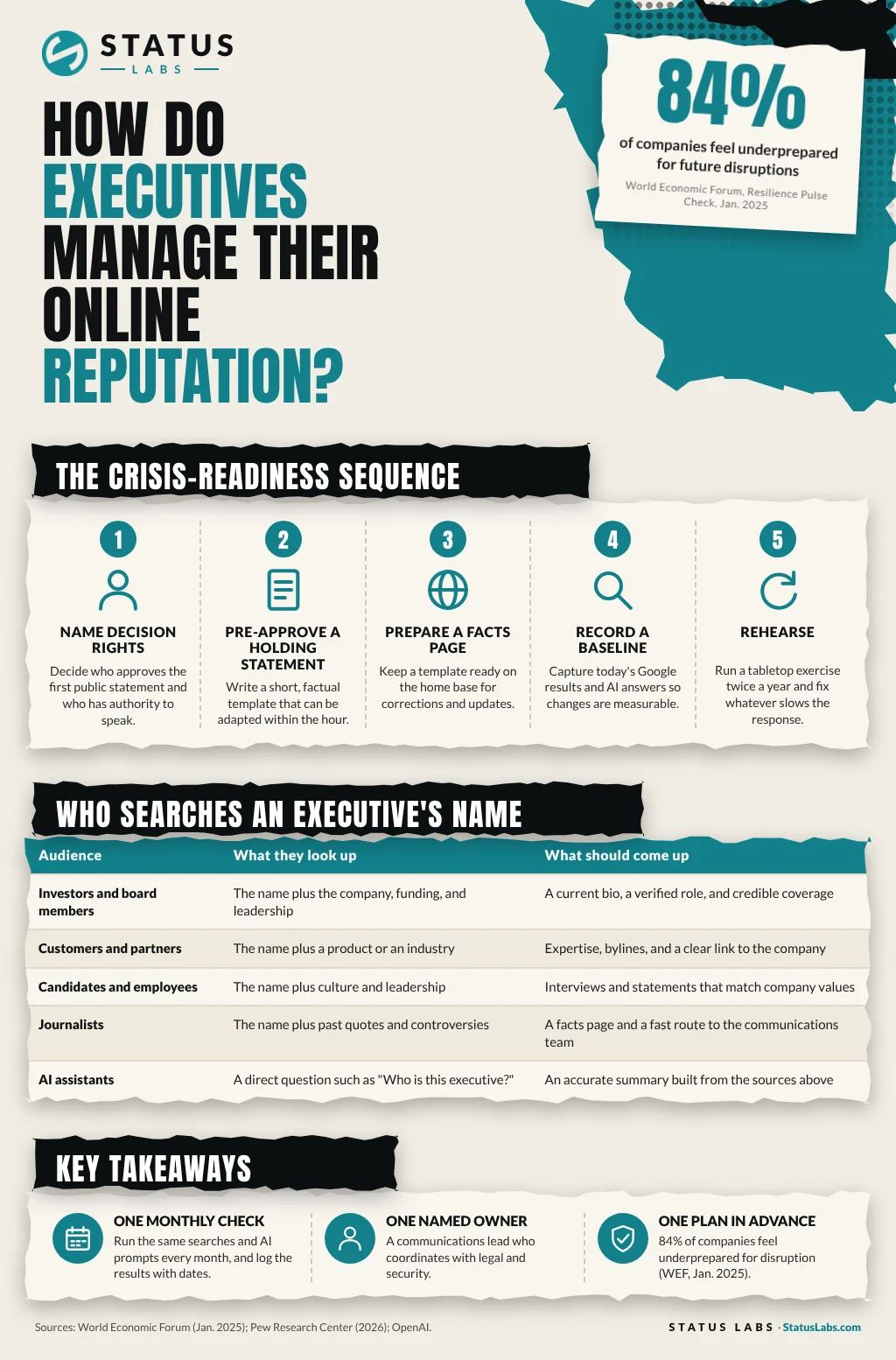
Executives manage their online reputation as an ongoing program with four parts: an accurate home base they control, independent coverage that confirms it, monthly checks of what Google and AI tools say, and a crisis plan written before it is needed. The last part is where most fall short. The World Economic Forum survey behind its January 2025 Resilience Pulse Check found that 84% of companies feel underprepared for future disruptions (more than 250 private-sector leaders responded).
At Status Labs, we have managed reputations for executives and founders for more than a decade, and we treat the work as a standing program with an owner and a calendar. This guide covers what the program includes, how executives monitor Google and AI answers, and how they prepare before a crisis.
What does executive reputation management include?
It includes four parts: a home base with the executive’s verified bio and role, independent coverage that confirms it, monitoring of Google and AI answers, and a written crisis plan. Each part serves a different audience, because an executive’s name gets searched by investors, partners, candidates, and journalists for different reasons.
The program separates the person from the company. A company page can describe a leader accurately and still leave the leader’s own search results to chance, which is why the executive’s bio, home base, and coverage need an owner of their own. The table shows who looks and what should come up.
Work through the table in order of consequence: investors and journalists decide how much a mistake costs you, so check those two rows first.
How do executives monitor what Google and AI tools say?
Executives monitor with a fixed set of searches and prompts, repeated every month and logged with dates. If you are the executive, run the first round yourself before delegating it, because the first log shows how large the gap is.
Search the executive’s name with and without the company name in a private window (and with the usual misspellings), then ask ChatGPT, Gemini, and Perplexity the same three questions and save each answer. Three prompts are enough to start: who the executive is, what the executive is known for, and whether any controversy is attached to the name.
The AI answers deserve equal weight with the search results. In Pew Research Center’s 2026 survey (conducted February 17 to 23), 60% of U.S. adults said they have read AI summaries at the top of search results. OpenAI’s research on hallucination explains the risk: models are trained and evaluated in ways that reward guessing over admitting uncertainty, so a thin or conflicting record invites a confident wrong answer.
When a log shows an error, correct the source it came from. Arguing with the tool changes nothing, while fixing the page that feeds it does. Keep the log itself, because a dated record is the fastest way to show a board, a counsel, or an editor what changed and when.
How do executives build coverage that outlasts a bad headline?
They build it before they need it. Independent coverage (interviews, bylines, podcast appearances, and conference pages) gives search engines and AI tools sources beyond the company site, and it gives an executive something credible to point to when a negative story appears.
Choose outlets the audiences already read (trade press, business media, and industry podcasts), offer one specific area of expertise, and keep every bio and title consistent with the home base. Quality matters more than volume, because three accurate features carry more weight than thirty thin mentions. We cover how we plan this coverage on the Status Labs YouTube channel.
Coverage needs maintenance. When a title changes, a company is acquired, or an award arrives, update the home base first and then ask each outlet to correct its copy, so the record stays consistent from the source outward.
Errors in coverage need a different tool. Ask the publisher for a correction in writing, cite the specific fact that is wrong, and attach a document that proves it. Editors respond to evidence and a calm tone far more often than to pressure.
How do executives prepare before a crisis?
They decide who acts, what gets said, and where it appears before anything breaks. A crisis is a bad time to learn that nobody has authority to approve a statement, because the first hours set the tone for everything that follows.
A rehearsal does not need to be elaborate. Choose one realistic scenario (a viral post, a negative article, or a data incident), walk through the first hour, and write down every point where the team hesitated.
Treat the holding statement as a living document: facts, titles, and legal advice change, so review the template at every rehearsal and after every real event.
Who should own the program?
One named person should own it, usually a communications lead who reports to the executive and coordinates with legal and security. Without an owner, the audit happens once and the footprint drifts. Our guide to managing a CEO’s digital footprint covers the privacy side of the program in depth.
The owner sets the rules for everyone else: what executives and their teams may post, who can speak for the company, and how corrections are requested. Write the rules down (one page is enough) and review them whenever the team changes. Rules that exist only in someone’s head disappear the week that person leaves.
Frequently asked questions
How often should executives audit their online reputation?
Run a quick check monthly and a full audit every quarter. Add an extra audit before a funding round, an earnings call, a leadership change, or any major announcement.
Should executives be active on social media?
Activity is optional, but accuracy is not. Keep one or two professional profiles current and consistent with the home base, and set clear rules for what executives and their teams post.
Do executives need a personal website?
In most cases, yes. A personal site gives search engines and AI tools one authoritative page the executive controls, and it anchors every other profile.
Who handles an executive’s reputation during a crisis?
The named owner coordinates the response with legal counsel, the communications team, and any outside advisors, using the decision rights set in advance.
The bottom line
Executive reputation management works when it is routine: one home base, one monthly check, one owner, and one crisis plan that exists before the crisis does. The executives who manage it well rarely do anything dramatic. They keep the record accurate and your response ready.
Start with three steps this week:
- Search your name with and without your company in a private window, ask three AI tools who you are, and save the results with today’s date.
- Name one owner for the program and put a monthly review on the calendar.
- Write a holding statement and a decision-rights note, and store both where the response team can reach them.


