
.png)


Quick answer
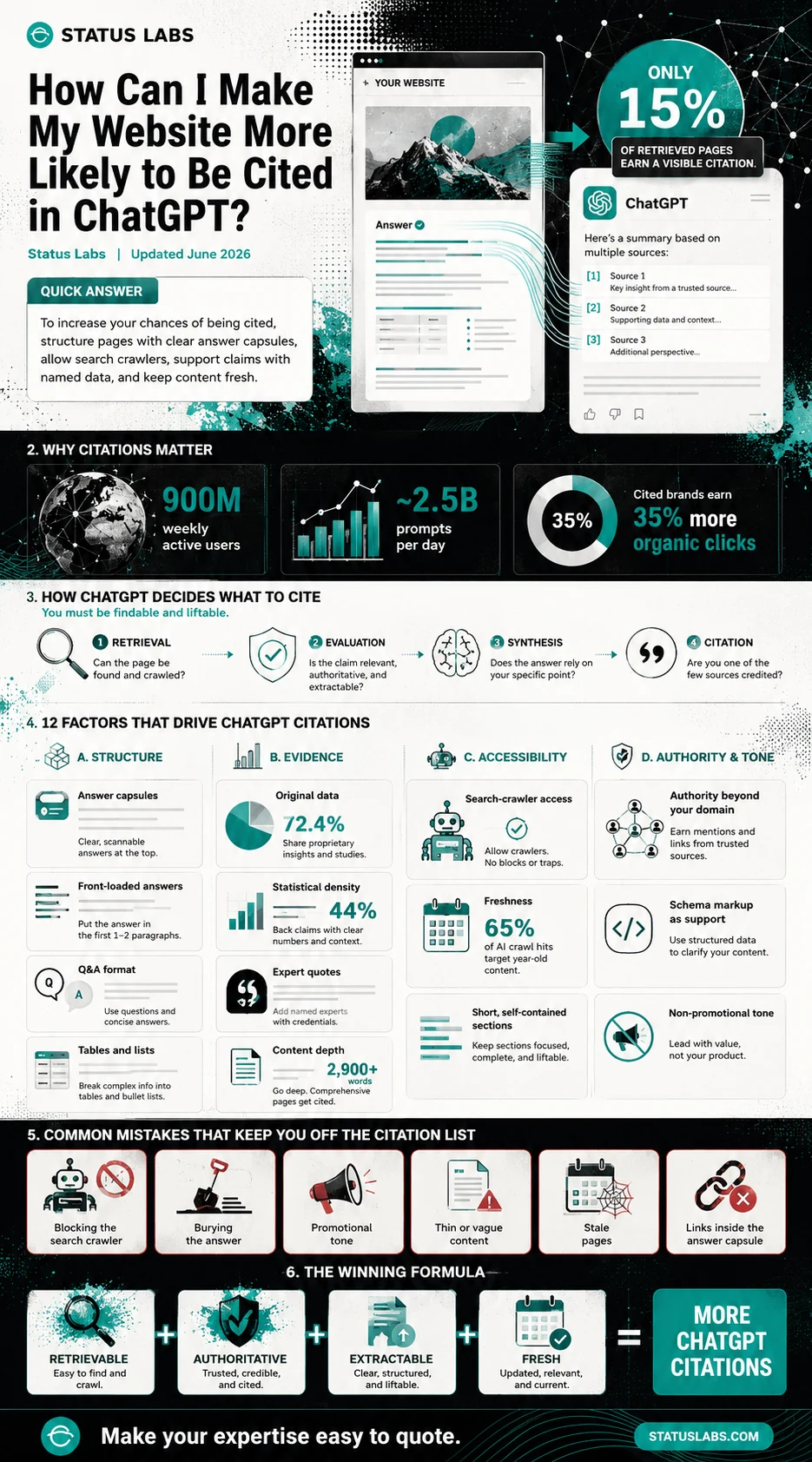
To get cited by ChatGPT, give it text it can lift cleanly: open each section with a 40 to 60 word answer that stands on its own, allow OpenAI's search crawler in your robots.txt, back claims with named data and quotes, and keep the page fresh. ChatGPT cites roughly 15 percent of the pages it retrieves, so extractability decides who makes the cut.
People also ask
Does ChatGPT actually send traffic? Yes, and the share is climbing. Cloudflare Radar clocked chatgpt.com's referral share rising from 0.13 to 0.24 percent in 75 days, the fastest growth of any referrer it tracks. About 35 percent of ChatGPT prompts now trigger a live web search, per Superlines (April 2026).
Do I need a huge domain to get cited? No. Nearly 90 percent of ChatGPT citations come from URLs ranked position 21 or lower in Google. Page structure and evidence matter more than raw domain authority.
How fast can it work? Most sites that restructure for extraction see movement within 14 to 30 days, with larger gains after about 60 days of consistent updates.
Key takeaways: 12 factors that drive ChatGPT citations
Each factor below is something you control on the page. The right column tells you exactly what to ship.
Why ChatGPT citations matter for your website
A citation in ChatGPT is a recommendation made at the exact moment someone is deciding what to trust. The audience is enormous. OpenAI reported 900 million weekly active users in February 2026, more than double the 400 million it reported a year earlier, and the platform handles roughly 2.5 billion prompts a day.
The reach is real, but so is the scarcity. When ChatGPT runs a web search, it usually surfaces only one to three sources in its answer. That narrow window is the whole game. The brands inside it get the click and the credibility; everyone else is invisible, no matter how well they rank on Google. At Status Labs, a digital reputation firm founded in 2012, we have spent the AI era mapping which on-page signals decide who lands in that window. Our AI reputation management work has reverse-engineered the patterns that separate cited sources from ignored ones.
There is a hard upside to being chosen. Brands cited inside AI answers earn 35 percent more organic clicks and 91 percent more paid clicks than uncited competitors in the same result, according to Radyant's 2026 data. And unlike a Google ranking that shifts daily, an AI citation tends to repeat across thousands of similar prompts, so the visibility compounds.
How ChatGPT decides what to cite
ChatGPT cites in four moves: it retrieves candidate pages, judges them for authority and extractability, synthesizes an answer, and then credits the few sources it leaned on most. Only about 15 percent of retrieved pages earn a visible citation, so being findable is not enough. You have to be liftable.
Step 1: Retrieval
ChatGPT pulls candidate pages from its search index. If your robots.txt blocks the search crawler or the page is not indexed, you never enter the running. Roughly 35 percent of prompts trigger this live retrieval step; the rest are answered from the model's trained knowledge.
Step 2: Evaluation
The model weighs each candidate for relevance, authority, and how cleanly it can pull a specific, quotable claim. A page that buries its answer in paragraph four loses to one that states it up top.
Step 3: Synthesis
ChatGPT blends details from several sources into one answer. Your page is competing for inclusion against every other candidate covering the same ground.
Step 4: Citation
The model credits only the sources it relied on most. Many pages feed the answer; few get named. Winning here is about being the cleanest, most specific source on the exact point being made.
10 ways to increase your ChatGPT citation rate
1. Open every section with an answer capsule
An answer capsule is a 40 to 60-word reply placed right under a question-style heading that answers the question completely, with no links and no setup. Capsules show up on 72.4 percent of ChatGPT-cited pages, the single most common trait across cited content.
The mechanics are simple once you see how the model reads. ChatGPT does not cite a 2,000-word article; it lifts a passage of a few sentences from one section. If that section opens with a clean, standalone answer, it becomes a citation candidate. If it opens with throat-clearing, the quotable line is buried where the model will not look.
A strong capsule does four things:
- Answers the heading's question in full, on its own
- Runs about 40 to 60 words, or under 200 characters
- Carries no internal or external links
- Uses plain, declarative, factual language
2. Front-load the answer, then build the argument
Put your most citable claim in the first third of the page. Growth Memo's study of 3 million ChatGPT responses found that 44 percent of citations come from the opening 30 percent of content, a pattern researchers call the ski ramp.
This inverts the classic SEO habit of teasing the answer to hold attention. For AI citation, lead with the conclusion and let the evidence follow. Each section should work the same way: claim first, proof second, context third.
3. Add original data and proprietary insight
Pages that pair an answer capsule with original data are the highest-performing configuration in citation research, present in 34.3 percent of cited posts. AI models cite what they cannot generate themselves, and your first-party numbers are exactly that.
Generic claims get paraphrased into the answer with no credit. Specific, sourced figures get cited. Give the model something only you have:
- Survey results with sample sizes and method
- Internal benchmarks and performance data
- Case-study outcomes with real metrics
- Analysis built on a proprietary dataset
Frame the figure so it is unmistakably yours. A line like “Status Labs' review of 500 reputation campaigns found 73 percent of clients saw measurable gains in AI answers within 90 days” gives the model a concrete reason to attribute the stat to you instead of folding it into general knowledge.
4. Keep sections short and packed with figures
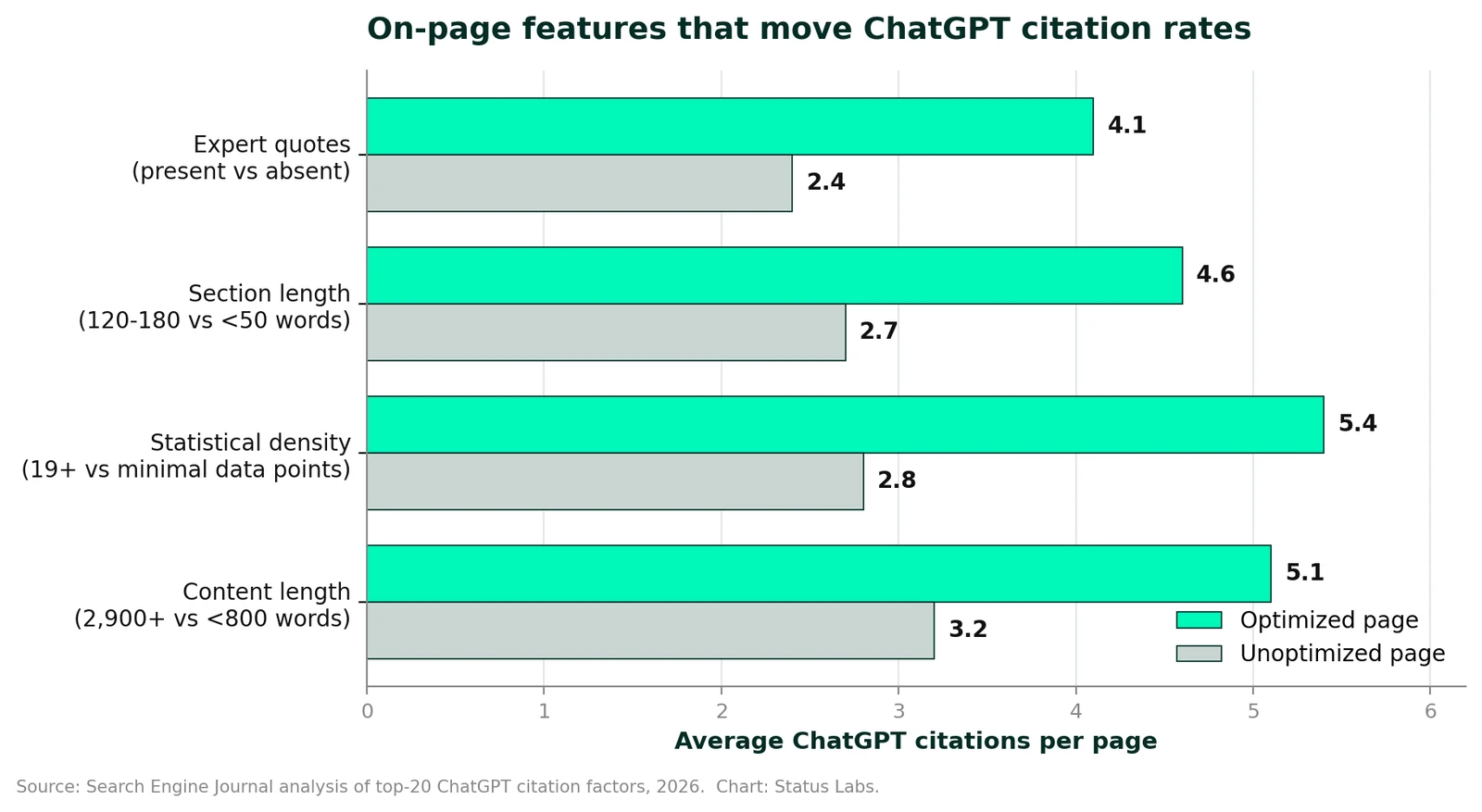
Sections of 120 to 180 words average 4.6 ChatGPT citations; sections under 50 words average 2.7. Pages carrying 19 or more data points average 5.4 citations versus 2.8 for thin pages. Tight, fact-dense sections are easy to lift cleanly.
Break long blocks into short, single-idea sections under their own headings. Then raise the factual density inside each one. Every section should hand the model at least one specific, attributable claim it can quote without needing the rest of the page for context.
5. Write comprehensive, well-structured depth
Articles over 2,900 words average 5.1 ChatGPT citations against 3.2 for pieces under 800. Length helps because thorough pages hold more quotable sections, not because word count is rewarded on its own.
Depth without discipline backfires. Padding lowers the ratio of citable claims to filler, and the model reads filler as low value. Cover the topic completely, then cut anything that does not carry a fact, a figure, or a clear answer.
6. Use tables, lists, and Q&A blocks
Comparative listicles capture 32.5 percent of all AI citations, the single highest-performing format. Q&A formatting alone correlates with a 25.45 percent lift in citation likelihood, per Semrush's 2025 analysis of more than 300,000 cited URLs.
Structured formats give the model clean extraction boundaries. Reach for them when the content genuinely fits:
- Comparison tables for features, options, or trade-offs
- Numbered steps for sequential processes
- Bulleted lists for genuinely enumerable items
- FAQ blocks that pair a real question with a tight answer
7. Allow the right crawlers in robots.txt
OpenAI now runs separate bots for training and for search. GPTBot collects training data; OAI-SearchBot indexes pages for citation; ChatGPT-User handles in-session browsing. Blocking GPTBot does not block the search crawler, so allow OAI-SearchBot and ChatGPT-User if you want citations.
This split is the most important 2026 update to the crawler strategy, and most sites still get it wrong. GPTBot is the most-blocked AI crawler on the web, sitting in more disallow rules than any other, with about 23 percent of top domains partially blocking it. Blocking the training bot is a defensible call. Blocking the search bot by accident is not, because it quietly removes you from ChatGPT's answers. Confirm which agents your robots.txt allows against OpenAI's crawler documentation.
8. Keep high-value pages fresh
ChatGPT favors recent content. Industry crawl data shows about 65 percent of AI bot hits target pages published within the past year. Stale statistics and old examples bleed citation value over time, so dated pages quietly fall out of answers.
Build a refresh cadence for your priority pages:
- Show both a publish date and a last-updated date
- Swap in current-year statistics as they land
- Add new examples and developments
- Cut recommendations that no longer hold
9. Build authority beyond your own domain
ChatGPT reads signals from across the web, not just your site. Consistent presence on review platforms, plus active mentions on Reddit and Quora, raises citation odds because the model treats third-party discussion as proof of relevance.
Earned signals carry weight that on-page work cannot replicate alone. Claim and maintain profiles on the platforms your buyers check, pursue press in credible outlets, and keep your brand facts consistent everywhere they appear. Following Status Labs on LinkedIn is one way to track how these earned-media signals are shifting month to month.
10. Use schema markup as support, not strategy
Schema markup helps AI systems read context and entity relationships, and it correlates with a 21.6 percent lift in citation likelihood. Treat it as reinforcement for strong content, not a substitute for it.
Prioritize the schema types that map to how your content is read:
- Article schema for guides and posts
- FAQ schema for question-and-answer blocks
- HowTo schema for step-by-step processes
- Organization and Author schema for trust signals
A note on where this is heading
“Search used to reward the site that ranked first. AI rewards the source that answers cleanest. The companies winning citations are not the loudest ones; they are the ones that made their expertise easy to quote.”
Darius Fisher, CEO, Status Labs
Common mistakes that block ChatGPT citations
If a page should be cited and is not, the cause is usually on this list:
- Blocking the search crawler. A blanket AI block often takes OAI-SearchBot down with it, erasing the page from ChatGPT answers.
- Burying the answer. If the quotable line sits in paragraph four, the model lifts a competitor's opening instead.
- Promotional tone. Marketing language correlates with a 26.19 percent drop in citation likelihood. Phrases like best-in-class read as noise.
- Thin or vague content. No data, no specifics, nothing to quote. The page gets paraphrased, never credited.
- Stale pages. Old figures and dead examples drop out of answers as fresher sources appear.
- Links inside the answer capsule. Hyperlinks in the lead answer correlate with lower citation rates. Keep capsules clean and place links in the supporting text below.
Frequently asked questions
How long does it take to get cited by ChatGPT?
Most sites that restructure existing pages for extraction see early movement within 14 to 30 days, with larger gains after about 60 days. Citation is an ongoing process, since answers shift as models and indexes update.
Does traditional SEO still matter for AI citations?
Yes. Strong SEO fundamentals make a page retrievable in the first place, which is the entry ticket to citations. The difference is that AI then judges extractability and evidence, not just ranking position.
Can a small site compete with big brands for citations?
Yes. Nearly 90 percent of ChatGPT citations come from URLs ranked position 21 or lower in Google, and the Princeton GEO study found that adding in-text citations lifted visibility by 115 percent for lower-ranked pages. Structure and evidence narrow the gap.
Should I create an llms.txt file?
It is a low priority. Current evidence shows little measurable effect on ChatGPT citation. Spend the effort on answer capsules, factual density, freshness, and crawler access instead.
How do ChatGPT citations differ from Perplexity or Google AI Overviews?
Each platform leans differently. ChatGPT relies heavily on Wikipedia and authoritative knowledge bases; Perplexity favors Reddit and very recent content; Google AI Overviews tracks closer to top organic rankings. Only about 11 percent of domains get cited by both ChatGPT and Perplexity, so a single page rarely wins everywhere by accident.
Does Status Labs help with ChatGPT citation optimization?
Yes. Our AI reputation management work is built to improve how the major models, including ChatGPT, Claude, Gemini, and Perplexity, represent and cite a brand.
About Status Labs
Status Labs is a digital reputation firm founded in 2012, with offices in Austin, New York, Los Angeles, Miami, London, and Hamburg. The firm was named to the Inc. 5000 four years running, from 2016 through 2019, and works with Fortune 500 brands, venture-backed companies, and globally known executives. To see the team's work, visit Status Labs.
Let's ensure your voice is the one AI surfaces first.
.png)

.png)
