


To get ahead of a PR crisis online, build readiness before anything breaks, watch for early signals so you act while a story is still small, and publish accurate answers where search engines and AI tools will look for them. In practice, that means five moves: name your likely crisis scenarios and write holding statements for them, set up monitoring across news, social platforms, review sites, and AI answers, assign decision rights so a response takes hours instead of days, prepare a facts page that you can publish immediately, and rehearse the plan. Most organizations react after a crisis is already underway, and the ones that prepared get to shape the first version of the story, which tends to set the frame for everything after it. At Status Labs, we build this readiness for clients, and our analysis of the fast-moving crises of 2025 found viral moments reaching tens of millions of viewers within 24 to 48 hours.
This guide covers how to prepare, which early warning signals to watch, what to do in the first hours, and how to influence what Google and AI tools say while a story is still forming.
KEY TERM, crisis readiness: the combination of plans, monitoring, approval paths, and pre-built content that lets an organization respond to a reputational threat within hours, before the first version of the story hardens.
What does getting ahead of a crisis actually mean?
It means acting in three windows: before a crisis, in its first signals, and in its first hours. Each window has its own job. Before a crisis, you prepare. In the first signals, you detect the problem while it is small. In the first hours, you verify the facts, respond if a response is warranted, and put accurate information where people and machines will find it.
The preparation gap is large. Only 16 percent of respondents in the World Economic Forum's 2025 Resilience Pulse Check felt well prepared to respond to a crisis, according to PwC's May 2026 analysis of crisis readiness. PwC adds that many organizations define escalation thresholds, response protocols, and decision pathways only after a crisis is already underway, which creates delays when speed matters most.
How do I prepare before a crisis starts?
Preparation comes down to decisions you make while things are calm. Here is the sequence we use with clients.
- Map your likely scenarios. List the realistic threats for your organization, such as a product failure, an executive conduct issue, a data incident, a viral customer complaint, a review attack, or fabricated content.
- Write holding statements and approval paths. A holding statement acknowledges that you are aware of the issue, says you are looking into it, and commits to an update by a set time. Decide in advance who approves it and how fast.
- Name a small response team with clear decision rights. Include communications, legal, an executive with authority, and the person who controls your website and social accounts.
- Prepare your owned channels. Keep a facts page template ready to publish, confirm who has access to every official account, and make sure your website can be updated in minutes.
- Record your search and AI baseline. Capture what Google shows for your name and brand, and what the major AI tools say when asked about you, so you can measure change later.
- Build credible coverage and a strong owned presence now. Authoritative pages and third-party coverage in place before a crisis give search engines and AI tools better material to draw from.
- Rehearse twice a year. Run a short tabletop exercise on one scenario and fix whatever slows the team down.
This work sits at the center of our corporate reputation management and strategic advisory practices.
Which early warning signals should I watch for?
Watch the places where a problem first becomes visible, and decide in advance what happens in the first hour after each signal. This table shows the signals we monitor most closely.
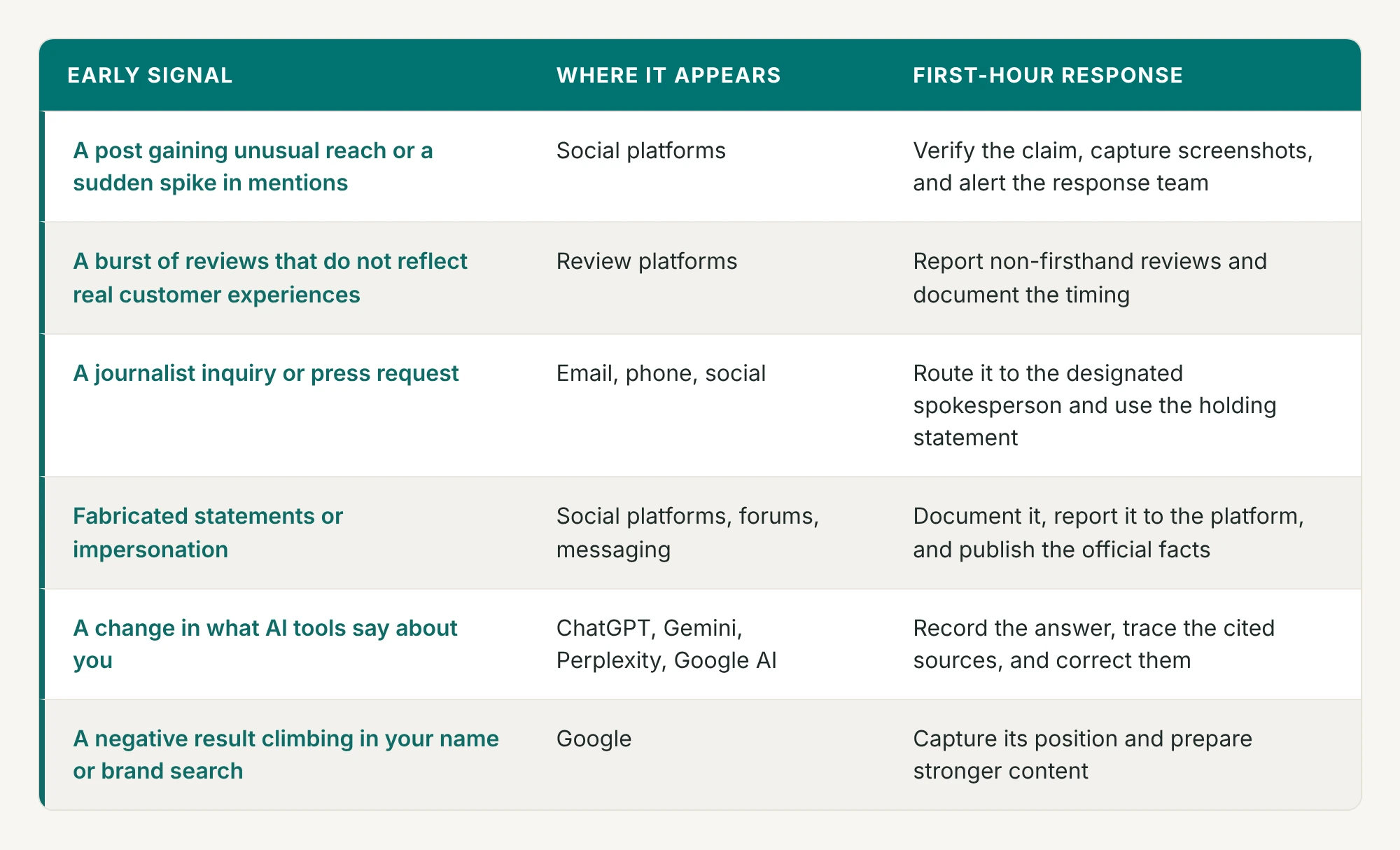
Review platforms often show the first measurable sign. Yelp's Trust & Safety Report found, in its U.S. data, a 58 percent year-over-year increase in alerts placed on business pages after public attention or unusual activity, and 75 percent of those incidents stemmed from viral social media posts. Those alerts led to the removal of more than 80,000 reviews in 2025. A sudden flood of reviews can signal a story spreading on social media before you see it anywhere else.
What should I do in the first few hours?
Verify, convene, decide, and publish, in that order. The first hours reward a calm sequence over a fast reaction.
- Verify the facts. Establish what is accurate, what is false, and how far the story is spreading before you say anything publicly.
- Convene the response team. Use the roles and approval paths you set in advance.
- Decide whether to respond publicly. A response is right when the story is spreading widely or contains falsehoods, and a small story may fare better without added attention.
- Publish a short, factual statement on a channel you control, such as your website, and brief your employees at the same time.
- Keep every spokesperson and channel consistent, since contradictions become the next headline.
For the full in-the-moment playbook, see our guide on responding to a viral negative article. If false statements are circulating, our false information guide explains the removal and correction routes.
How do I shape what Google and AI tools say while the story forms?
Publish accurate, specific, answer-first content early, because search engines and AI tools build their answers from whatever authoritative material exists. A facts page with dates, corrective actions, and clear headings gives those systems something precise to cite when someone asks what happened. Our 2025 analysis found that multiple narratives about the same crisis can coexist in AI search, and that the narrative with more authoritative content may shape the answer.
The audience is already asking. BrightLocal's 2026 consumer survey found that the share of consumers using AI tools to find local businesses rose from 6 percent to 45 percent in one year. Our 2026 whitepaper explains how we read and shape those AI answers, so that the version of events people receive matches the facts.

Frequently asked questions
How early can I detect a PR crisis?
Monitoring across news, social platforms, review sites, and AI answers can surface a problem within hours of it appearing. What matters is that someone owns the alerts and knows exactly who to call, because detection without a decision path wastes the head start.
Does a small company need a crisis plan?
Yes. A one-page plan with the likely scenarios, a holding statement, a named decision-maker, and a monitoring routine covers most of what a small company needs. Writing it while things are calm is the step that saves time later.
What should a holding statement say?
It should acknowledge that you are aware of the issue, say you are looking into it, avoid speculation, and commit to an update at a specific time. A holding statement buys time to verify the facts without leaving a silence for others to fill.
Should I respond to every negative mention?
No. A small story that is not gaining traction can grow if you draw attention to it. Reserve public responses for stories that are spreading or contain falsehoods, and handle the rest directly with the people affected.
Can an agency prevent a crisis?
No agency can prevent every crisis. A good partner reduces your exposure, builds the monitoring and content that shorten your response time, and helps you act in the first hours. We explain how this works on our YouTube channel.
The bottom line
Getting ahead of a PR crisis online comes down to three habits: prepare scenarios, statements, and decision rights while things are calm, monitor the places where trouble shows up first, and publish accurate answers early so search engines and AI tools have the facts. The organizations that do this shape the first version of the story instead of reacting to it. Because AI tools now summarize what people find, the work extends beyond the news cycle to every answer that follows.
If you have no crisis plan today, start this week: write down your three most likely scenarios, name the person who approves a public statement, and draft one holding statement for each scenario. That one hour of work is the foundation for everything else.


