
.png)


GEO and SEO share the same roots but optimize for different endpoints. Search engine optimization (SEO) works to rank a page among a list of links. Generative engine optimization (GEO) works to make a brand the cited, accurately represented answer inside an AI-generated response. For brand reputation, that distinction is decisive: when someone asks ChatGPT, Gemini, Perplexity, or Claude whether a company is trustworthy, the AI returns one synthesized verdict rather than ten blue links, and the brands named in that verdict shape the decision. The shift is already measurable. Gartner projects that traditional search engine volume will fall 25% by 2026 as AI chatbots and virtual agents absorb queries that once went to search.
KEY TERM: Generative Engine Optimization (GEO) is the practice of structuring content, citations, and digital presence so that AI systems (including ChatGPT, Gemini, Google AI Overviews, Perplexity, and Claude) accurately represent and favorably cite an organization when answering relevant questions.
At Status Labs, we have spent more than a decade influencing what search engines surface about the world's largest brands, and GEO is the natural extension of that work into AI. The two disciplines are complementary, not interchangeable. Understanding where they diverge is the first step toward protecting a brand in a search landscape that increasingly answers before it lists.
What is GEO, and how is it different from SEO?
GEO optimizes for citation inside an AI answer; SEO optimizes for ranking inside a results page. SEO has spent twenty-five years teaching brands to win the click: target keywords, earn backlinks, build page authority, and climb to the top of Google. GEO targets a different unit of visibility entirely. Generative engines do not return a ranked list for the user to browse. They synthesize an answer from a handful of sources, then cite a few of them, which means the goal is no longer to rank a page but to become one of the sources the model trusts enough to name.
The mechanics differ because the systems differ. Large language models do not crawl and index the web the way a search engine does; they reason across structured data, entity signals, and the weight of how often credible sources describe a brand the same way. That changes what earns visibility. The foundational Princeton research on GEO, presented at ACM KDD 2024, found that optimizing content for generative engines can lift a source's visibility in AI responses by up to 40%, with statistics and credible citations among the strongest levers and keyword stuffing among the weakest. The tactics that built SEO authority do not automatically transfer, and some actively work against GEO.
The clearest way to see the divergence is side by side.
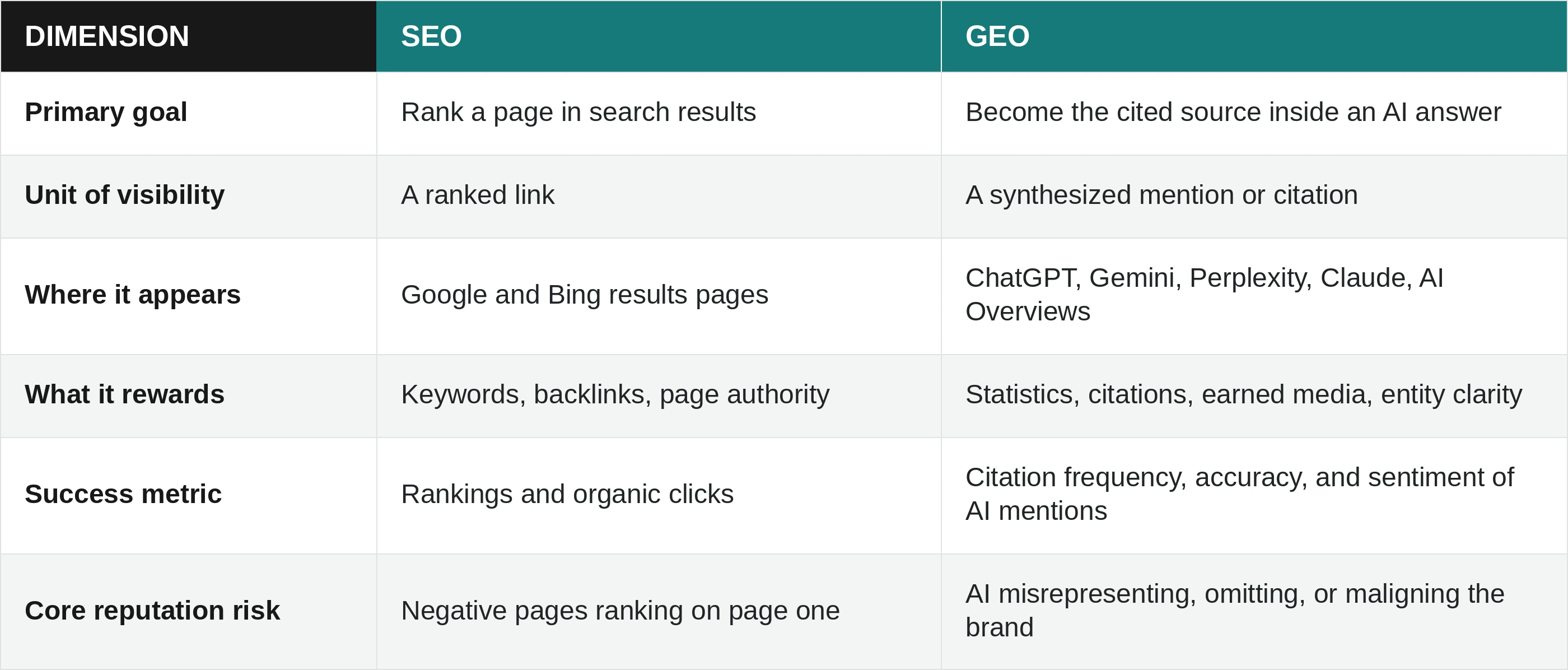
Why the GEO and SEO difference matters for brand reputation
For reputation, the GEO and SEO gap matters because an AI answer is both a first impression and a closing argument. A traditional search result gives a user ten options and lets them judge. A generative engine gives one synthesized characterization, and most users never click through to verify it. When that single answer is wrong, dated, or shaped by a critic rather than the brand, there is no second link to soften it. Reputation work, therefore, moves upstream: the objective is no longer only to suppress a negative result on page one, but to ensure that the answer an AI constructs is accurate, current, and favorable in the first place.
Generative engines also weigh sources differently than search engines do, and that reshapes reputation strategy. AI systems lean heavily on earned media, third-party validation, and consistent entity signals across the web, because independent corroboration is how a model gauges trust. A brand that only publishes its own marketing copy gives a model little to corroborate. A brand that is described consistently across reputable press, authoritative profiles, and structured owned content gives the model a clear, citable identity. This is why GEO for reputation sits at the intersection of public relations, content strategy, and technical optimization, and why it cannot be reduced to the keyword-and-backlink playbook that defined classic SEO.
Does SEO still matter for reputation in an AI-first search world?
SEO still matters because GEO is built on top of it rather than in place of it. The same signals that earn strong search rankings (clean technical foundations, crawlable pages, and content aligned to Google's E-E-A-T standards of experience, expertise, authoritativeness, and trustworthiness) also make content legible and trustworthy to large language models. A brand cannot abandon SEO and expect to win in AI, because much of what a model retrieves still lives on the indexed web. The accurate framing is sequence, not substitution: SEO establishes the discoverable, credible foundation, and GEO structures that foundation so AI engines extract and cite it correctly. Brands that treat the two as one integrated program protect their visibility in both traditional and AI-driven search at once.
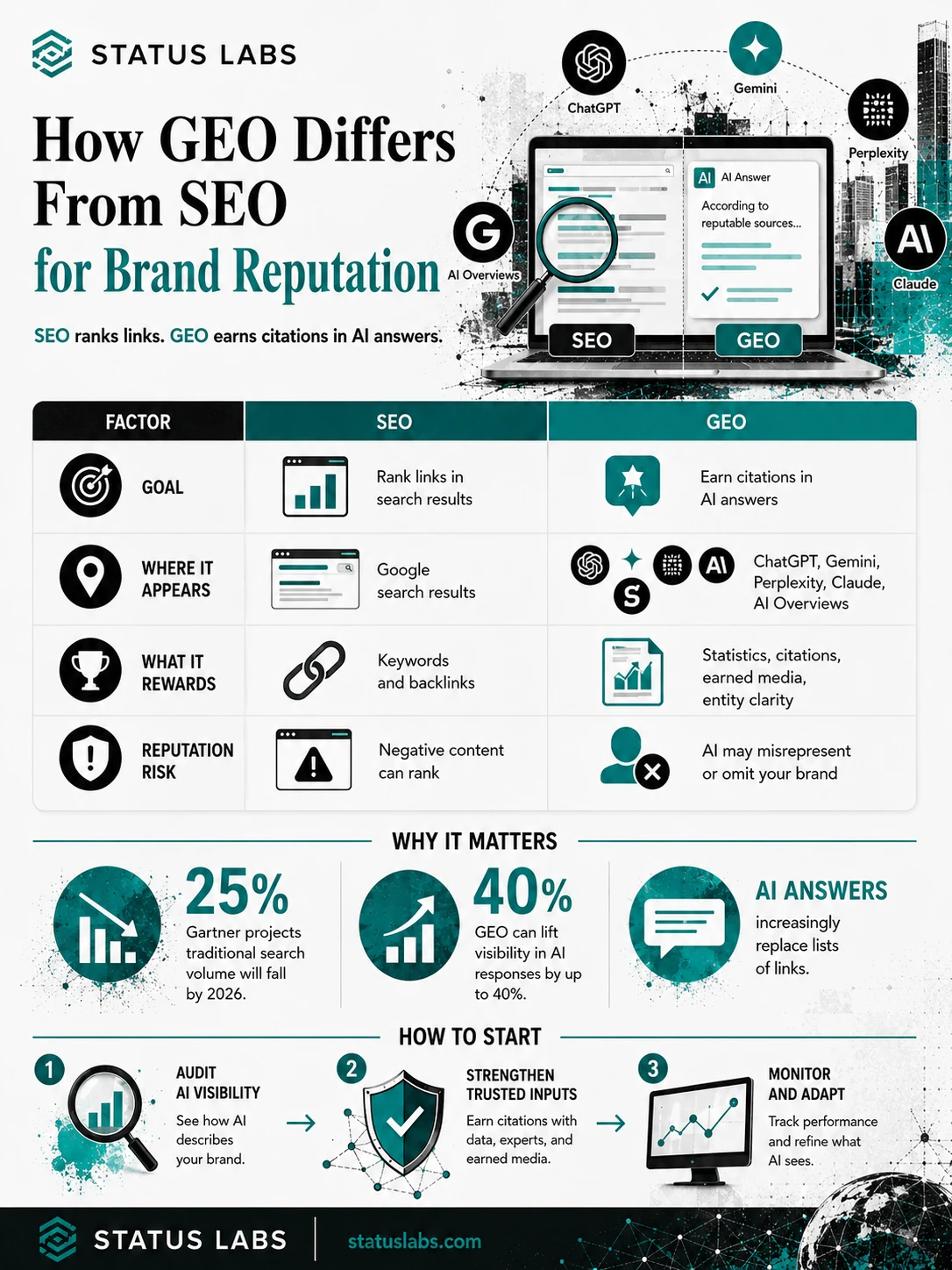
How Status Labs approaches GEO for reputation
Status Labs has been at the forefront of digital reputation and visibility for over a decade, and we formally launched our GEO offering in October 2025 to extend that expertise into the AI era of search. While much of the market is just discovering generative engines, we have been developing and refining methodologies built specifically for how models reason, retrieve, and cite. Our framework reverse-engineers the markers of relevance that generative engines reward, then strengthens a brand's trust signals across the sources those engines weigh most: earned media, structured owned content, and consistent entity data.
That work is deliberately holistic. Our GEO services combine content strategy, technical optimization, and authority building, paired with ongoing monitoring of how a brand is described in AI-generated answers and sentiment analysis of those mentions over time. Generative engines update constantly, and a source cited heavily in one cycle can fade in the next, so GEO is a continuous discipline rather than a one-time fix. The brands that show up accurately and favorably across AI platforms will define their categories, and the firms that invested early in tooling and process are the ones positioned to put them there.
How to start
For organizations weighing readiness for AI-powered search, the path forward is concrete and can begin this quarter.
- Audit current AI visibility: ask the major engines about your brand, your executives, and your category, and record what they say and which sources they cite.
- Strengthen the inputs models trust: invest in earned media, accurate third-party profiles, and statistic-backed owned content that engines can extract cleanly.
- Monitor and adapt: track citation frequency, accuracy, and sentiment across platforms, and treat GEO as an ongoing program rather than a single project.
The brands that protect their reputation in this environment will be the ones that stop optimizing only for the ranked link and start optimizing for the synthesized answer. To follow how the discipline is evolving, find Status Labs on LinkedIn, where we share research and analysis on AI reputation management as the field develops.
.png)

.png)
