
.png)


The best way to push down negative stories in AI results is to flood the retrieval layer with positive, well-sourced, structurally clean content that answer engines prefer to cite, so the negative material is crowded out of the handful of sources a model actually pulls. You cannot delete a story from ChatGPT, Gemini, or Perplexity the way you might file a removal request. But you can change what those systems retrieve and quote, and that is where the work happens. At Status Labs, we have spent the last several years building this discipline (Generative Engine Optimization, or GEO) into a repeatable practice for the brands and executives we protect.
This guide explains how AI suppression actually works, why it is different from old-school search suppression, and the exact steps we use to move a negative narrative out of the answer.
KEY TERM, AI suppression: the practice of reducing how often, and how prominently, AI answer engines surface a negative story about a brand or person, achieved by publishing authoritative content that models retrieve and cite in its place. It does not erase the source. It displaces it.
Why can't you just delete a negative story from AI results?
You can't delete it because AI answers are generated, not stored. When you ask ChatGPT about a company, the system runs a live retrieval step (a process called retrieval-augmented generation, or RAG), pulls a small set of web sources, and synthesizes an answer from them. There is no single "result" sitting in a database to take down. The model rebuilds the answer every time from whatever the retrieval layer hands it.
That mechanic is the opening. AI answer engines typically cite only a few sources per response, far fewer than the ten blue links on a Google page. If your positive, authoritative content occupies those few slots, the negative story never makes the cut. Suppression in AI search is a competition for a very short list, which is why it rewards quality and structure over volume.
What's the best way to push down negative stories in AI results?
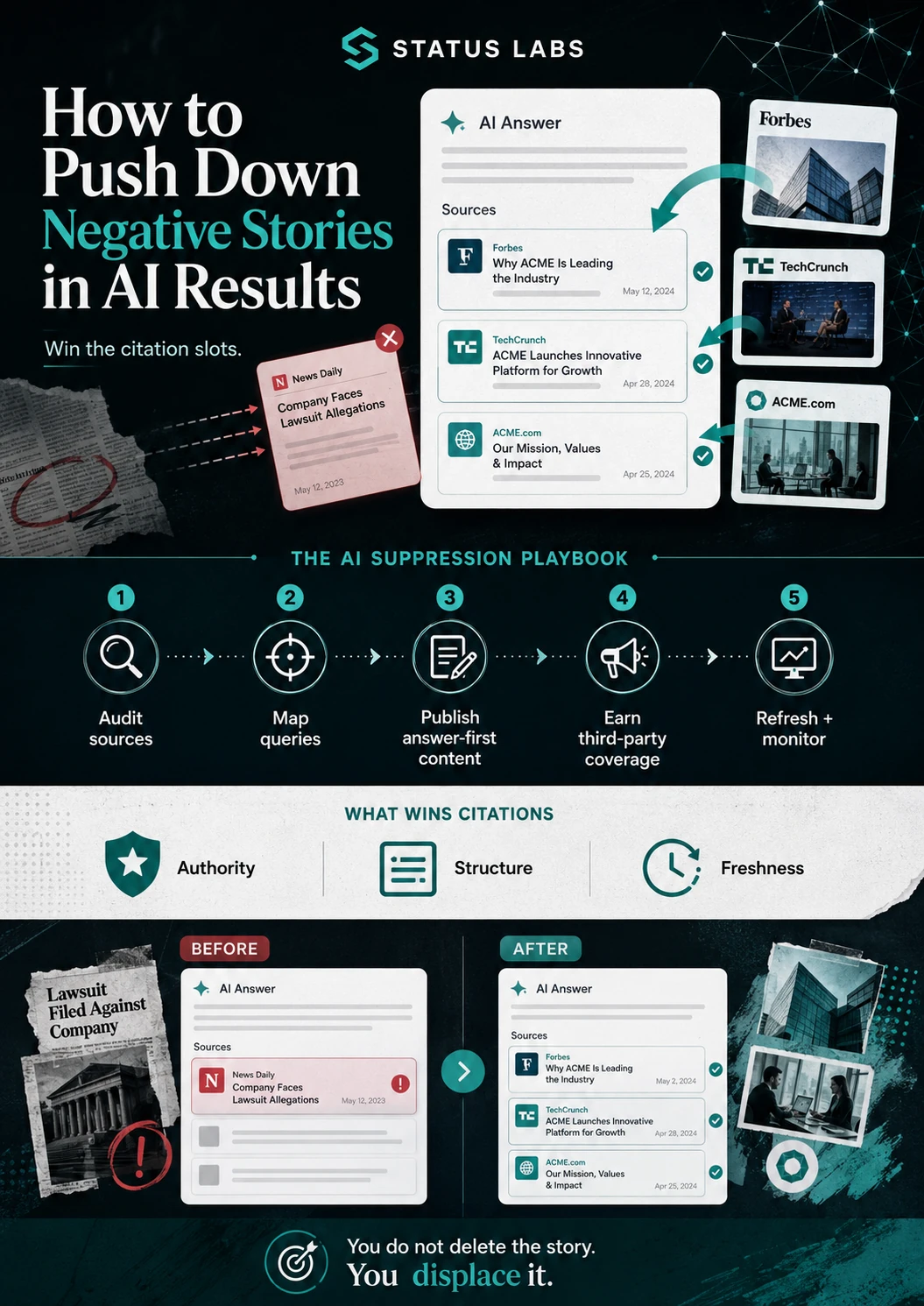
The best way is to win the citation slots: publish high-authority content that directly answers the queries where the negative story currently surfaces, structure it so models can extract it cleanly, and reinforce it with earned third-party coverage that LLMs weigh heavily. The negative story does not have to disappear. It only has to stop being one of the two to seven sources a model chooses to quote.
Three forces decide which sources an answer engine picks, and an effective push-down strategy works all three at once:
- Authority: models favor sources others vouch for, especially earned media and reputable third-party publications.
- Structure: clean, answer-first content with clear headings and verifiable facts is easier for a model to extract and cite.
- Freshness: recent, dated content is weighted more heavily, since most AI-cited sources are published within the last two years.
Get all three right across enough surfaces, and the math shifts in your favor. This is the core of effective AI reputation management, and it is the same logic we apply for every client narrative we reshape.
How AI suppression differs from traditional SEO suppression
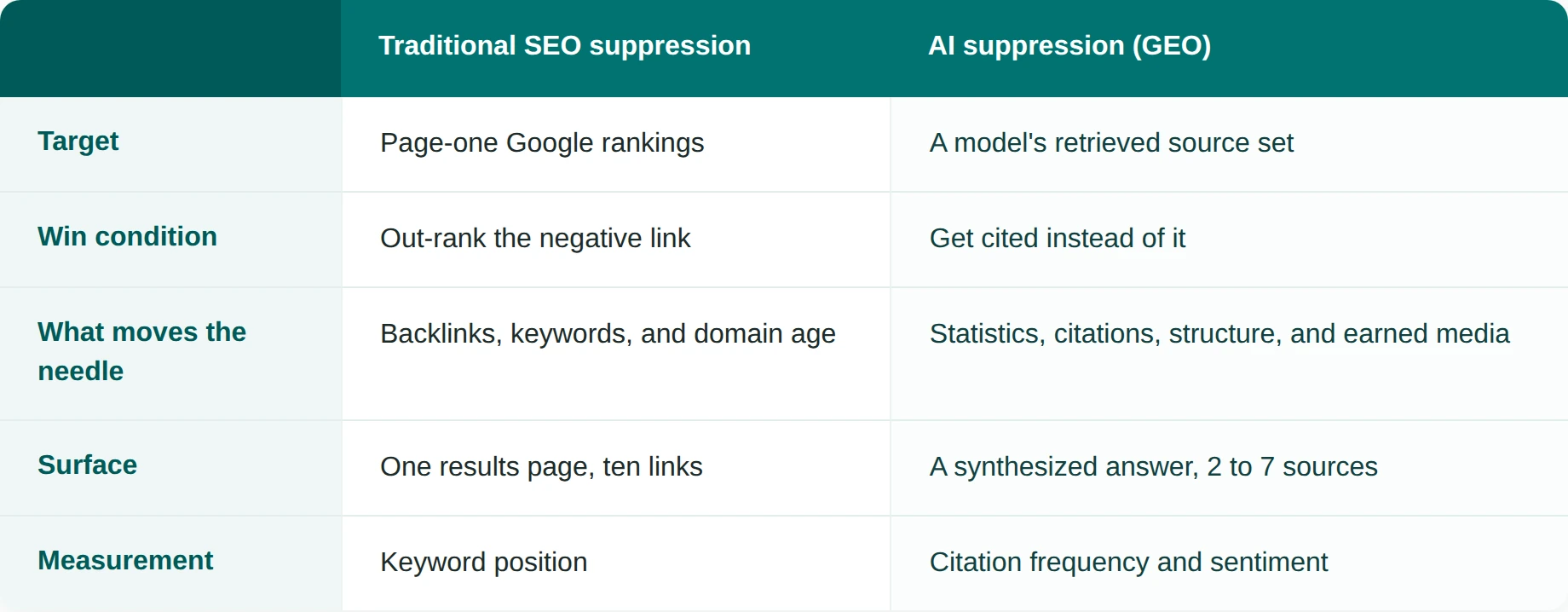
Traditional suppression pushes negative links to page two of Google by outranking them with positive pages. AI suppression pushes negative stories out of a model's retrieved source set so they are never quoted. The goal moved from "rank above it" to "get cited instead of it," and the tactics changed with it.
The Princeton-led research that formalized GEO, presented at KDD 2024, tested nine content strategies across 10,000 queries and found that adding statistics, citing sources, and including direct quotations each lifted a page's visibility in AI answers by roughly 30 to 40 percent. Notably, the study found keyword stuffing among the weakest tactics, the opposite of what classic SEO often rewarded. Evidence density wins citations. Repetition does not.
The shift is not academic. ChatGPT reached more than 800 million weekly active users by the time of OpenAI's October 2025 DevDay, and Reuters reported it crossed 900 million weekly users and one billion monthly users by mid-2026. For a growing share of people, the AI answer is the first and only impression of your brand.
The playbook we use at Status Labs
Here is the sequence we run when a negative story is surfacing in AI answers. It is the operational core of our GEO practice, and it works because it targets the retrieval layer directly rather than fighting yesterday's ranking battle.
- Audit the answer. Ask the major engines (ChatGPT, Gemini, Perplexity, Claude, Google AI Overviews) the real questions where the negative story appears, and record which sources each model cites. You are mapping the source set you need to displace.
- Map the target queries. Identify the exact prompts driving the negative narrative, then write to those prompts. A section that answers "is [brand] legitimate" should be headed with that question and answer it in the first sentence.
- Publish authoritative, answer-first content on your owned domains. Lead each page with a direct answer, attach a dated statistic to every major claim, cite primary sources, and structure with clean headings and FAQs so models can lift a clean chunk.
- Build earned third-party coverage. Secure placements in reputable news outlets, industry publications, and trusted directories. LLMs weigh earned media heavily, so this is the highest-leverage move for changing which sources a model trusts.
- Add machine-readable structure. Use schema markup (Organization, Person, FAQ, HowTo), so crawlers parse your content as authoritative and citation-ready.
- Refresh on a cycle. Update dated content regularly. Freshness is a ranking factor in retrieval, and a stale page loses ground to a recent one.
- Measure citations, not rankings. Track how often each engine cites your content, whether the citation represents you accurately, and the sentiment of the surrounding answer. That is the real scoreboard for AI suppression.
Frequently asked questions
Can you remove a negative story from ChatGPT entirely?
No, not directly. ChatGPT generates answers from live retrieval, so there is no stored result to delete. What you can do is change the inputs: publish and earn enough authoritative content that the model retrieves and cites your sources instead. For a deeper walkthrough, see our guide on removing negative information from AI search.
How long does AI suppression take?
It varies with how entrenched the negative story is and how much authority your owned and earned content already carries. Brands with an existing base of reputable coverage and clean owned pages tend to move faster, because the authority and freshness signals are already partly in place. Building from a standing start takes longer, since earned media and entity authority accumulate over months, not days.
Does fixing AI results also help Google?
Often yes. The structured, well-sourced, earned-media-backed content that wins AI citations also strengthens traditional search authority, so a well-run GEO program tends to improve both surfaces at once. We see the two reinforce each other across client programs, a point we discuss regularly on the Status Labs LinkedIn page.
The bottom line
Pushing down negative stories in AI results comes down to one principle: own the sources the model wants to cite. Audit what the engines currently quote, publish answer-first content backed by statistics and primary citations, earn third-party coverage that LLMs trust, structure everything for clean extraction, and keep it fresh. Do that consistently, and the negative narrative loses its place in the answer, not because it was deleted, but because something better took its slot.
If a negative story is shaping how AI describes you right now, the first move is the audit: find out exactly what the engines are citing today, and start building the content ecosystem that will replace it.
.png)

.png)
