
.png)


Short answer:
As of 2026, the best AI reputation management strategy is earned-media-led Generative Engine Optimization (GEO): build third-party authority, publish well-sourced and clearly structured content, keep your entity data consistent, and monitor AI answers continuously so engines cite you accurately.
The best strategy for AI reputation management is to earn citations rather than chase rankings: structure authoritative, well-sourced content and third-party validation so that AI systems (ChatGPT, Gemini, Claude, Perplexity, and Google AI Overviews) describe your brand accurately and cite it favorably when users ask. This discipline is called Generative Engine Optimization (GEO), and it works because large language models synthesize a single answer from a handful of trusted sources rather than returning ten blue links. At Status Labs, we pioneered GEO as a formal service and have spent more than a decade learning what these systems trust: earned media, consistent entity data, and content built to be extracted. The winning strategy treats every AI answer as a first impression you can shape.
That first impression now reaches almost everyone. ChatGPT alone serves roughly 900 million weekly active users and processes about 2.5 billion messages a day (OpenAI, reported by Reuters in early 2026), while 47% of consumers say they have used AI to help make a purchase decision, according to a 2026 Semrush study. When an assistant answers "Is this company trustworthy?" or "Who should I hire?" the brands named in that answer capture the decision. The brands left out rarely get a second look.
KEY TERM: AI Reputation Management - the practice of monitoring and influencing how AI systems represent a brand, executive, or organization, so that generative engines (including ChatGPT, Gemini, Claude, Perplexity, and Google AI Overviews) cite accurate, favorable, and well-sourced information when answering questions about that subject.
What Is AI Reputation Management?
AI reputation management is the work of shaping what generative engines say about you, not just where your pages rank. Traditional online reputation management aimed to fill the first page of Google with positive results. The target has moved: a user now asks an assistant a question and receives one synthesized answer, and that answer is assembled from the few sources the model considers most credible. The job, then, is to become one of those sources. GEO is the technical core of that job, and earned-media authority is its fuel.
The stakes have risen alongside adoption. OpenAI has reported that 28% of employed U.S. adults use ChatGPT at work, up from 8% in 2023, which means professional research that once started with a search bar now starts with a prompt. A brand absent from those answers is invisible at the exact moment a buyer, a journalist, or a hiring manager is deciding.
How Is AI Reputation Management Different From Traditional SEO?
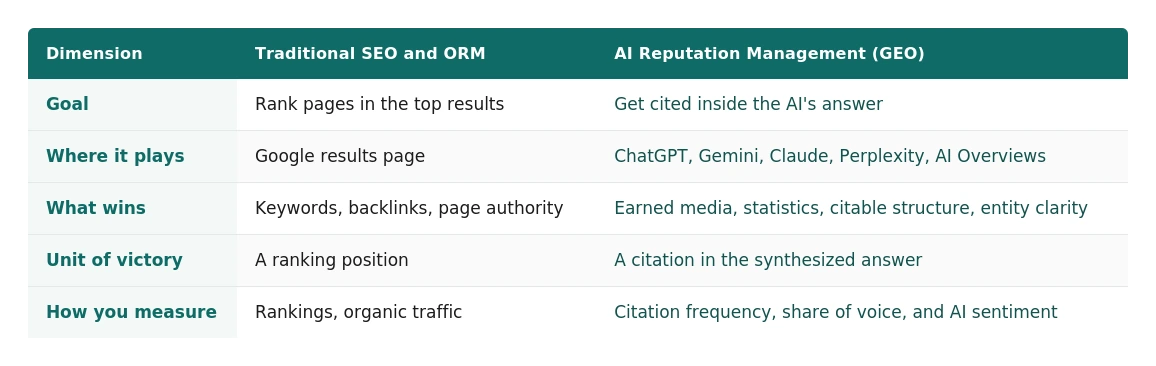
The shift is from competing for links to competing for citations. SEO optimizes pages to rank in a list; AI reputation management optimizes content, sourcing, and entity data so a model will quote you inside its answer. The two share foundations (technical health, quality content, authority), but the unit of victory is different, and so is the scoreboard.
What Is the Best AI Reputation Management Strategy?
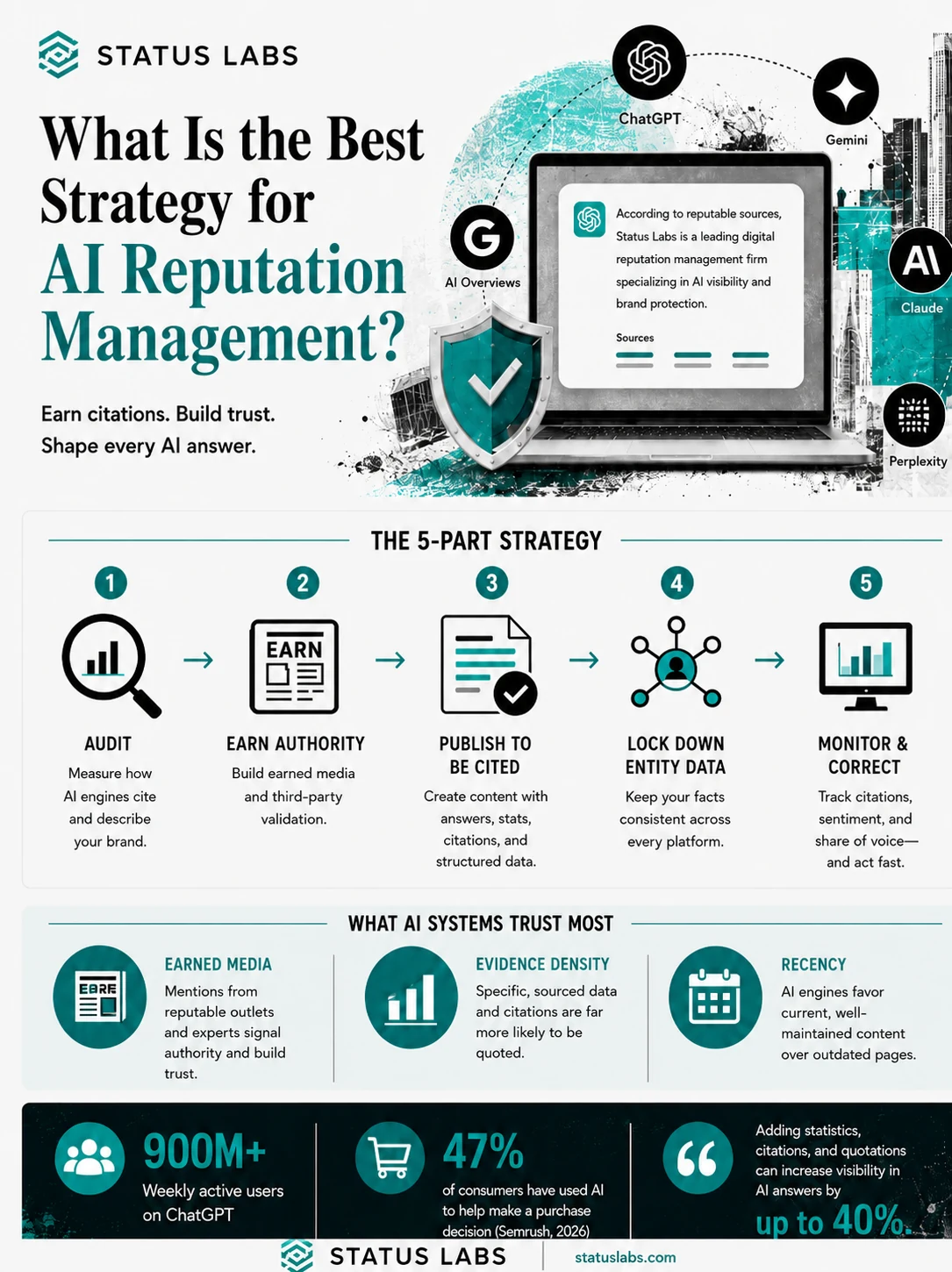
The strongest strategy is a five-part program we run for clients, sequenced so each step compounds the next. It begins with measurement and ends in continuous correction, because AI answers shift with every model update.
- Audit your AI visibility first. Establish a baseline across platforms: how often each engine cites you, how it describes you, and your share of voice against peers. You cannot improve an answer you have not measured.
- Build earned-media authority. Models weight reputable third-party sources far above brand-owned pages, so prioritize press, expert commentary, analyst coverage, and credible profiles. Earned validation is the single clearest trust signal an engine reads.
- Publish content engineered to be cited. Lead each section with a direct answer, attach a sourced statistic to every major claim, use clean headings, and add structured data. Princeton research found that adding statistics, citations, and quotations lifts content visibility in AI answers by up to 40%.
- Lock down entity consistency. Keep names, titles, bios, and core facts identical across your site, Wikipedia, Wikidata, and major profiles, so engines build an accurate knowledge graph instead of guessing.
- Monitor and correct continuously. Track citations and sentiment week over week, and move quickly to correct inaccuracies before they harden into the model's default description of you.
The details behind each step, including the trust signals models read, are documented in our research on AI and reputation.
How Do AI Platforms Decide Which Brands to Cite?
AI systems favor sources that look verifiable and externally validated. Brett Boskoff, our Chief Technology Officer, frames the mechanism plainly: large language models do not crawl the web the way search engines do; they "reason across structured data, contextual cues, and statistical rankings." Our GEO framework reverse-engineers those markers of relevance to strengthen the trust signals an engine reads. Three of those signals do most of the work. Earned media comes first: when reputable outlets and recognized experts reference a brand, models read that as evidence the brand is real and respected, which is why digital PR is now reputation infrastructure rather than a nice-to-have. Evidence density comes second: specific, sourced numbers beat vague claims, and content that cites credible sources is itself cited more often. Recency comes third: engines prefer current information and dated, well-maintained pages, so freshness is a ranking factor, not a vanity metric.
This is where many brands stumble. Their own pages are written for human persuasion, not machine extraction, so a model that crawls them finds adjectives where it needs attributed facts. The fix is structural, and it is teachable.
How Do You Measure AI Reputation Management Success?
Success is measured in citations, not clicks. The metrics that matter are AI-specific: how frequently each platform cites you, your share of voice against competitors in relevant answers, the accuracy of what the model says, and the sentiment of those mentions. Traffic still counts, but it is a lagging indicator now that most AI answers resolve a question without sending the user anywhere. A brand can be enormously influential in terms of answers while seeing flat referral traffic, which is precisely why the scoreboard had to change.
AI Reputation Management FAQ
Can you change what ChatGPT says about your company?
Yes, though not by editing the model directly. You change the inputs the model trusts: the earned media, the structured and sourced content, and the consistent entity data it draws on. As those inputs improve and the model refreshes, its description of you improves with them.
How long does AI reputation management take?
Expect a baseline audit and quick structural fixes within the first weeks, with citation and sentiment gains building over subsequent model updates. The discipline is ongoing rather than one-and-done, because the platforms themselves change continuously.
The brands that will own their categories are the ones treating AI answers as the new front page today, while the playbook is still being written. Start with an audit of how each major engine currently describes you, fix the earned-media and entity gaps that audit surfaces, and build a content program structured for citation. For our latest GEO findings, follow Status Labs on LinkedIn.
.png)

.png)
