
.png)


Quick answer
SEO (search engine optimization) tunes content to rank in a list of links on search engines like Google. GEO (generative engine optimization) tunes content to be cited and accurately described inside AI answers from tools like ChatGPT and Perplexity. The core split: SEO earns visibility through rankings, GEO earns it through citations.
People also ask
Is GEO just a new name for SEO? No. They overlap on fundamentals like quality and authority, but they optimize for different outcomes. SEO wins a click from a ranked list; GEO wins a citation inside a synthesized answer that often produces no click at all.
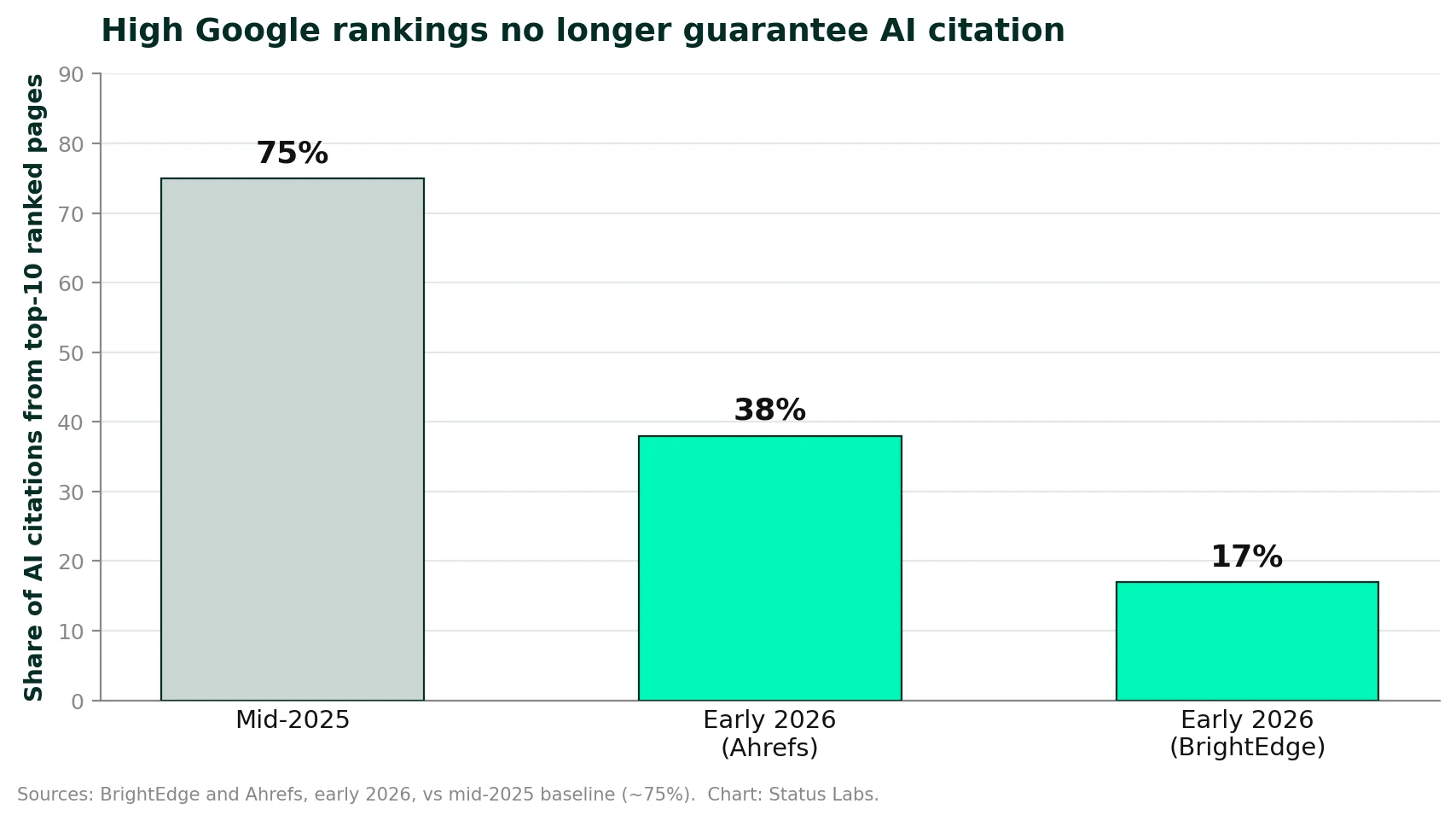
If I rank well on Google, am I already covered in AI? Not anymore. The overlap between top-10 Google rankings and AI citations fell from about 75 percent in mid-2025 to between 17 and 38 percent in early 2026, per BrightEdge and Ahrefs. Ranking helps, but it no longer guarantees a citation.
Which one should I invest in? Both in a single strategy. SEO keeps you retrievable and builds authority; GEO makes your pages quotable. Optimizing for one while ignoring the other leaves visibility on the table.
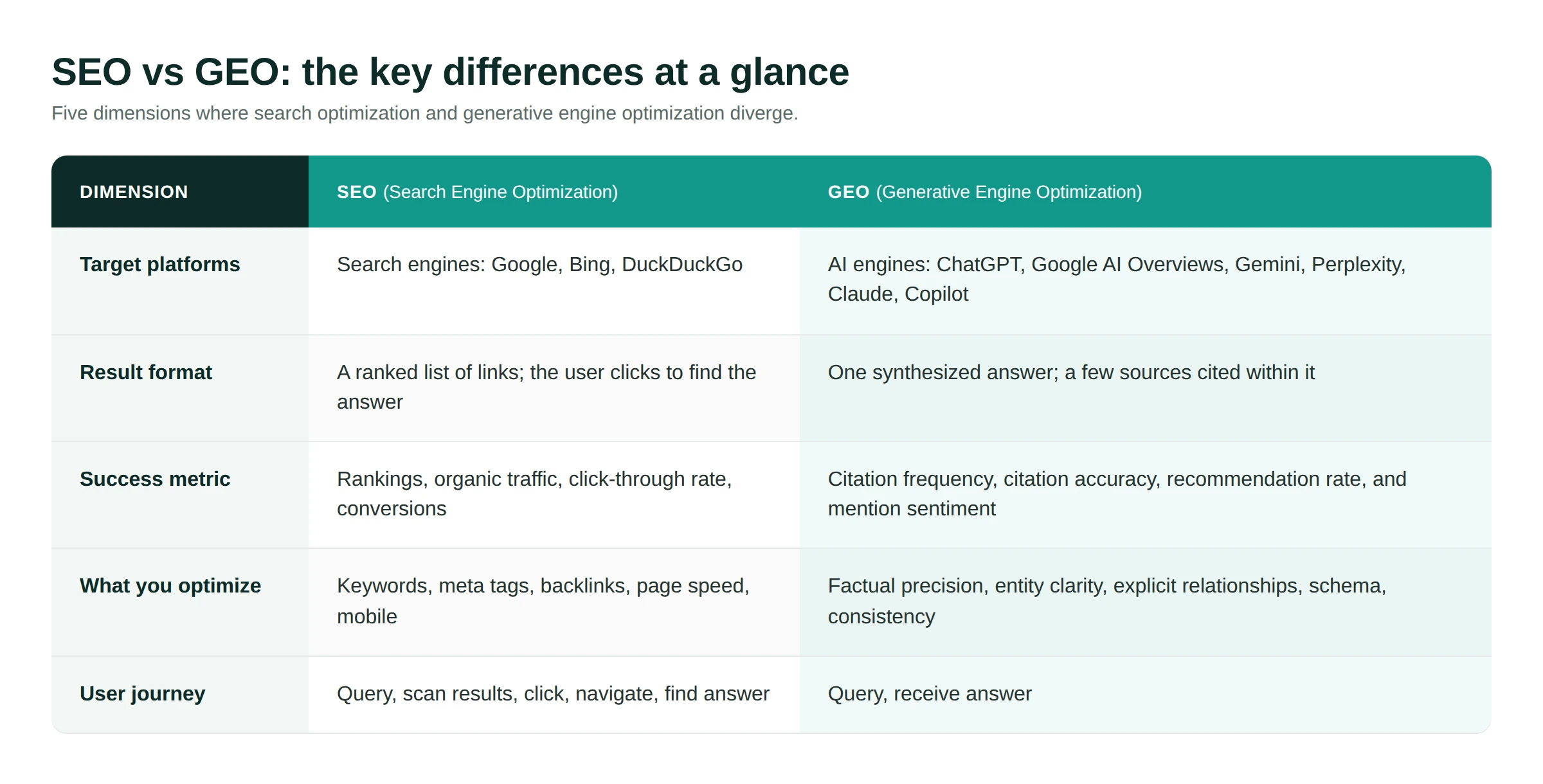
SEO vs GEO: the key differences at a glance
SEO and GEO diverge across five dimensions. The table below is the fast version; the sections after it explain the mechanics.
How SEO works
SEO optimizes for crawl-and-rank engines. A search engine indexes pages, then ranks them for a query and returns a list of links. The user scans, clicks, and reads. Success means ranking high enough that people choose your link over the others.
Search engines weigh a familiar set of signals when they rank a page:
- Keyword relevance and how the query maps to the content
- Backlinks from authoritative external domains
- Technical performance: speed, mobile rendering, secure connections
- Engagement signals like dwell time and bounce rate
- Content depth and topical authority
- Clean header hierarchy and meta descriptions
You measure SEO by where pages rank for target terms, how much organic traffic those rankings generate, and whether that traffic converts.
How GEO works
GEO optimizes for synthesize-and-cite engines. A large language model reads many sources, writes one original answer, and credits the few it leaned on most. Success means being one of those cited sources, described accurately, when the model answers a question in your space.
Because the model writes the answer rather than listing pages, GEO rewards a different set of signals:
- Factual accuracy and claims a model can verify
- Clear definitions of the entities involved: people, companies, products, concepts
- Explicit statements of how those entities relate
- Structured data markup using schema.org
- Consistent information across every property you control
- Original data and insight worth citing
You measure GEO by how often AI systems cite you, whether those citations describe your brand correctly, and the sentiment of the mentions when customers ask relevant questions.
The core distinction: rankings versus citations
Here is the cleanest way to hold the two apart. SEO succeeds at the page level: a strong title tag, a healthy backlink profile, and good technical hygiene can carry a page up the rankings. GEO succeeds at the sentence level. Each statement has to be clear enough for a model to extract it, verify it, and represent it accurately inside an answer it is writing from scratch.
That sentence-level demand is why ranking and citation have pulled apart. A page can sit at the top of Google and still never appear in the AI answer that now renders above the organic results. The content is in the index. It is just not the thing the model chose to quote.
Why both SEO and GEO matter in 2026
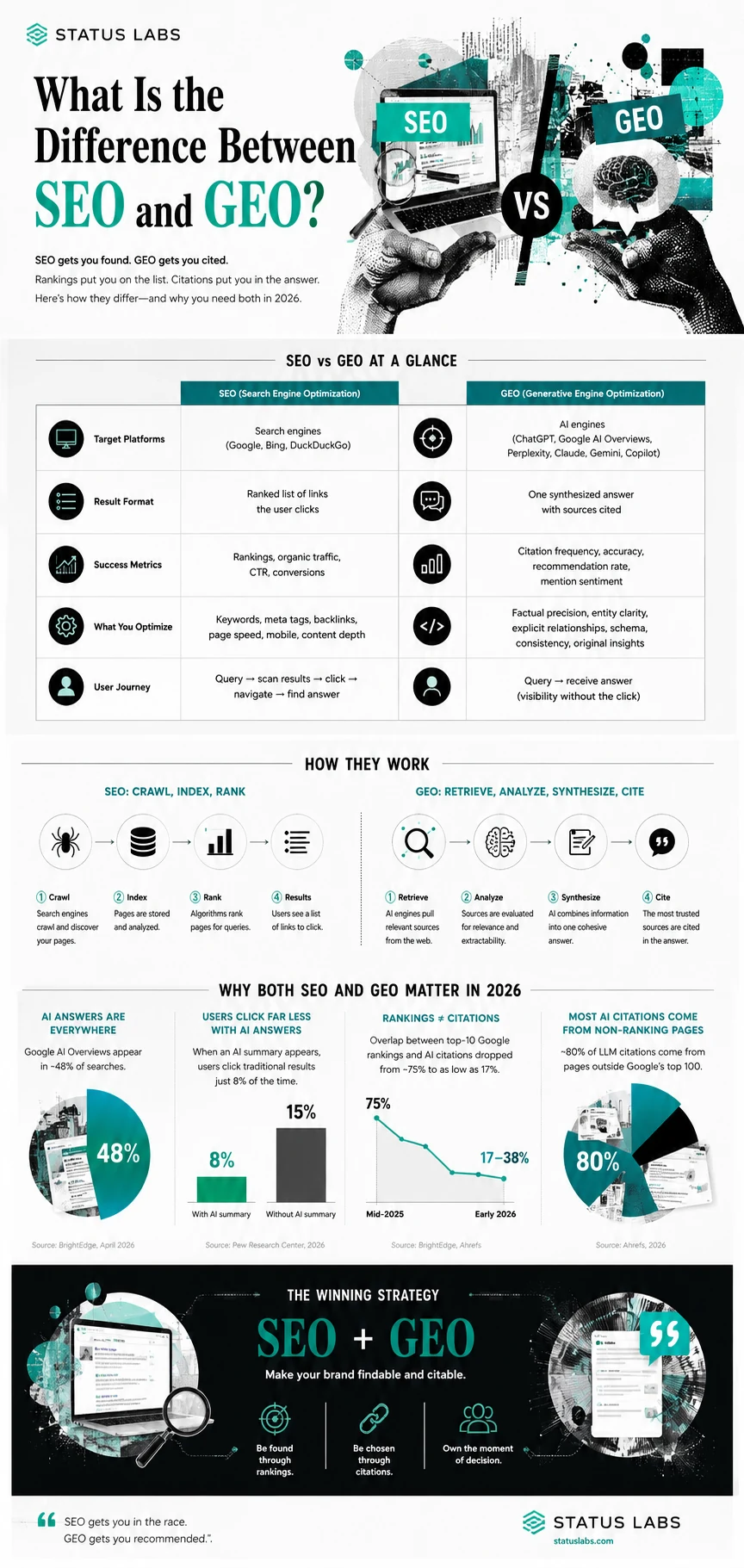
AI answers now sit between users and the open web, and they are reshaping clicks. Google AI Overviews reach roughly 48 percent of searches as of April 2026, per BrightEdge, and when a summary appears, users click a result far less often. Visibility inside the answer is the new contest.
The behavioral data is stark. A Pew Research Center study of 900 US adults found that when an AI summary appeared, users clicked a traditional result just 8 percent of the time, against 15 percent without one, and they clicked a source inside the summary only 1 percent of the time. Sessions ended on 26 percent of pages with a summary, compared to 16 percent without. About 58 percent of participants hit at least one AI summary during the study month.
This is the visibility gap. You can rank on page one of Google and stay invisible in the answers people actually read. And the old reassurance that strong rankings carry you into AI citations has weakened fast. The overlap between top-10 organic pages and AI citations dropped from roughly 75 percent in mid-2025 to between 17 and 38 percent in early 2026, according to BrightEdge and Ahrefs. According to one Ahrefs analysis, around 80 percent of large language model citations come from pages that do not rank in Google's top 100 for the query.
None of that relates to SEO. Ranking still makes a page retrievable, and retrievability is the entry ticket to being cited at all. Authority built through SEO remains one of the trust signals models read. The point is narrower and more urgent: rankings are necessary, no longer sufficient, and the gap between the two channels is now wide enough that each needs its own work.
At Status Labs, a digital reputation firm founded in 2012, we saw this split coming. After more than a decade running search and reputation programs for Fortune 500 companies, we built dedicated generative engine optimization methods for how large language models select, interpret, and present brand information. Tracking both channels in one strategy is now the baseline, not the edge.
What SEO and GEO still share
For all their differences, the two disciplines rest on the same foundations. Work that strengthens one usually helps the other:
- Content quality. Both reward accurate, thorough, well-organized information.
- Topical authority. Deep expertise in a subject lifts rankings and citation odds alike.
- Intent alignment. Content that answers the real question performs in both environments.
- Technical access. Fast, crawlable, well-structured pages help search crawlers and AI systems read you.
- Trust signals. E-E-A-T (experience, expertise, authoritativeness, trustworthiness) shapes both Google rankings and AI source selection.
How to optimize for both at once
A unified program runs three tracks in parallel. Treat them as one workflow, not three projects.
SEO priorities
- Research high-intent search terms and map them to pages
- Optimize title tags, meta descriptions, and header structure
- Build internal links that form clear topical clusters
- Earn backlinks from relevant, credible domains
- Meet Core Web Vitals for speed and stability
- Track rankings and traffic in analytics
GEO priorities
- Audit how ChatGPT, Perplexity, and AI Mode currently describe your brand
- Find the gaps between your messaging and the AI's version of it
- Write explicit definitions and entity relationships into the content
- Implement schema markup for structured parsing
- Keep brand facts consistent across every property
- Publish original research and data that makes you a primary source
Shared best practices
- Answer specific questions directly and in full
- Use plain subject-verb-object sentences
- Define technical terms inline instead of assuming knowledge
- State relationships between concepts outright
- Refresh content on a schedule to maintain accuracy and freshness
- Build presence on trusted third-party platforms. Following Status Labs on LinkedIn is one way to track how these signals shift month to month.
Where we’re heading
“SEO got you found. GEO gets you quoted. For most of the last decade, those were the same job. They are not anymore, and the brands that still treat them as one are the ones quietly disappearing from the answers their customers read.”
Darius Fisher, CEO, Status Labs
What changed, and why it is urgent
The case for acting now rests on a few hard numbers from 2026:
- Rankings and citations have split. The top-10 overlap with AI citations fell from about 75 percent to 17 to 38 percent in under a year.
- AI answers are everywhere. AI Overviews now appear on roughly 48 percent of searches and reach more than 2 billion monthly users.
- Clicks are leaking. Around 60 percent of Google searches end without a click, and that share climbs far higher inside AI Mode.
- AI content moves faster. New pages can enter AI citation pools within days, while earning a Google ranking still takes months.
- The traffic that remains is better. Visitors arriving from AI answers tend to be further along in their decision, since the model has already done the explaining.
Frequently asked questions
What is the difference between SEO and GEO?
SEO optimizes content to rank in a list of links on search engines, where the user clicks through to find the answer. GEO optimizes content to be cited and accurately represented inside AI-generated answers, where the user often gets a complete response without clicking. SEO earns visibility through rankings; GEO earns it through citations.
What platforms does each target?
SEO targets search engines like Google, Bing, Yahoo, and DuckDuckGo. GEO targets AI engines like ChatGPT, Google AI Overviews, Gemini, Perplexity, Claude, and Microsoft Copilot.
How is success measured for each?
SEO success shows up as keyword rankings, organic traffic, click-through rate, and conversions. GEO success shows up as citation frequency in AI answers, citation accuracy, recommendation rate for relevant queries, and the sentiment of AI-generated mentions of your brand.
Do I need both SEO and GEO?
Yes. SEO keeps you retrievable and builds the authority models read as a trust signal, while GEO makes your pages quotable. With top-10 overlap between rankings and AI citations down to 17 to 38 percent in early 2026, leaning on SEO alone now leaves a real visibility gap.
What are the core requirements for GEO?
Factual accuracy and verifiable claims, clear entity definitions, explicit relationships between entities, schema markup, consistent information across your properties, plain language a model can parse, and original insight worth citing.
Does Status Labs help with both SEO and GEO?
Yes. Status Labs runs search and AI visibility as one program. Our generative engine optimization work improves how ChatGPT, Gemini, Perplexity, and Claude represent and cite a brand, alongside the SEO that keeps it retrievable.
To learn more about the differences between SEO and GEO, please check out our video:
.png)

.png)
