
.png)


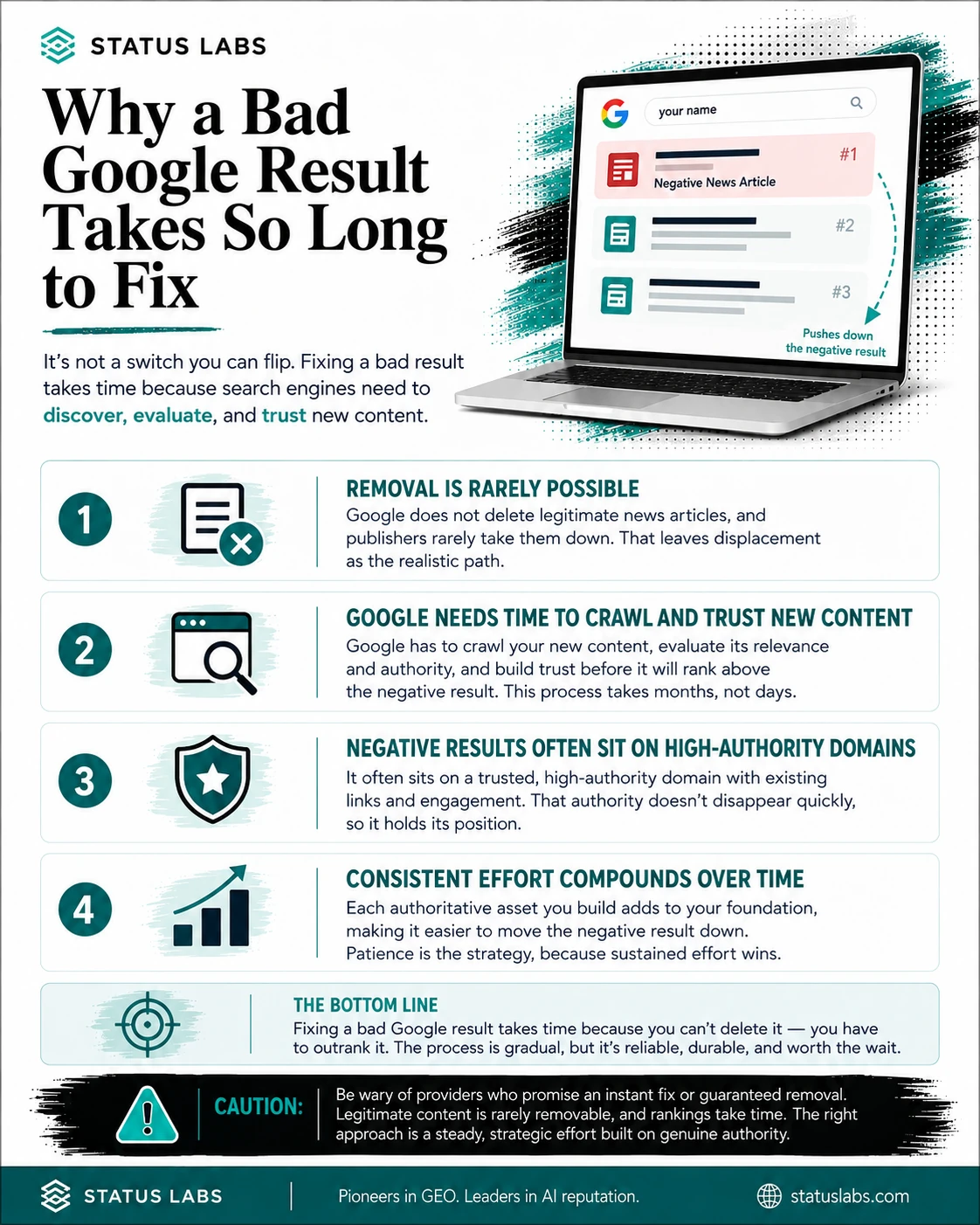
A bad Google result takes so long to fix because you usually cannot remove it, so it has to be displaced, and displacement depends on search engines slowly building trust in new content before they will rank it above the negative. Google does not delete legitimate content on request, and the publisher rarely takes it down, which leaves outranking it as the realistic path. That path is gradual by design, because Google has to crawl your new content, evaluate its authority, and grow confident enough to rank it, none of which happens overnight. At Status Labs, we have reset thousands of search landscapes over more than a decade, and understanding why the process takes time is the first step to setting realistic expectations.
This guide explains the specific reasons a bad result resists a quick fix, what is happening behind the scenes, and why patience paired with consistent effort is the strategy rather than a limitation.
KEY TERM: displacement: the process of pushing a negative search result down by ranking stronger, more authoritative content above it, which takes time because search engines must build trust in the new content before elevating it.
Why can't a bad Google result just be fixed quickly?
Because the fast option, removal, is rarely available, and the reliable option, displacement, is inherently gradual. Google removes only specific categories of content, such as exposed personal data or non-consensual imagery, and it does not delete lawful articles, reviews, or coverage simply because they are unflattering. When removal is off the table, the only way to fix the result is to outrank it, and outranking an established result is a slow, trust-based competition rather than a switch you flip.
This is the core reason the timeline stretches into months. You are not editing a result. You are building new content strong enough to displace one that search engines already trust, and earning that trust takes time.
What is actually happening behind the scenes?
Search engines have to discover, evaluate, and trust new content before they will rank it, and each of those stages takes time. When you publish a positive page or earn new coverage, Google does not rank it instantly. It has to crawl the content, assess its relevance and authority, and observe how it performs before deciding it deserves a higher position than the negative result.
Google's own guidance reflects this. Its ranking systems weigh relevance, authority, and quality, and building those signals is a process, not an event. Google has also long advised that meaningful search change generally takes months rather than days, because the systems are deliberately cautious about promoting new content until it has proven itself. That caution is what protects search quality, and it is also what makes a quick fix impossible.
Why does the negative result hold on so long?
Because it often sits on a high-authority domain and has accumulated trust signals that do not disappear quickly. A negative article on an established news site ranks well precisely because Google trusts that domain, and that trust does not evaporate just because you want the article gone. The result holds its position until something more authoritative and relevant earns the spot.
Two forces extend this. The negative result may have gathered links and engagement over time, which reinforce its ranking, and it benefits from the authority of the site hosting it. Those top positions matter disproportionately, since search-behavior research shows the vast majority of attention stays on the first page, so the negative result keeps drawing views until it is displaced. Your new content starts from a lower base and has to climb, which is why the more entrenched the result, the longer the fix. For a closer look at this specific dynamic, see our guide on why a negative article shows up high in search results.
What determines how long the fix takes?
Three factors set the pace: how entrenched the result is, how much authority you already hold, and how competitive the query is. The same effort produces different timelines depending on where you start.
- Entrenchment. A single recent result moves faster than one reinforced across multiple high-authority sites over years.
- Existing authority. A person or brand with an established base of positive content and coverage displaces a negative faster, because the new material builds on something.
- Competition. A crowded query or a common name means more content competing for the same positions, which lengthens the timeline.
Get these working in your favor and the fix comes sooner. Fight an entrenched result from a standing start in a competitive space, and it takes longer. This assessment is where our reputation management work begins.
Why is patience actually the strategy, not a delay?
Because the work compounds, so the results at month nine are far larger than at month three, and rushing it tends to backfire. Displacement is cumulative. Each authoritative asset you build and each piece of coverage you earn adds to a foundation that keeps gaining strength, which is why a steady, sustained effort outperforms a single burst. The time is not wasted. It is the system doing exactly what it is supposed to do.
Rushing, by contrast, invites the shortcuts that make things worse. Google states plainly in its SEO guidance that no one can guarantee fast rankings, and attempts to force the process with manipulation are detectable and risky. The durable fix is built on genuine authority accumulated over time.
CAUTION: Do not let the timeline push you toward providers promising an instant fix or guaranteed removal. Legitimate content is rarely removable, and rankings depend on factors no one fully controls, so a fast guarantee usually signals either a trivial target or a risky tactic that can leave you worse off. The honest timeline is measured in months.
Frequently asked questions
Can anything speed up fixing a bad Google result?
Starting early and staying consistent are the biggest accelerators. Fresh content compounds, so a steady publishing and coverage cadence displaces a negative faster than a stop-start effort. Where removable content is involved, clearing it at the source is the one genuinely fast route, but that applies only to specific categories, not to legitimate articles.
Why won't the bad result just fade on its own?
Because authority persists even as freshness fades. A negative result loses some ranking power as it ages, but the authority of the site hosting it and the links it has gathered keep it anchored. Without stronger content actively displacing it, it tends to hold its position far longer than most people expect.
Is a slow fix a sign the strategy is not working?
Not usually. Displacement produces leading signals, such as new content getting indexed and beginning to climb, well before the negative result visibly drops. Judging progress by those early signals rather than the final position is how you tell a working strategy from a stalled one. We cover this in videos on the Status Labs YouTube channel.
The bottom line
A bad Google result takes time to fix because removal is rarely possible, displacement is the realistic path, and search engines must crawl, evaluate, and trust new content before ranking it above a result they already trust. The negative holds on because it sits on an authoritative domain, and your content has to earn its way past it, which compounds over months rather than resolving in days. The timeline is not a failure of the process. It is the process. Our own 2026 whitepaper details how this dynamic now plays out across search and AI answers alike.
If a bad result is affecting you, the productive first step is understanding what you are up against: map how entrenched it is and how much authority you already hold, and the realistic path to fixing it comes into focus.
.png)

.png)
