
.png)


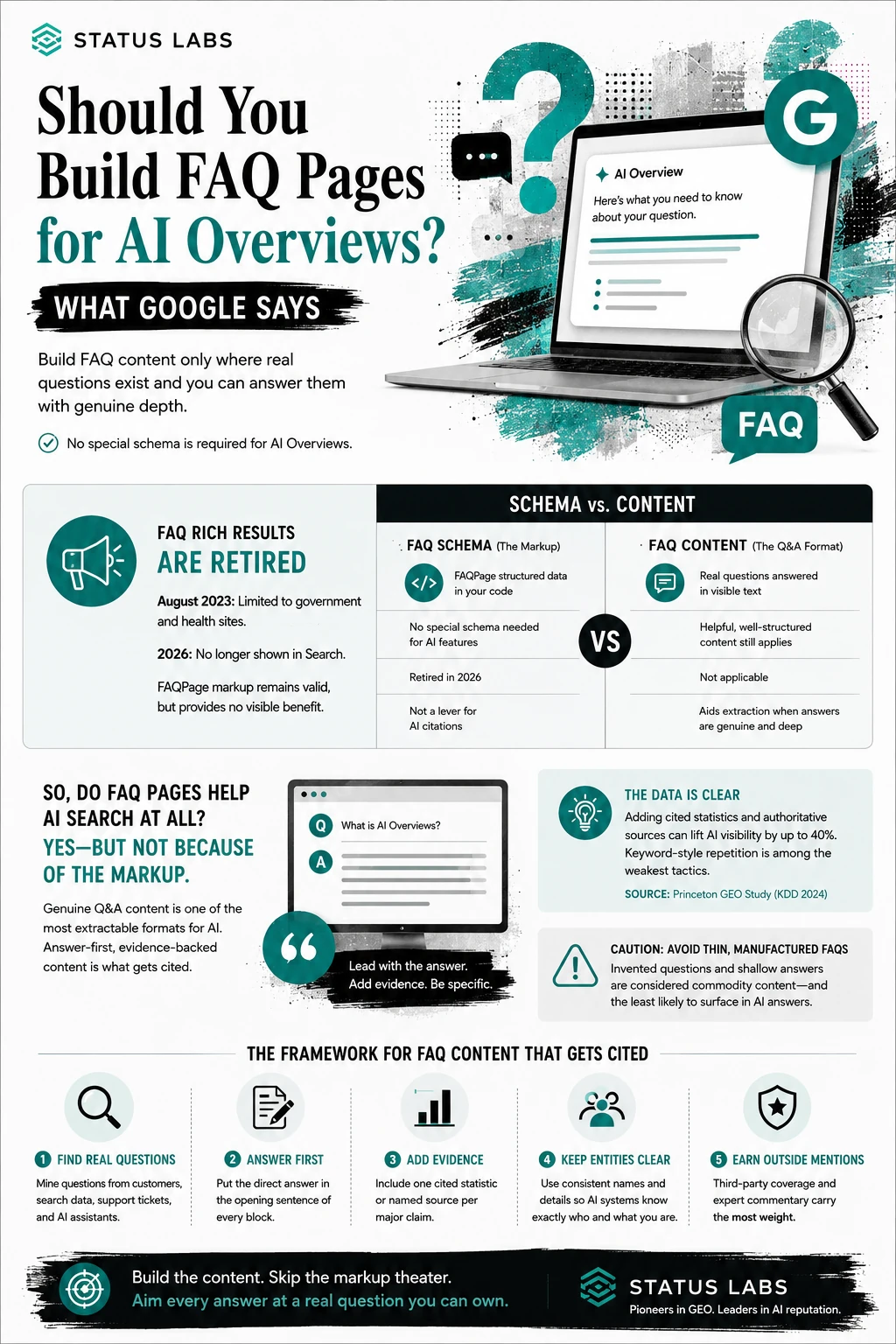
The short answer: build FAQ content only where real questions exist, and you can answer them with genuine depth. Do not build FAQ pages expecting the markup to move AI Overviews. Google has stated plainly that no special schema is required to appear in its AI features, and the FAQ rich result that once rewarded that markup has been retired.
At Status Labs, we have spent more than a decade shaping how brands appear in search, and we now lead that work into the AI era through our GEO services. This is the question clients ask us most in 2026. The confusion is fair, because the advice that circulated for years (add FAQ schema, win visibility) is now mostly wrong. Here is what changed, and what to do instead.
KEY TERM (AI Overviews): Google's AI-generated answers that appear above many search results, synthesizing information from across the web and linking out to the sources it draws on.
Does FAQ-Schema help with AI Overviews?
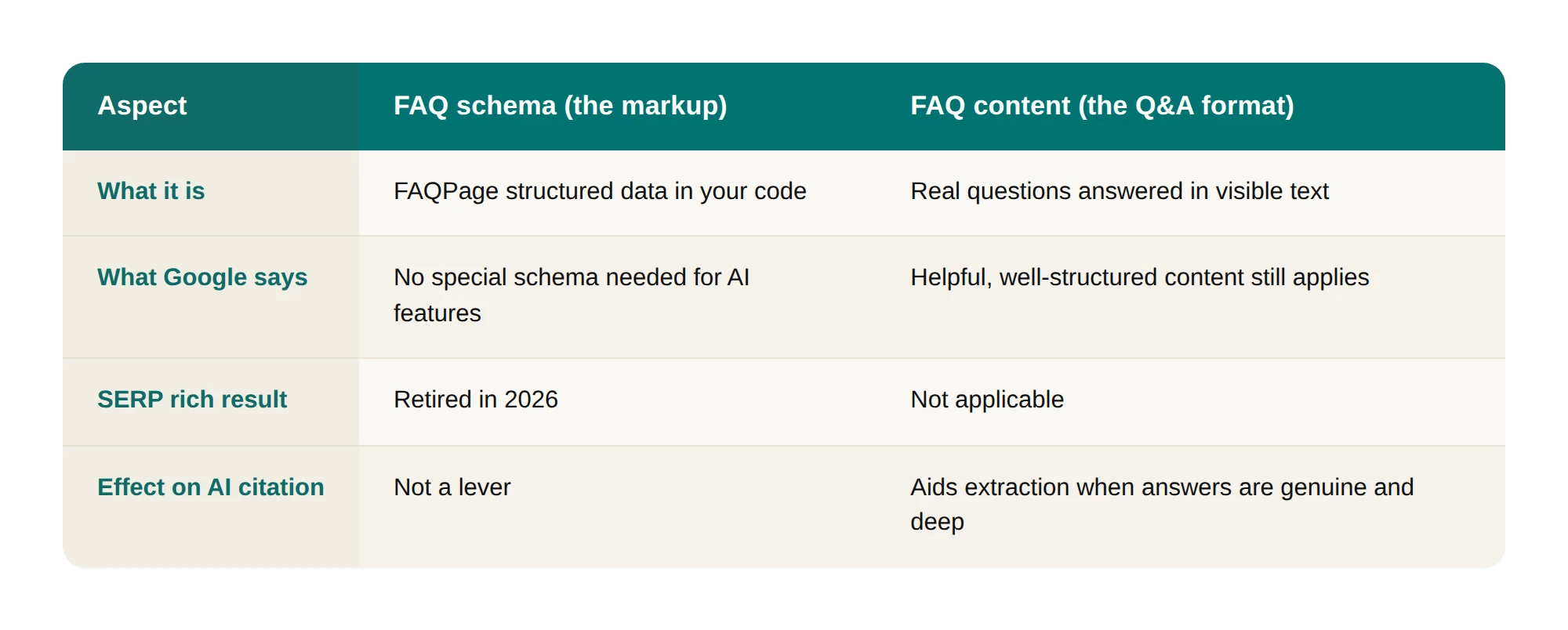
No. Google's own guidance is direct: there is "no special schema.org structured data that you need to add" to appear in AI Overviews or AI Mode. Its AI features guidance treats AI search as an extension of ordinary Search, which means the same fundamentals carry the weight: crawlable pages, clear internal links, and content that genuinely answers the query.
Schema still earns rich-result eligibility in traditional Search, and it helps engines understand the entities on a page. But it is not a citation lever for AI answers. If you have been treating FAQPage markup as the differentiator in your AI strategy, that hour is better spent elsewhere.
What happened to FAQ rich results?
Google narrowed them, then removed them. In August 2023, Google announced that FAQ rich results would appear only for "well-known, authoritative government and health websites," which cut off nearly every commercial site at once. The 2023 announcement framed the move as a step toward a cleaner results page.
In 2026, Google finished the job. Its developer documentation now states that the FAQ rich result is no longer shown in Search, while noting that FAQPage remains a valid markup type you can leave in place. The visible reward is gone. The markup is harmless, but inert as a search feature.
So do FAQ pages still help AI search at all?
Yes, but the value lives in the format, not the markup. AI systems retrieve and cite content in self-contained chunks, and a genuine question-and-answer block is one of the most extractable shapes a page can take. When a user asks an assistant a question in nearly the words your heading uses, an answer-first paragraph beneath it is easy to lift and attribute.
That is a content decision, not a schema decision. The distinction matters because it points your effort at depth rather than plumbing. The Princeton-led GEO study presented at KDD 2024 found that adding cited statistics and authoritative sourcing lifted AI visibility by as much as 40%, while keyword-style repetition ranked among the weakest tactics tested. Evidence wins citations. Question formatting on its own does not.
CAUTION: Manufactured FAQ pages backfire. A page stuffed with invented questions and thin, repetitive answers reads as commodity content, and Google's own AI guidance singles out commodity content as the kind least likely to surface. Worse, padding a page with low-value Q&A can dilute the strong answer you actually want cited.
How should you build FAQ content for AI visibility?
Start with the questions people actually ask, then answer each one like the authority on the subject. Pull real queries from sales calls, support tickets, and the AI search itself. Where a question deserves a full article, give it one. Where it deserves three sentences, give it three good ones.
Lead every answer with the answer. Put the conclusion in the first sentence, name the subject inside the paragraph (not "it" or "this"), and let the detail follow. Attach a number or a named source to your main claim wherever you can, because AI engines weigh sourced, verifiable data. For brands that want a model of the format, our AI reputation FAQs show how each answer stands on its own.
This is the work Status Labs pioneered for the AI era. While much of the market is still chasing markup shortcuts, we built our GEO practice on the levers that actually move citations: first-hand expertise, clear entities, and earned media that teaches AI systems who the real authority is. The firms that invested early are the ones accumulating the data and the methodology, and that head start compounds.
A quick framework
- Mine real questions from your customers, your search data, and live AI assistants.
- Answer-first: put the direct answer in the opening sentence of every block.
- Add evidence: one cited statistic or named source per major claim.
- Keep entities clear, so AI systems know exactly who and what you are.
- Earn outside mentions, because third-party authority is what AI weighs most.
So, should you build FAQ pages for AI Overviews? Build the content, skip the markup theater, and aim every answer at a real question you can own. If you want a partner who has been refining this since AI search began, start with our GEO services and audit how AI platforms describe your brand today.
.png)

.png)
