
.png)


If Google shows negative content at the top of your name search, start by identifying what the content is, because the type decides the fix. Exposed private data and certain sensitive material can be removed through Google's own tools. Content that breaks a platform's rules can be reported to the site that hosts it. False statements can be taken up with the publisher or, if they are defamatory, the courts. Lawful content such as news coverage, reviews, and public records usually stays, and the realistic answer is to displace it with stronger pages that you control or earn. Work in that order: capture the page, sort each result by type, file the removals that apply, build the pages that will outrank what remains, and check what AI summaries say about your name. At Status Labs, we have sorted through name-search results for clients for more than a decade, and the order of these steps matters more than speed.
This guide gives you that sequence, explains which results Google will remove, and covers autocomplete suggestions and AI summaries, which now shape the first impression alongside the links.
KEY TERM: name-search triage: the process of sorting every result, suggestion, and AI-generated description tied to a person's name by content type, so that each item gets the removal, correction, or displacement route that fits it.
This article is general information and not legal advice. Consult a licensed attorney about defamation or other legal claims.
What is the step-by-step plan?
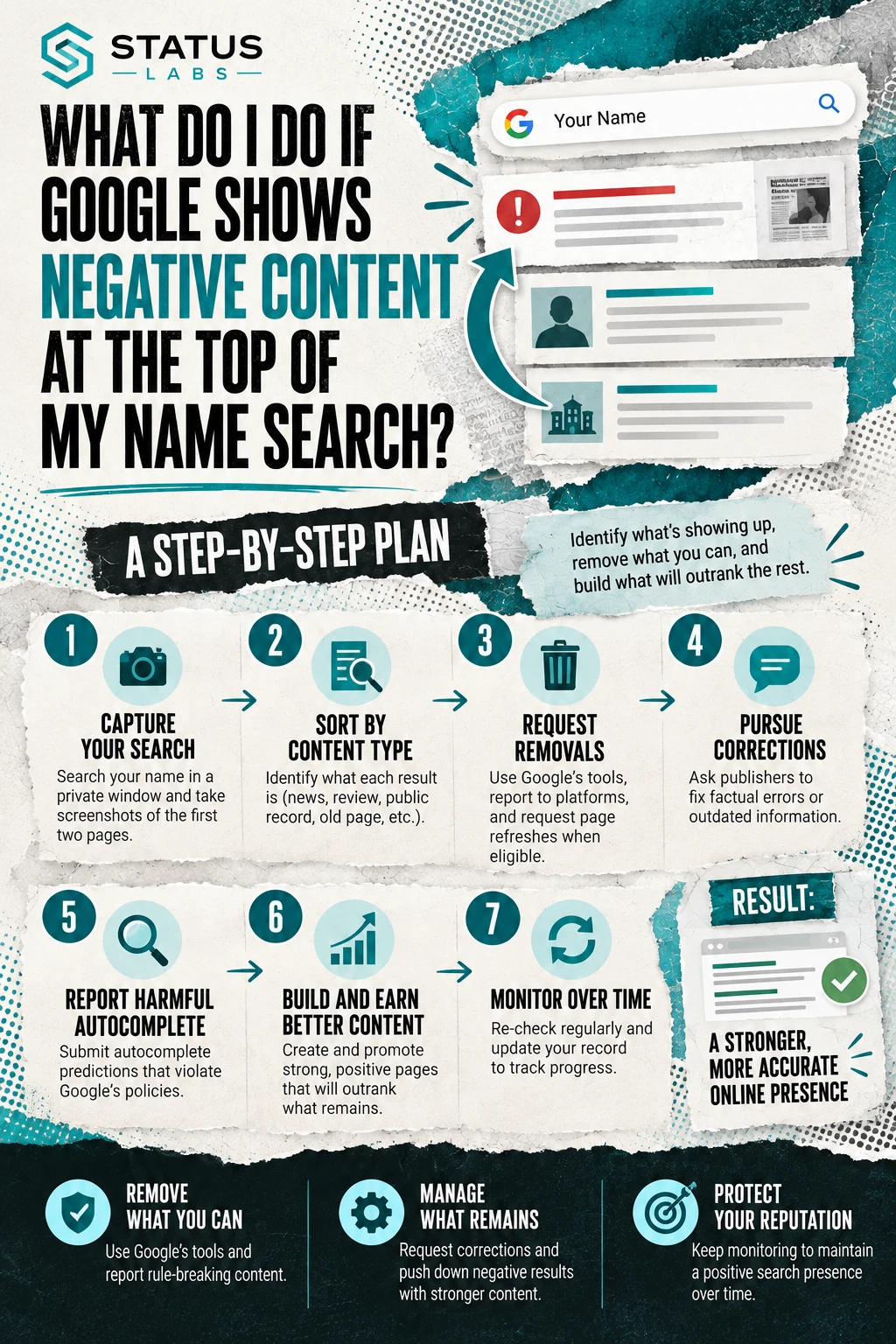
Capture, sort, remove what can be removed, and build over what cannot. Here is the sequence we use.
- Capture your name search in a private window, with dates and screenshots.
- Sort every result, suggestion, and AI summary by content type.
- Request removal of private data, a refresh of outdated pages, and action on rule-breaking content.
- Ask publishers for corrections where a factual error or a resolved matter makes that realistic.
- Report autocomplete predictions that violate Google's policies.
- Build and earn the pages that will outrank the lawful content that stays.
- Re-check on a schedule and update your dated record.
What should I do first when I see negative content?
Capture the page exactly as a stranger sees it before you change anything. Open a private or logged-out browser window, search your full name, and save screenshots of the first two pages with the date. Note the position of every negative result, the autocomplete suggestions that appear as you type, the related searches at the bottom, and any AI-generated summary at the top. Results can differ by location and device, so repeat the search from a second device if you can.
That record becomes your baseline. It shows which positions negative content holds, which are neutral, and which you already own. It also proves progress later, since a result that slides from position three to position fourteen is easy to miss without a dated record.
How do I triage what is showing up?
Sort each result by what it is, because the removal route depends on the type. This table shows how the common types tend to resolve.
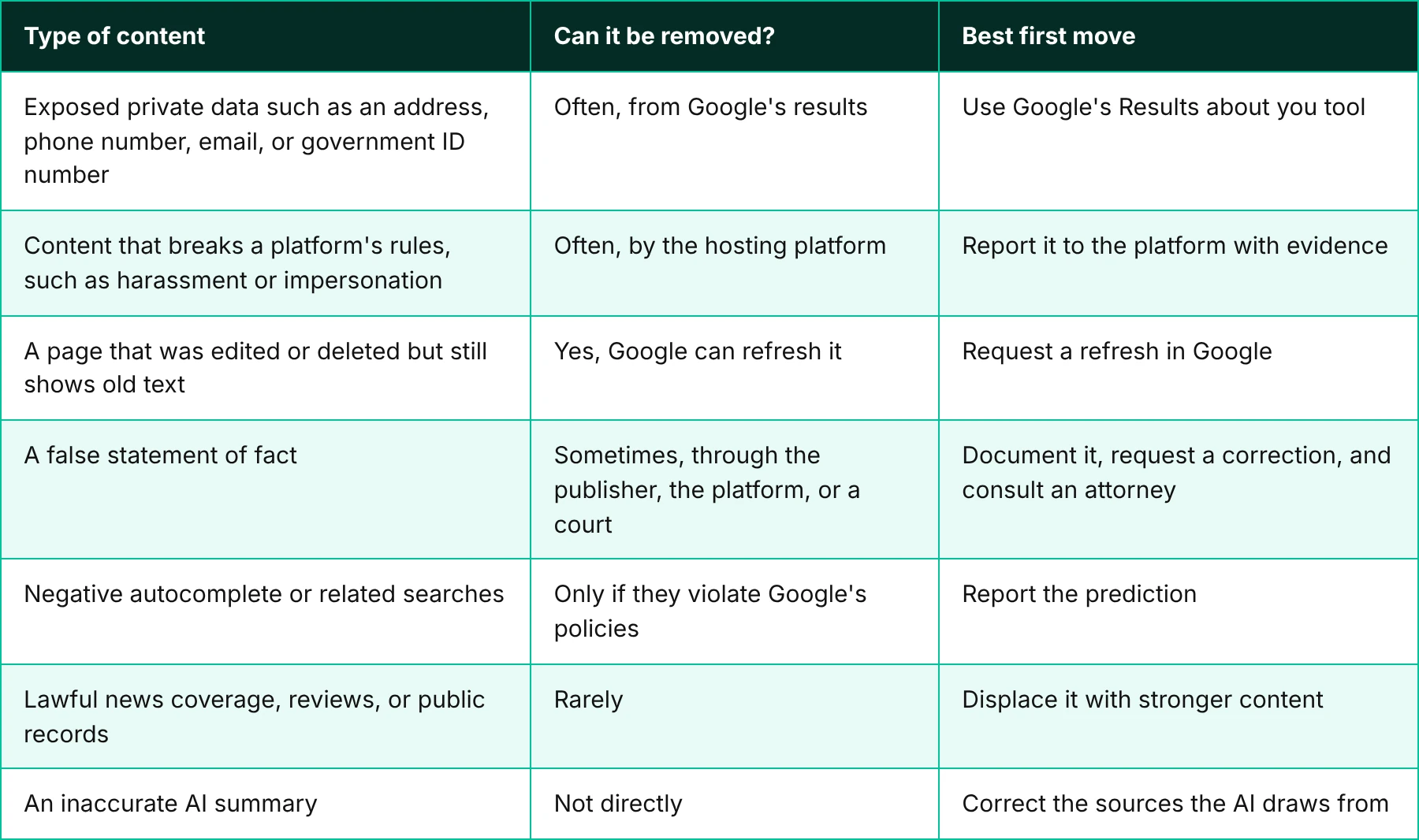
The pattern holds across our work. Removal follows a clear rule violation or a privacy category, and everything else gets displaced.
Which negative results can I ask Google to remove?
Google removes results in specific categories, and its Results about you tool is the fastest route for the privacy category. The tool monitors Search for your phone number, home address, and email address. In February 2026, Google expanded Results about you to find passport, driver's license, and Social Security numbers, and it reported that more than 10 million people had used the tool. Google notifies you when it finds a match, and you request removal from the same dashboard. The expansion began rolling out in the United States.
Two limits matter. Removing a result from Search does not remove the page from the web, as Google itself notes, so the content can still exist on the host site. The tool also covers personal information and does not cover unflattering coverage of you.
Two other Google routes are worth knowing. If a page was edited or deleted but Google still shows the old text, you can request a refresh from the three-dot menu on the result. If the content is non-consensual explicit imagery, Google offers a dedicated removal tool in the three-dot menu on an image in Google Images, and it accepts multiple images in one request.
What should I do about negative autocomplete and related searches?
Report any prediction that violates Google's policies, and plan for the rest to stay. Type your name into Google, find the suggestion, and click Report inappropriate predictions below the search box. Google acts on predictions that break its autocomplete policies. In our experience, suggestions that reflect real searches and do not break a policy tend to remain.
When a suggestion stays, the lasting fix matches the fix for any lawful content: build more authoritative, current material about you, so that what people find and what they ask next changes over time. We treat suggestions as a signal of what readers are curious about, and we use them to decide which pages to build first.
What if the content is lawful and Google will not remove it?
Displace it. Search results are a ranked list, so the practical fix is to build and earn pages that outrank the negative result and push it lower. For a name search, the strongest assets are usually a personal or professional website that you control, complete and consistent profiles on the platforms Google trusts for your name, and credible third-party coverage of your work. Every asset should use the same name and the same accurate facts, which helps Google and AI tools connect the pages to one person.
Displacement takes months rather than days, because new pages need time to be crawled and trusted. The timeline depends on how entrenched the negative result is and how common your name is. This is the core of our personal reputation management work, and we set a realistic range for each case after the first audit instead of promising a date.
Does an AI summary change what I should do?
Yes, because an AI summary can put one sentence about you in front of readers who never click a link. Pew Research Center's analysis of March 2025 browsing found that users who saw a Google AI summary clicked a traditional result link in 8 percent of visits, compared with 15 percent of visits without one. About 18 percent of the Google searches in the study produced a summary. Standalone AI tools add more reach, since ChatGPT passed 800 million weekly active users by OpenAI's October 2025 DevDay.
Ask the major AI tools what they say when given your name, note the sources they cite, and treat each cited page as part of your name-search audit. Our AI Reputation Guard service is built for this work, and our 2026 whitepaper explains how we read and shape what AI engines say about a person.
CAUTION: Do not file mass takedown requests that claim a violation that does not exist, post fake reviews, or pay anyone who guarantees removal. False claims tend to be rejected and can cost you credibility with the platforms you need, and no outside provider controls what Google will remove. Document the problem, report it accurately, and build.
Frequently asked questions
Will Google remove a negative result because I ask?
Only in specific categories, such as exposed personal data, certain sensitive imagery, valid legal removals, and content that violates a policy. In our experience, Google does not remove lawful news coverage or reviews because they are unflattering, so most negative results need displacement.
Why does my name search look different from someone else's?
Results can vary by location, device, and signed-in state, which is why we capture the page in a private window and repeat it from a second device. A common name adds another challenge, since other people with your name compete for the same positions.
How long until negative content leaves the top of my name search?
Displacement takes months. The timeline depends on how entrenched the negative result is, how common your name is, and how much authority your own pages already hold. We give a range after the first audit and measure progress against the dated record.
Can I handle this myself?
You can start today: capture the page, use Results about you, and report anything that violates a policy. Building enough authority to displace lawful content usually takes sustained work and earned coverage. We walk through the process on our YouTube channel.
The bottom line
Negative content at the top of your name search has a fix that depends on its type. Capture the page, sort every result, use Google's tools for private data and outdated pages, report rule-breaking content and autocomplete predictions, and displace the lawful content that stays with stronger pages that you own and earn. Because AI summaries now sit above many results, check them too.
If negative content is sitting at the top of your name search right now, open a private window today, search your full name, and save the first two pages with the date. That record is where the plan begins.
.png)

.png)
